

 4 weeks ago
32
4 weeks ago
32
PROTECT YOUR DNA WITH QUANTUM TECHNOLOGY
Orgo-Life the new way to the future Advertising by AdpathwayThere is so much more taking place than what you can see.
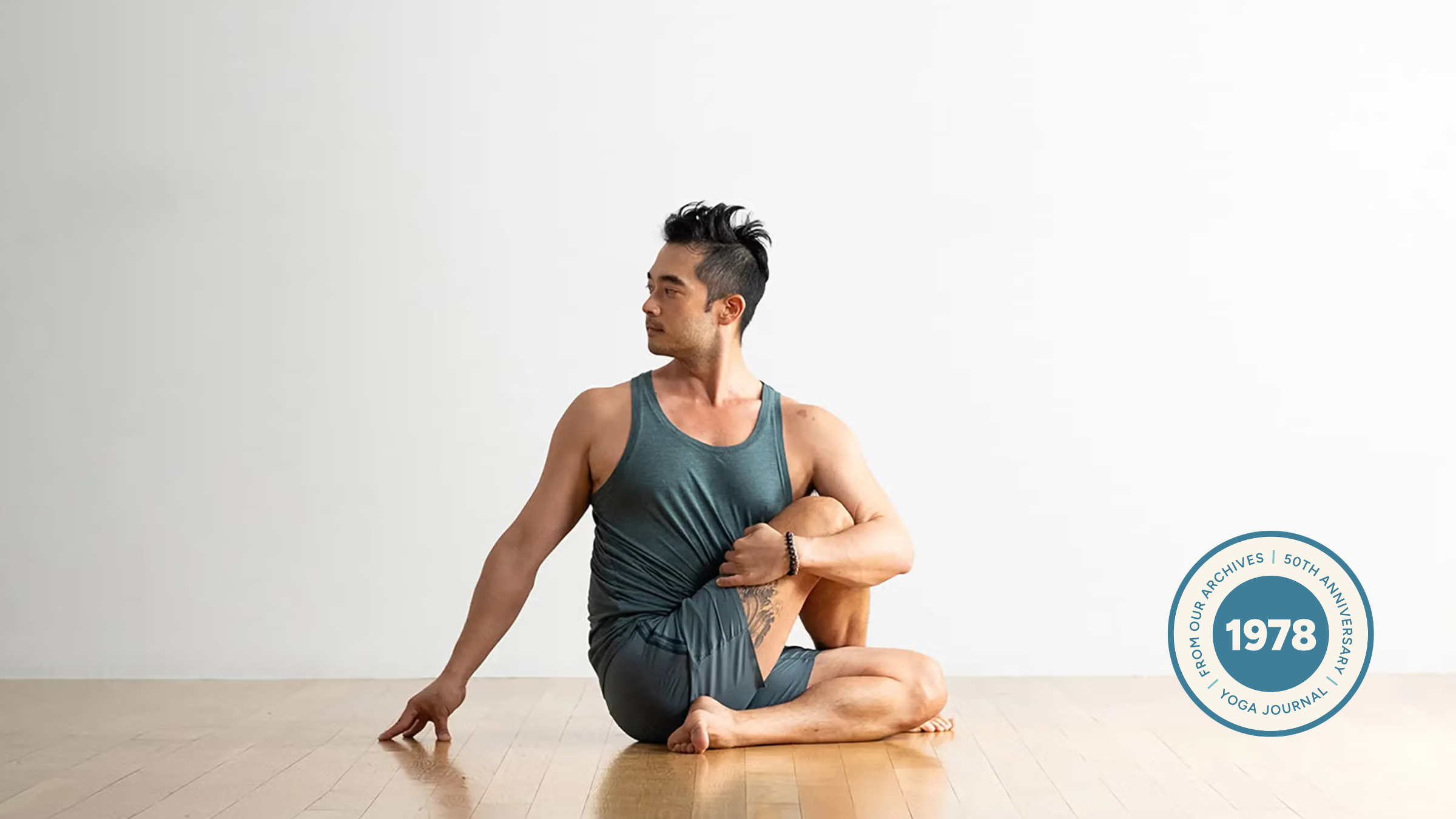
(Photo: Andrew Clark)
Published July 31, 2026 09:58AM
Yoga Journal’s archives series is a curated collection of articles originally published in past issues beginning in 1975. This article about Ardha Matsyendrasana (Half Lord of the Fishes) first appeared in the November-December 1978 issue of Yoga Journal. Note that the suggested leg position has changed somewhat over the decades.
Providing a myriad of benefits, Ardha Matsyendrasana I is one of the most basic and beautiful poses of the twisting series. The name comes from the Sanskrit “ardha,” meaning half, and “Matsyendra,” meaning Lord of the Fishes, to whom the asana is dedicated. The pose is called “half” because it gives a milder twist to the back in comparison to the more dramatic effect of the full twist, Paripurna Matsyendrasana, in which one leg is in a lotus position. Psychologically, Ardha Matsyendrasana I makes one acutely aware of limitation and constriction. For many, twisting is not easy, and therefore progress comes slowly. Most students experience both physical and mental resistance to the pose. It seems to them that there is just not room enough for the body to move or that there is little chance of the hands being able to reach one another. Progress that comes with patience and perseverance in this pose is usually not a dramatic or sudden experience, but rather more gradual. If this progress is not observed carefully, it can be overlooked in the daily practice.
Body structures, particularly the spinal column, are affected by Ardha Matsyendrasana. Part of the wisdom of Hatha Yoga is that it systematically manipulates the spine in all directions, thereby contributing to the health of the intervertebral discs. A disc is composed of fibrous material surrounding a pulpy center. It receives no direct blood supply after the third decade of life, instead receiving its nourishment from the surrounding tissue. With vertebral movement, cleansing fluids rush in and out of the sponge-like discs. Plump, healthy discs are important because spinal alignment, as well as the health of nerves exiting the spine between the vertebra, depends upon the spaces produced and maintained by the discs.
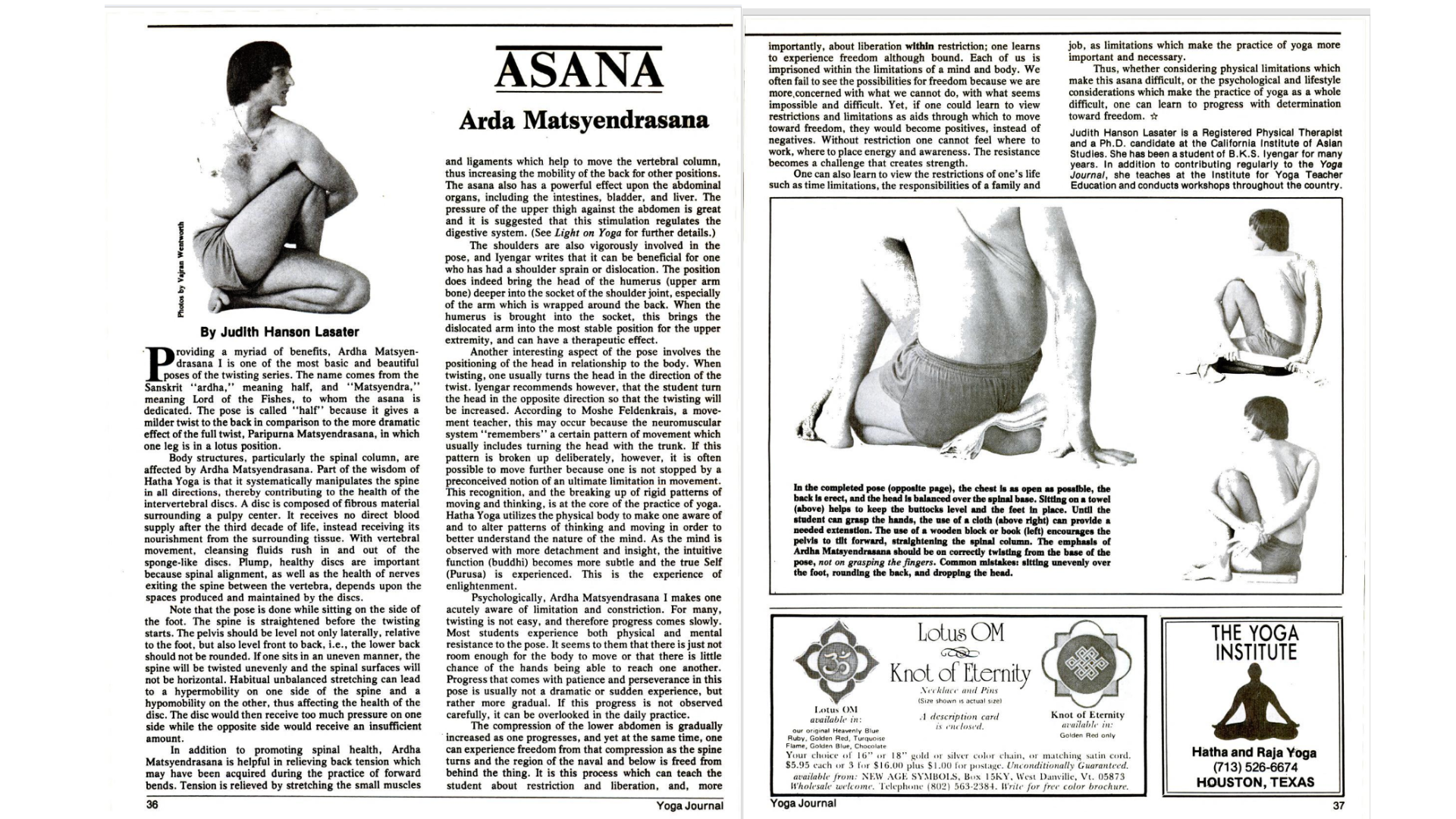
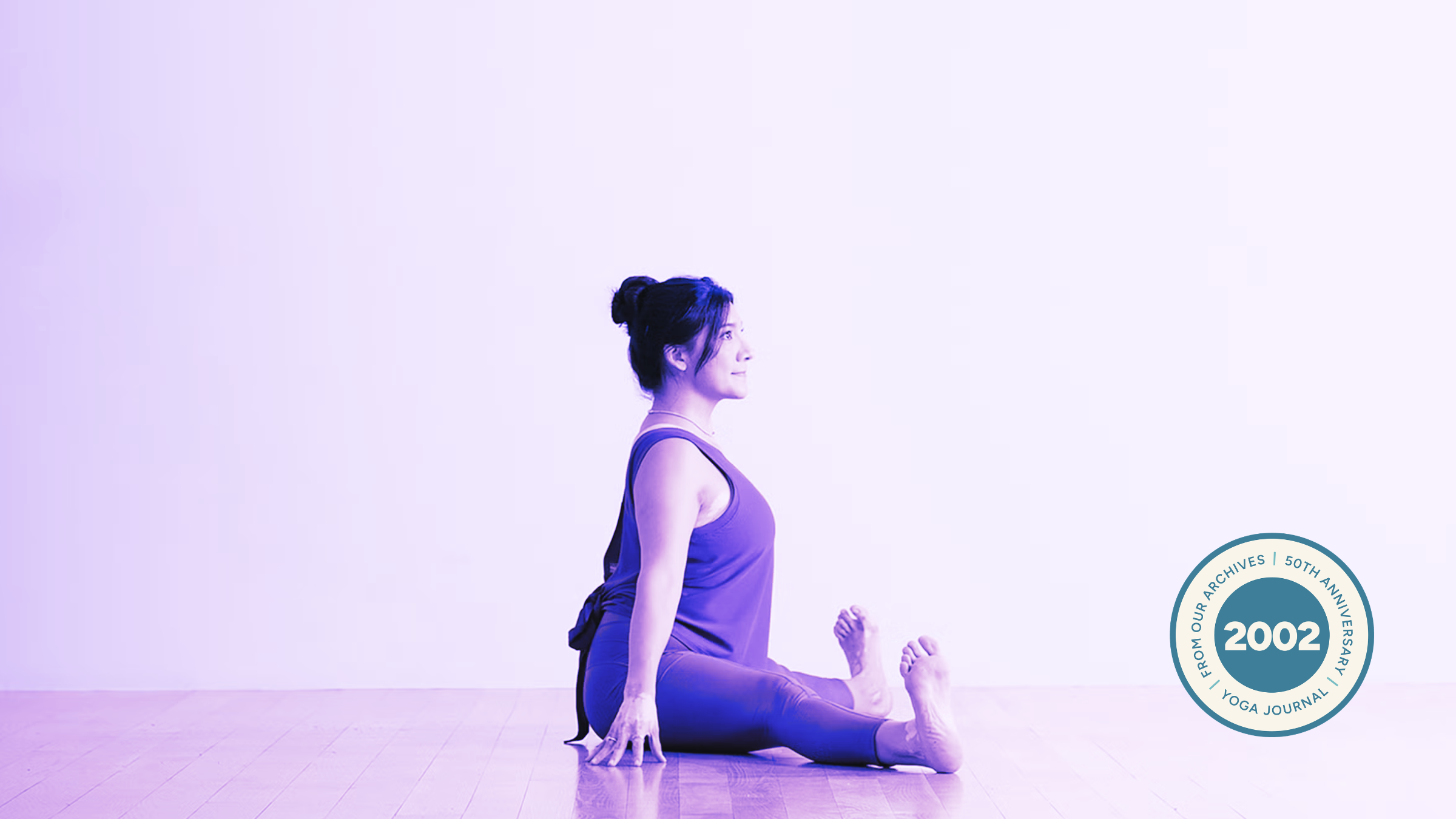
In the completed pose (opposite page), the chest is as open as possible, the back is erect, and the head is balanced over the spinal base. Sitting on a towel (above) helps to keep the buttocks level and the feet in place. Until the student can grasp the hands, the use of a cloth (above right) can provide a needed extension. The use of a wooden block or book (left) encourages the pelvis to tilt forward, straightening the spinal column. The emphasis of Ardha Matsyendrasana should be on correctly twisting from the base of the pose, not on grasping the fingers. Common mistakes: sitting unevenly over the foot, rounding the back, and dropping the head.
Note that the pose is done while sitting on the side of the foot. The spine is straightened before the twisting starts. The pelvis should be level not only laterally, relative to the foot, but also level front to back, i.e., the lower back should not be rounded. If one sits in an uneven manner, the spine will be twisted unevenly and the spinal surfaces will not be horizontal. Habitual unbalanced stretching can lead to a hypermobility on one side of the spine and a hypomobility on the other, thus affecting the health of the disc. The disc would then receive too much pressure on one side while the opposite side would receive an insufficient amount.
In addition to promoting spinal health, Ardha Matsyendrasana is helpful in relieving back tension which may have been acquired during the practice of forward bends. Tension is relieved by stretching the small muscles and ligaments which help to move the vertebral column, thus increasing the mobility of the back for other positions. The asana also has a powerful effect upon the abdominal organs, including the intestines, bladder, and liver. The pressure of the upper thigh against the abdomen is great and it is suggested that this stimulation regulates the digestive system. (See Light on Yoga for further details.)
The shoulders are also vigorously involved in the pose, and Iyengar writes that it can be beneficial for one who has had a shoulder sprain or dislocation. The position does indeed bring the head of the humerus (upper arm bone) deeper into the socket of the shoulder joint, especially of the arm which is wrapped around the back. When the humerus is brought into the socket, this brings the dislocated arm into the most stable position for the upper extremity, and can have a therapeutic effect.
Another interesting aspect of the pose involves the positioning of the head in relationship to the body. When twisting, one usually turns the head in the direction of the twist. Iyengar recommends however, that the student turn the head in the opposite direction so that the twisting will be increased. According to Moshe Feldenkrais, a movement teacher, this may occur because the neuromuscular system “remembers” a certain pattern of movement which usually includes turning the head with the trunk. If this pattern is broken up deliberately, however, it is often possible to move further because one is not stopped by a preconceived notion of an ultimate limitation in movement.
This recognition, and the breaking up of rigid patterns of moving and thinking, is at the core of the practice of yoga. Hatha Yoga utilizes the physical body to make one aware of and to alter patterns of thinking and moving in order to better understand the nature of the mind. As the mind is observed with more detachment and insight, the intuitive function (buddhi) becomes more subtle and the true Self (Purusa) is experienced. This is the experience of enlightenment.
The compression of the lower abdomen is gradually increased as one progresses, and yet at the same time, one can experience freedom from that compression as the spine turns and the region of the naval and below is freed from behind the thing. It is this process which can teach the student about restriction and liberation, and, more importantly, about liberation within restriction; one learns to experience freedom although bound. Each of us is imprisoned within the limitations of a mind and body. We often fail to see the possibilities for freedom because we are more concerned with what we cannot do, with what seems impossible and difficult. Yet, if one could learn to view restrictions and limitations as aids through which to move toward freedom, they would become positives, instead of negatives. Without restriction one cannot feel where to work, where to place energy and awareness. The resistance becomes a challenge that creates strength.
One can also learn to view the restrictions of one’s life such as time limitations, the responsibilities of a family and job, as limitations which make the practice of yoga more important and necessary. Thus, whether considering physical limitations which make this asana difficult, or the psychological and lifestyle considerations which make the practice of yoga as a whole difficult, one can learn to progress with determination toward freedom.









 English (US) ·
  French (CA) ·