

 4 weeks ago
42
4 weeks ago
42
PROTECT YOUR DNA WITH QUANTUM TECHNOLOGY
Orgo-Life the new way to the future Advertising by AdpathwayPublished July 20, 2026 08:24AM
Yoga Journal’s archives series is a curated collection of articles originally published in past issues beginning in 1975. This article about Legs Up the Wall (Viparita Karani) first appeared in the November-December 1991 issue of Yoga Journal.
For many of us, everyday life is filled with constant stress. In the frenetic pace of our activities, it’s difficult to maintain any semblance of the inner peace that yoga is supposed to foster. Viparita Karani, a supported, inverted relaxation posture, can rescue us from this bleak situation.
Whereas stress makes relaxation physiologically difficult, Viparita Karani (Legs Up the Wall or Supported Inverted Pose) positions the body so that it’s almost impossible to remain tense. Viparita Karani has an advantage over other inverted poses such as Headstand, Shoulderstand, and Handstand because it’s comparatively easy to perform. A Headstand will not lower our blood pressure and calm us down if we’re terrified of the pose or too weak to hold it. Viparita Karani is a nonthreatening position that most people can happily hold long enough for gravity to return the blood from the extremities.
The powerful, stress-relieving effects of Viparita Karani, combined with its almost universal accessibility, make this pose a great boon. If I could teach someone only one yoga posture, I would choose Viparita Karani.
Origins of Viparita Karani
The ancient text Hatha Yoga Pradipika speaks of a pose called Viparita Karani but leaves only vague instructions for its performance, stating that the practice “should be learned from the guru himself.” Knowledge of how to practice the pose was almost lost over the centuries. In struggling to rediscover the pose, B.K.S. Iyengar used hints from the text and his own experience to develop the method presented in this article.
The discussion of Viparita Karani in the Hatha Yoga Pradipika indicates that, even in ancient times, this pose was viewed as an important means to renew the vital life force. Whereas modern scientists speak in terms of blood pressure and stress hormones, the ancient yogis had a different theory of how bodily systems wear down over time. They posited that there was an inner “moon” at the root of the palate, from which issued forth a stream of cool nectar. The inner “sun,” they said, was located near the navel. Modern physiology now views this region as the source of our metabolic fire, and the term “solar plexus” literally means “network of the sun.”
According to the Hatha Yoga Pradipika, “Every particle of nectar…that flows from the ambrosial Moon is swallowed up by the Sun. Hence the body becomes old. There is a most excellent process by which the sun is deceived. This is known as Viparita Karani. It consists in making the Sun and the Moon assume exactly their reverse positions, i.e. the Sun that is now below the navel, and the Moon that is above the palate, change places.” The cool nectar of the moon is no longer consumed by the fire of the sun.
We experience that cool nectar when we practice Viparita Karani.
Benefits of Legs Up the Wall
Stress has a dual effect. On the one hand, it depletes our reservoirs of vital energy. On the other hand, it speeds up our metabolism so that even when we get the opportunity to rest, we might be unable to slow down and recuperate. (This metabolic speediness occurs because stress activates the sympathetic nervous system, causing a hormonal reaction—the “fight or flight” response—that elevates the heart rate, blood pressure, and blood-glucose levels.) Thus, our store of vital energy becomes like a bank account that is barred from receiving deposits, but from which constant withdrawals are made.
When we turn upside down, gravity assists the venous blood—which otherwise tends to pool in the legs—to return easily to the heart. When the heart receives an ample store of blood, it may not have to beat as fast, because it pushes more blood with each stroke. As we stay in the pose, the physical agitation and fatigue that accompany stress fade away.
The mind also responds to the pose. Imagine that your thoughts and emotions are like the sound of a radio. Practice of Viparita Karani turns down the volume, so a mind filled with a jumble of shrieking thoughts and feelings becomes quieter. Our thoughts remain, but become more like background music to our inner stillness.
Yoga teaches that part of Viparita Karani’s soothing effect derives from the angle of the torso. Whereas Headstand and Handstand cause blood to pour directly from the legs toward the head, Viparita Karani creates an intermediate step, making the abdomen into a tank that collects the blood draining out of the legs. The blood overflows this tank and cascades like a gentle waterfall toward the heart in a smooth, controlled flow. This waterfall effect creates a peaceful, soothing sensation. It can be practiced by people who are too weak or debilitated for other inversions. Even those who lack control of their leg muscles can be placed in this posture with their legs strapped securely to a pillar or other support.
Any restorative pose must permit the breath to move freely. In Viparita Karani, the placement of the shoulders below the belly ensures that the chest will remain open. The lung tissue is not compressed, and the rib cage and diaphragm spread broadly without any effort. By contrast, in inverted postures such as Headstand and Shoulderstand, this opening must be actively created, which can be difficult for beginners. Viparita Karani’s passive spreading of the chest enables the heart to feel open and free. It pumps smoothly and effortlessly, easily receiving the increased supply of blood.
Viparita Karani provides a way to cast off the physiological effects of living under pressure. Its practice refills our energy reservoirs, like taking a long drink from a deep, cool well. To our detriment, modern life allows us to function at full steam throughout the year. Modern conveniences shield us from the elements. Many of us live divorced from any connection with our environment. Hence, we’ve lost any enforced, regular period of rest and recuperation.
Viparita Karani is one way to work a regular time of restoration back into our lives. The pose gives us a short period of hibernation whenever we practice it. Such a time regularly devoted to self-renewal is as critical to our lives as the water that nourishes a plant. If we approach our daily life with depleted reservoirs, the crop we reap will be paltry, because we can’t nourish what we plant. If we come to our daily challenges with full reservoirs, we will find ourselves with a bountiful harvest.
How To Practice Legs Up the Wall
As taught by B.K.S. Iyengar, Viparita Karani relies on a supportive prop, such as a bolster or a pile of blankets, that elevates the lower torso. The prop must be the proper height, width, and firmness if the student is to receive the benefits of the pose.
As one prop option, you might use several firm blankets (such as army blankets) folded to the appropriate dimensions. You might also try “yoga bolsters,” available from a number of yoga-prop companies. These bolsters are convenient but most come in a single size that may not exactly meet your needs. Sofa or chair cushions are also convenient but are even less likely to be the correct size. Whatever prop you choose must provide a firm, level support; fluffy blankets or pillows will not maintain their shape when weight is placed on them.
The chosen prop should be low enough to keep the abdominal area parallel to the ground, but high enough to lift the abdomen considerably above the shoulders. Elevating the lower torso allows the ribcage to spread; the chest should appear convex rather than flat.
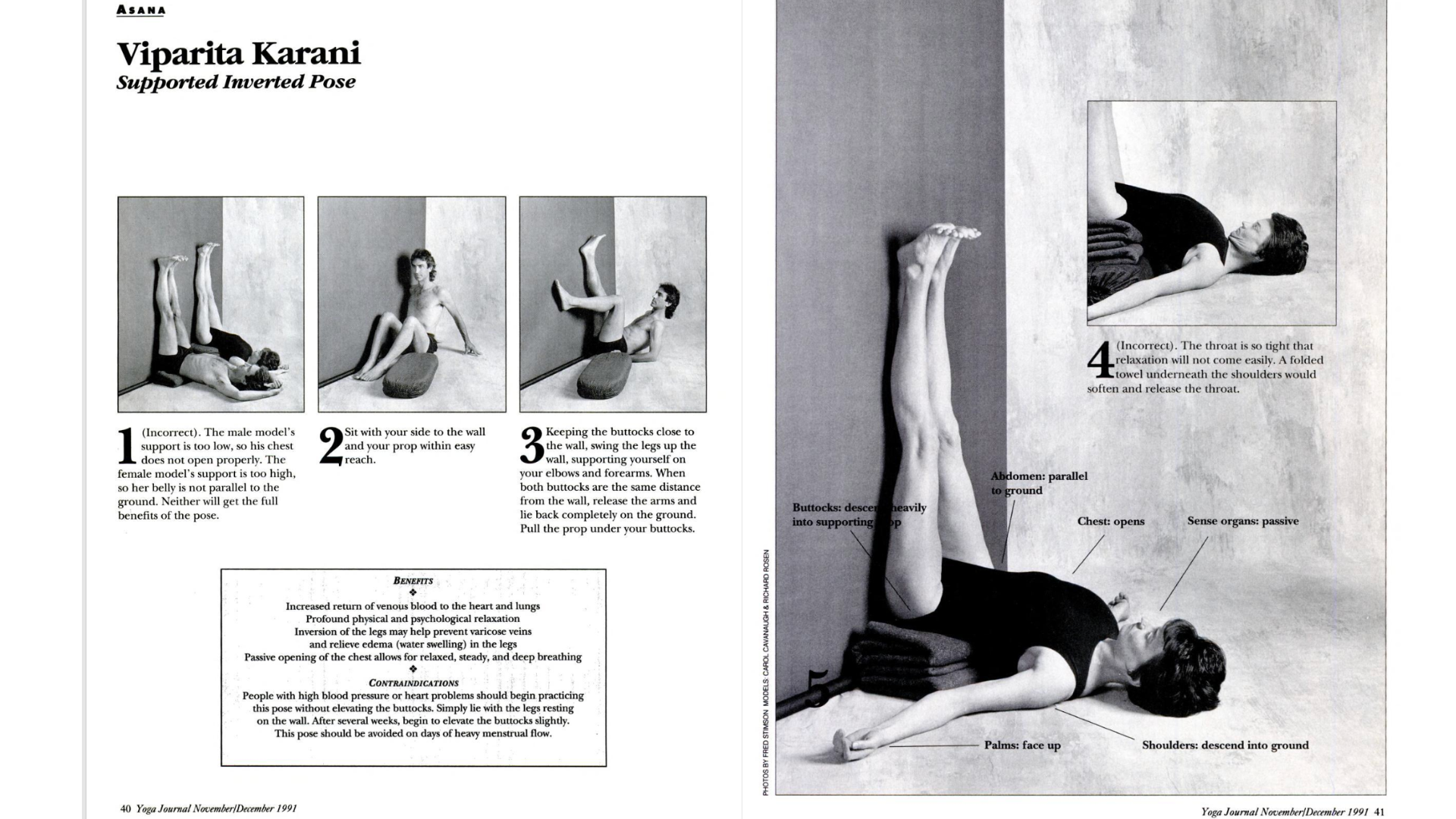
Both of the students in Figure 1 are using props of an incorrect height. The male model’s support is too low. His belly is parallel to the ground, but his chest is flat and sunken. He will not get the “waterfall effect,” because his heart and lungs are not significantly below his abdomen. The female model’s support is too high. Her chest is nicely opened, and it is easy to see how blood would cascade from her belly into her upper torso. However, her abdomen is not level. Therefore, it will not create a “tank” to store the blood. In Figure 5, the prop is the appropriate height, allowing the pelvis to remain level as the chest opens.
The width of the prop is also important. For many students, its edge can be placed roughly at the level of the kidneys (waistline level). This placement allows the back to curve in such a way that the lower lumbar spine is protected while the kidneys are massaged. However, if the prop is the correct height, and the chest still appears flat and sunken, it may be necessary for the prop to support still more of the back. In this case, fold the blankets a little wider or pull the prop a few inches out from the wall. (Be careful; if the prop is too wide it may elevate the heart, and the pose would then stimulate rather than calm its practitioner. The shoulders must rest completely on the ground.)
How to Enter the Pose
For most people, Viparita Karani is easy to hold, but daunting to get into. Many students collapse in laughter or frustration as they attempt to get the buttocks up against the wall, only to slide or tumble off the bolster. Try using this simple method for entering the pose.
Sit on the floor with your right side facing a wall (Figure 2). Put your chosen prop slightly off to one side, but within reach. Now, keeping your right buttock as close to the wall as you can, pivot around and begin to lift your legs up the wall (Figure 3). Support yourself on your elbows and forearms. As the legs straighten fully, swing the left side of the body around so that both buttocks are equally close to the wall. Then release the support of the arms and lie back on the ground.
Slide your buttocks against the wall if you can. Now reach out to the side and pull your prop close to your buttocks. Without sliding away from the wall, lift your buttocks off the ground just long enough to pull the bolster or pile of blankets underneath them. This action may seem awkward at first, but practice will make it easier.
While in the pose, the arms may be stretched out to the sides (Figure 5). The palms should face upward, and the arms should not be wedged against the torso. This position of the arms helps to create opening of the upper chest and freedom of the breath. An alternative position is to take the arms overhead, placing one palm in the other (Figure 1). This variation provides somewhat more stretch to the lower ribcage and the diaphragm.
If the legs are flexible enough, the buttocks should descend very heavily into the prop, so they sink slightly beneath the level of the waistline. Unfortunately, if the legs are tight, this alignment may be difficult to achieve. To help the sitting bones ground, it may be helpful to leave about two inches of space between the prop and the wall. In this variation, the buttocks touch the wall, and the sitting bones sink into the narrow space between the wall and the prop. (If you try this variation, remember to use a slightly narrower prop, so it will still support the same amount of the torso.)
Occasionally, Viparita Karani causes discomfort in the neck and shoulders. Figure 4 shows a student who is likely to have this complaint. Her chin appears to be digging into her chest, and the front of her throat looks short and tight. Such a student may confess with embarrassment that she doesn’t understand why Viparita Karani is thought of as a resting pose. Because blood flow to her head is obstructed when she attempts the pose, her brain may feel tight and clogged. It is not surprising that she experiences little peace in the pose.
This problem is easy to solve. A small folded towel (approximately one inch thick) may be placed under the shoulders. The towel allows the head to drop slightly below the shoulders, producing a dramatic sense of relief.
How to Be in the Pose
Once you’ve entered Viparita Karani, allow your eyes to close. Since this is a resting pose, it is not necessary to actively stretch the legs or lift the breastbone. If correctly positioned, the prop should allow the chest to open without any effort on your part. Drink in the cooling, soothing effects of the pose. Most people can stay in this pose as long as they wish.
Viparita Karani can be especially powerful after a stressful day or a period when you’ve been on your feet without interruption. At such times, your first few minutes in the pose may remind you of a speeding race car rapidly slowing to a halt. You may feel the blood draining down the legs into the torso. Initial sensations of physical relaxation will be followed by quieting of the mind and spirit. Gradually you will feel the effects of stress drain away, to be replaced by a sense of inner peace.
Viparita Karani, like all yoga poses, can teach us a larger lesson: that simply by changing the position of our physical body, we can alter the way the world appears to us. The thoughts and emotions that seem so vital are merely a transient perception of the world. If we alter our physiology, life will take on different shades and nuances. Thus we are not the victims of our own physical and emotional states. This is the true flexibility produced through the practice of yoga: a suppleness that creates a broader point of view and an awareness of different options.








 English (US) ·
  French (CA) ·