

 4 hours ago
2
4 hours ago
2
PROTECT YOUR DNA WITH QUANTUM TECHNOLOGY
Orgo-Life the new way to the future Advertising by Adpathway
(Photo: Canva)
Published August 16, 2026 07:37AM
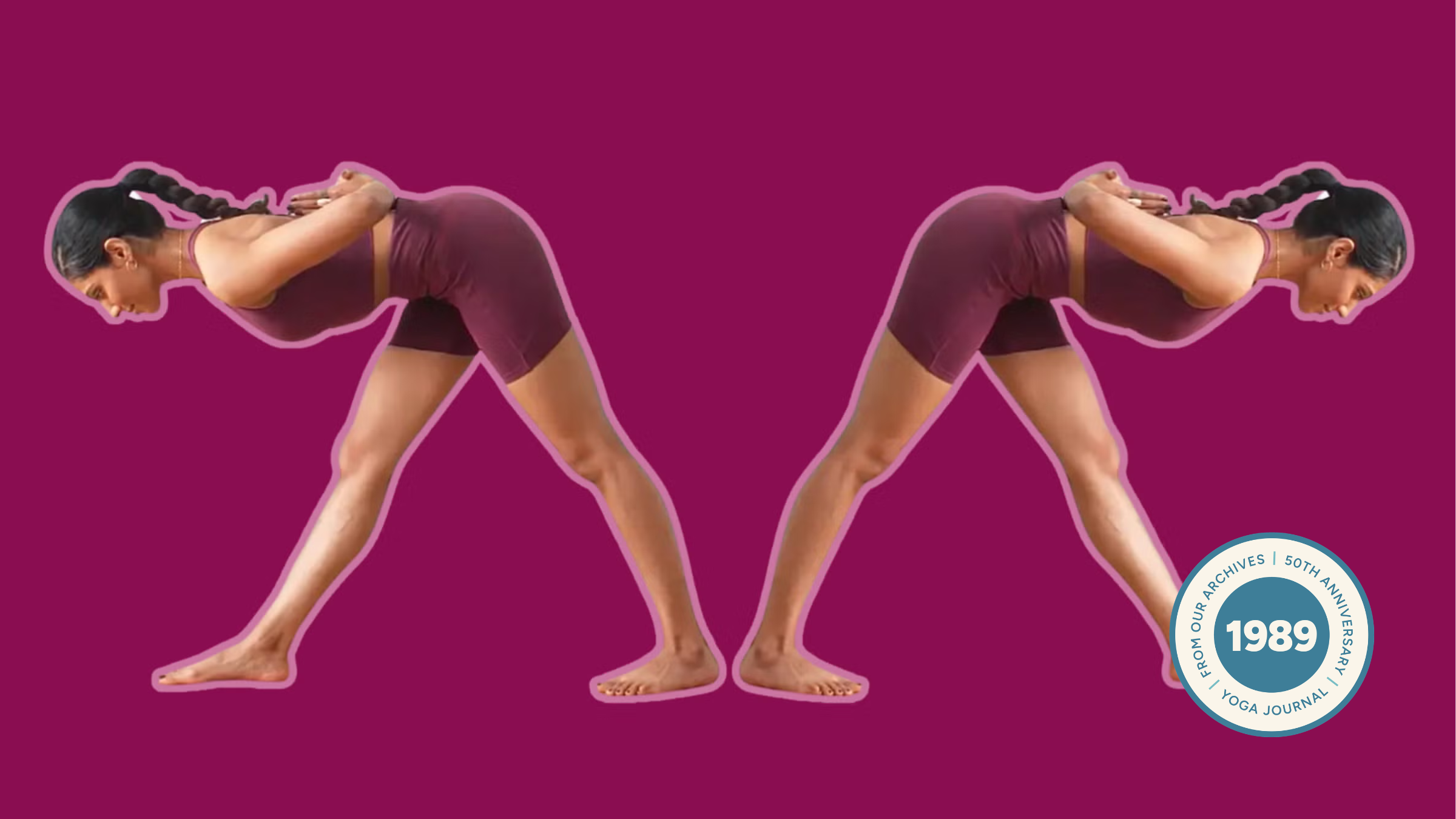
Yoga Journal’s archives series is a curated collection of articles originally published in past issues beginning in 1975. This article about Prasarita Padottanasana (Extended Leg Stretch or Standing Wide-Legged Forward Bend) first appeared in the September-October 1986 issue of Yoga Journal.
Most beginning practitioners of yoga find that their hamstring muscles in the posterior (back) of the upper thigh are tight, due in part to a lifetime of sitting and engaging in running and other sports activities. Standing poses put emphasis on stretching these important muscles. Sitting forward bends, which also stretch the hamstrings, are very difficult because of the tightness many students (especially men) experience there. Overzealous students may, in fact, overstretch and strain the lower back in these poses by struggling to reach their toes. Prasarita Padottanasana, in contrast, lets gravity help stretch the leg muscles and tends to put less of a strain on the structures of the vertebral column.
Begin by placing the feet wide apart (usually at least four feet), taking care that the toes are aligned. Make sure that the quadriceps in the anterior (front) thigh remain firm throughout without forcing the knee joint backwards into hyperextension. All movement on the muscles of the legs should feel balanced between lifting up and pushing down, with no horizontal movement at the knee joints.
Place the hands on the waist and with an exhalation bend forward, keeping the back long and slightly curved. Keep the abdomen firm, and feel the work of the buttocks and hamstrings as they aid in letting the trunk down against the pull of gravity. Do not let the back round as in Figure 3, and do not hold the breath, as this is as much a sign of resistance as tight muscles. Keep the breath even and free throughout the pose.
If the body is stiff, place the hands on a folded blanket, as shown in Figure 2. A stack of books may also be used, and for some students the seat of a chair may be necessary to help keep the back in good alignment. Hold the pose for several breaths, up to a minute. Take care that the neck is not lifted unduly, creating strain in the muscles of the cervical spine (neck) and upper back. If possible, stretch the arms out and grasp the ankles, or put the hands on the floor in line with the shoulders, keeping the elbows aligned with the hands.
In stretching the hamstrings, the closer the legs are kept together, the more difficult the stretch will be. As the legs are taken apart, the pull on the back of the legs, while maintained, is lessened, thereby allowing the stiffer student to get the feeling of letting go in this part of the body. In addition to stretching the hamstring muscles, Prasarita Padottanasana stretches the adductor (inner thigh) muscles because the legs are wide apart. The back muscles are also strengthened as the student goes down and comes up.
To reduce stress on the vertebral column in asana, one should maintain the column’s normal curves as much as possible as in Figure 1. In Prasarita Padottanasana, one should concentrate on using the buttock and abdominal muscles to keep the lower back slightly hollowed as the trunk is lowered and raised.
To come up without causing too much strain on the back, place the hands on the waist or hips. Keep the back long, and use the inner and back thigh muscles as well as the abdomen and buttocks to control the action. The breath, once again, should be free. Most students prefer to inhale while coming up and to exhale while going down.
Prasarita Padottanasana can be used in the standing pose series to cool the mind and body after more strenuous poses. It can also be used as a pleasant transition to other forward bends or to Sirsasana (Headstand).
Figure 1 Photograph of yoga practitioner in full Prasarita Padottanasana with head on floor
Figure 2 Photograph of yoga practitioner in modified Prasarita Padottanasana using a folded blanket
Figure 3 Photograph of yoga practitioner bending forward with hands on the floor, side view
Photos by Elise Miller






 English (US) ·
  French (CA) ·