

PROTECT YOUR DNA WITH QUANTUM TECHNOLOGY
Orgo-Life the new way to the future Advertising by AdpathwayThe Huascarán Circuit is a highlight of any pedal-powered adventure in South America. Not only does it make a fantastic loop in its own right, showcasing some of the highest peaks in Peru, but it’s also an ideal shakedown ride before embarking on the Peru Great Divide. Find Cass’s diary from his second lap around the eye-popping 230-kilometer loop, along with a map, itinerary, and a suggested pack list for both it and the Divide here…
Earlier this year, I travelled to Peru, packing in as much riding as I could into four blissful weeks in the Andes—see Conexión Oyon and Quebrada Forays for examples of what I got up to.
Sandwiched between these trips, I also set out to tackle the Huascarán Circuit. To those who aspire to pedal their laden bicycles in South America and encrust them in dirt, a lap of the Cordillera Blanca is likely to be high up on the shortlist—so much so that I’ve already done it! Back in 2013, whilst cycling between Alaska and Patagonia, I crisscrossed the range following what’s now known as the Huascarán Circuit, so named because of the peak that it encircles, 6,768-metre Nevado Huascarán, the highest in Peru.
I’d set out on this multi-year tour alone but along the way, I rode with a whole cast of remarkable folks, sharing this particular experience with Ben Masters, a Peace Corps volunteer stationed in the area for two years. Ben lived with his wife Katie and their Peruvian dog Badger in the shadow of mighty Huascarán, a 30 kilometre ride from the bikepacking base of Huaraz, half of which was unpaved and steep. Having heard about a grassroots bike co-op he’d set up in his village, Shirapucro, I rode out one day to meet them.
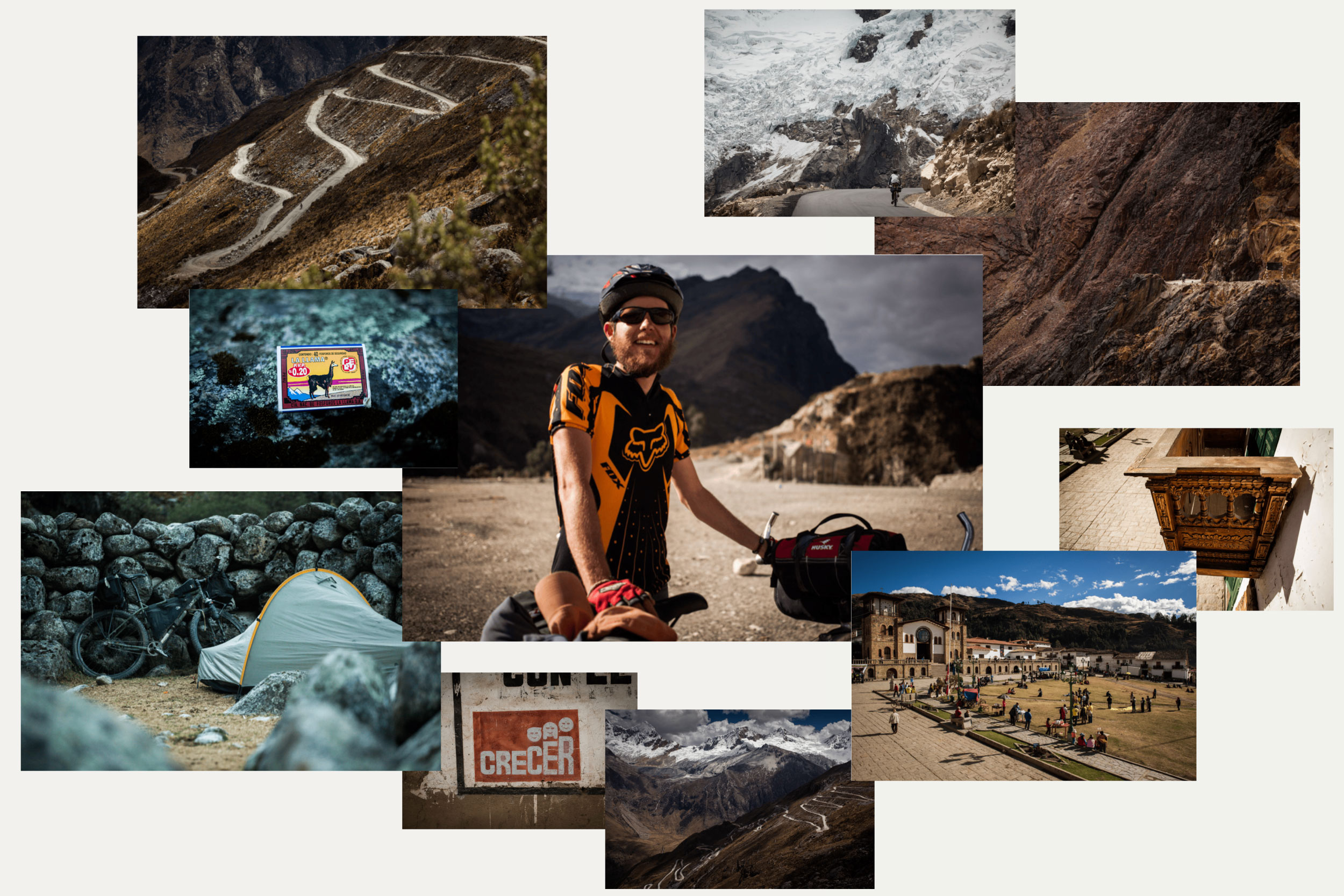
Ben and I hit it off straight away, and by way of a backstory, I should mention two qualities that initially stood out about him. The first was his unbridled love of bicycles, especially in their humblest of forms. Whilst he was aboard an old, scratched-up Trek hardtail for our ride around Huascarán—kitted out with basic panniers and a front roll made from a hardware store tool bag—Ben had also built his own bamboo bike. This dovetailed with his dedication to reducing his own reliance on petrol-powered transportation, to the point that back in the US, he’d once insisted on bicycling only for a whole year, refusing to take a single car ride. Not only that, but Ben started a bike co-op in the village in which he lived, where he taught kids how to repair bikes, which they hung on ropes slung around rafters instead of work stands. You can read more about the project at the bottom of this post.
And the other? It was the way he ate chicken, which he did in the typical Peruvian fashion. Ben left absolutely nothing to waste—skin, fat, and all—and it was a marvel to watch him nibble his way up and down each bone, until they were as clean as the ones you might see in a cartoon. I haven’t kept up with his current gastronomic habits, but I do know that he now runs a business called Crank Therapy, upcycling inner tube wallets, belts, and bags using, you guessed it, a bicycle-powered sewing machine.
Ben and I enjoyed a fantastic few days together, and since I was back in the area, I was keen to ride the loop again and rekindle memories. Fortunately for me, this aligned well with Chris’s plans, my fellow UK-born bikepacking companion on “Quebrada Forays.” Chris also planned to complete the circuit, in part to help acclimatise for the Peru Great Divide, and also because he’d heard so much about the route itself. So with that, we settled on a date, fine-tuned our pack lists, and steeled ourselves for pedalling our way up to almost 5,000 metres in elevation.
Day 1
Hectic Huaraz to Curious Cow Camping (67km, +1600m /-700m)
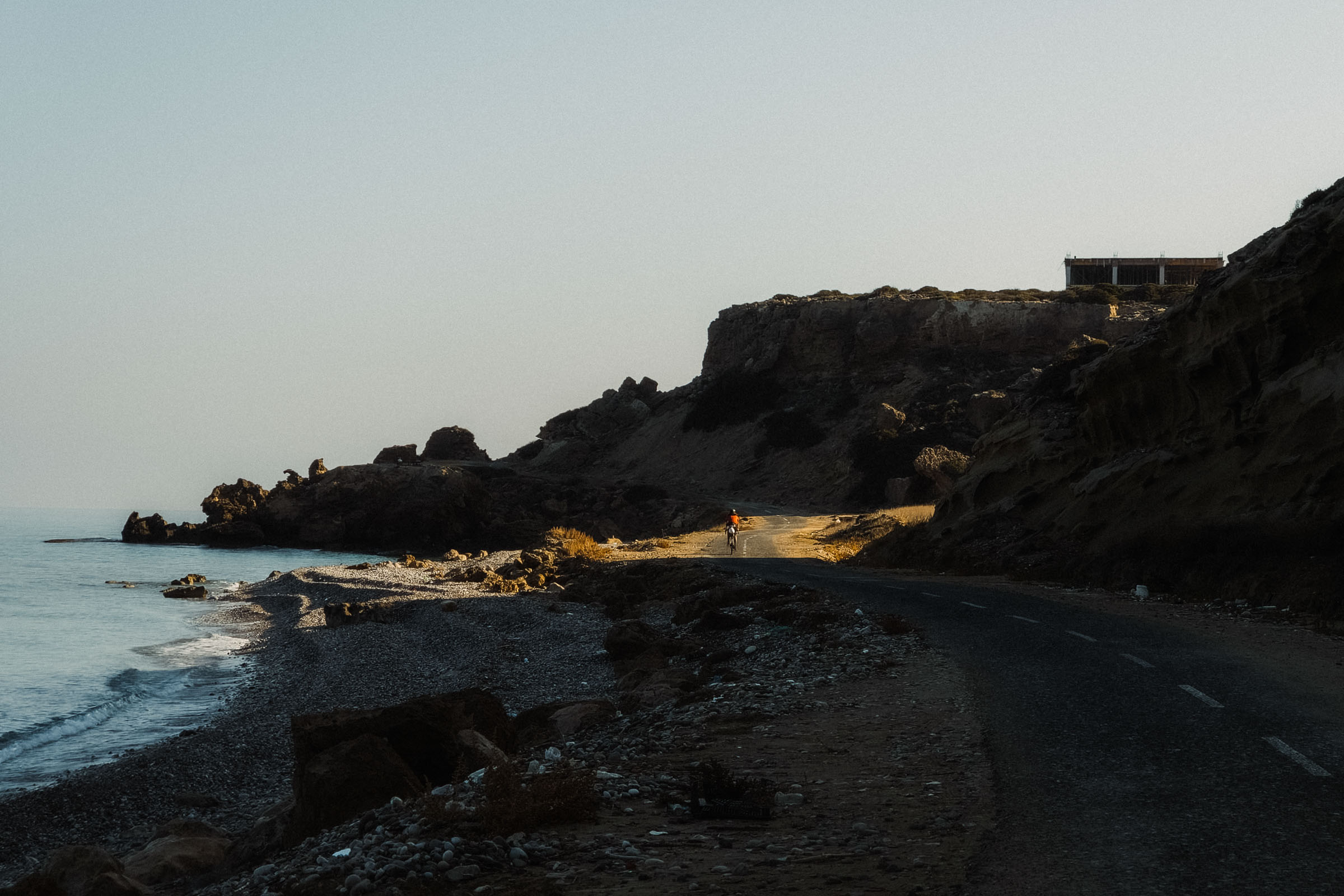
The ride out of Huaraz is busier and more hectic than I remember it, and whilst most of the traffic gives us just enough space to inhabit the edge of the road, there are still gangs of motley dogs to contend with that take up a frenzied chase until we cross their invisible territorial divides—at which point they lose all interest in us. Fortunately, this first 30-kilometre stretch involves a net descent of 400 metres, so it rolls by quickly enough, and once we’ve escaped the main road, peace prevails, at least by Peruvian standards.
A 10-sol menu refuels us in the small town of Carhuaz—lomo saltado and a big bowl of soup in which floats a chicken claw, and a tiny tub of jelly to cleanse the palate. Like many places here, the restaurant is both friendly and extremely noisy, whether from music playing overhead, diners watching TikTok on their phones, or passing street hawkers selling their wares through megaphones or pre-recorded and blaring from loudspeakers attached to the roofs of cars.
Our first night sees Chris valiantly chase off a curious cow, before settling back into his tent, the sound of munching grass beside him.
From here, the first segment of the climb to Punta Olímpica begins. Paved a decade ago, the kilometres pass by quickly, and we reach a Pikes-recommended camping spot at sunset—by Pikes, I mean the one and only Harriet and Neil Pike, fabled cicloviajeros and authors of a wonderful hiking and biking guide to Peru’s Cordillera Blanca. It’s windy, so we hunker down after chatting to Jock and Emma, two bike tourers from Scotland on a world tour, still recovering from a food-related illness and fresh from their ensuing visit to the hospital. Cooking up dinner, a cow wanders over and attempts to eat mine when my back’s turned, so we shoo it off, worried it’ll trip on our guylines.
Day 2
Curious Cow Camping to Shoe Box Chacas (50km, +1000m /-1600m)
We awake early, the clear skies we’re hoping for yet to materialise. In July, it gets dark at 6:30 p.m., so the nights are long ones. While I slept soundly, apparently Chris was back on patrol, fruitlessly chasing around the same cow that tried to eat my pasta across the pampa.
Amongst both pass-bagging cyclists and local drivers alike, the views from Punta Olímpica rank as some of the finest in the land, drawing both international and national tourists alike to the grandeur of its snow-capped peaks. Chris pulls away ahead of me, and eventually I catch up with Emma and Jock, who rolled out extra early. Somewhat bizarrely, however, they’ve yet to see him, so we send out their drone to scour the hairpins above and below us for signs of life. I must have overtaken him when he pulled over to snap a photo—impossible to resist around almost every bend, it seems—and we spy him working his way up a last set of switchbacks towards us.
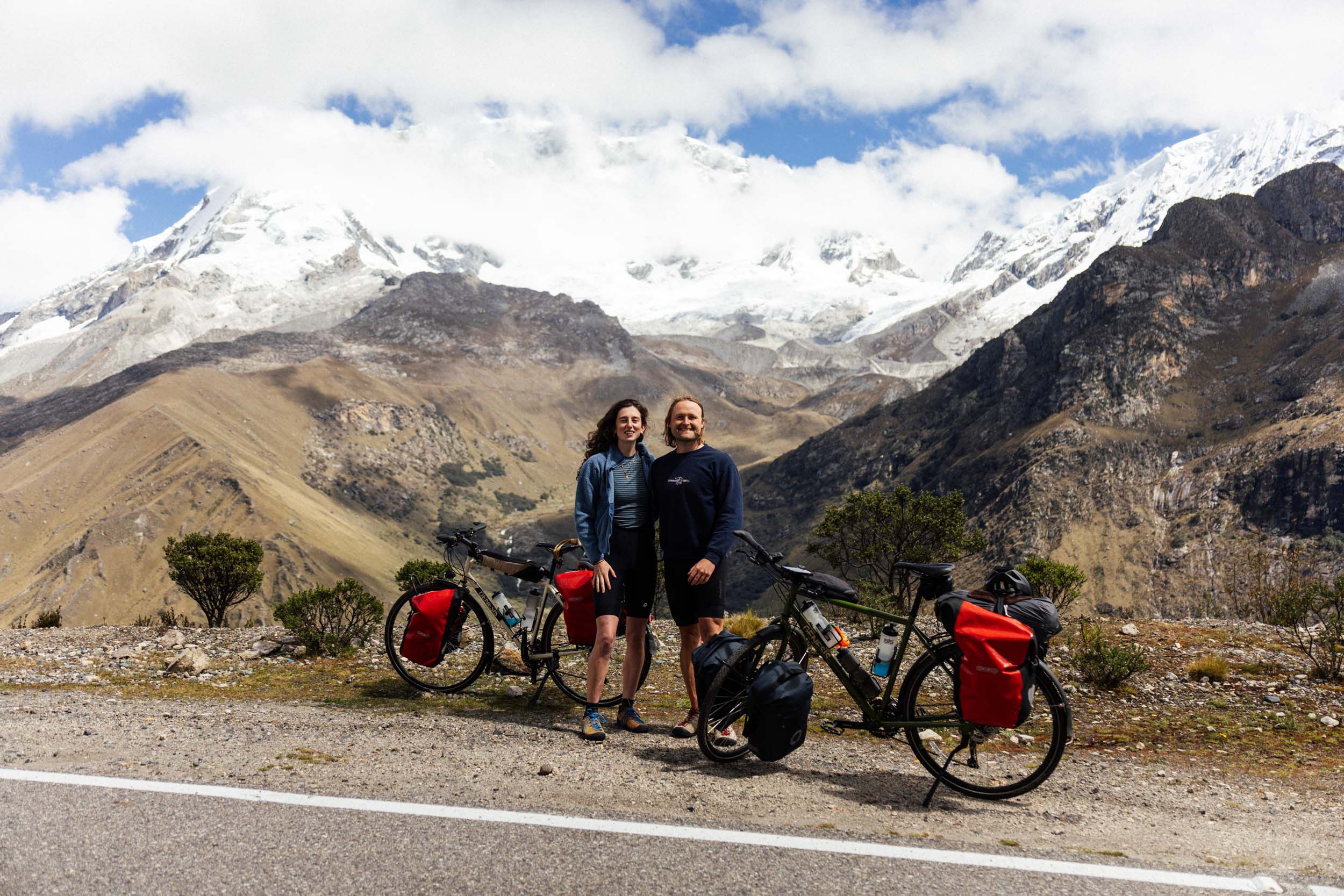
An entrepreneurial vendor, strategically positioning himself at the entrance to the tunnel, joins in with Emma and Jock’s celebration at Punta Olímpica tunnel, 4736 metres.
Jock and Emma are aboard more traditional touring setups with a full complement of bright Ortlieb panniers, and I eye their 32mm tyres with incredulity, knowing how this buttery-smooth asphalt will eventually give way to rock and dirt. Still, it doesn’t stop the four of us from riding together for now, and we fall into easy banter, parting ways at a tunnel, up at 4700 metres, that siphons off vehicles away from the actual Punta Olímpia above us. When I first rode this pass with Ben, the tunnel had only just been finished, though we still chose to continue zig-zaging our way ever upwards. This same road has now fallen into deep disrepair, and while we’ve heard it may no longer be passable, Chris and I at least set our sights on attempting the true summit, leaving our Scottish amigos to dive into the darkness of the paved but unlit tunnel instead.
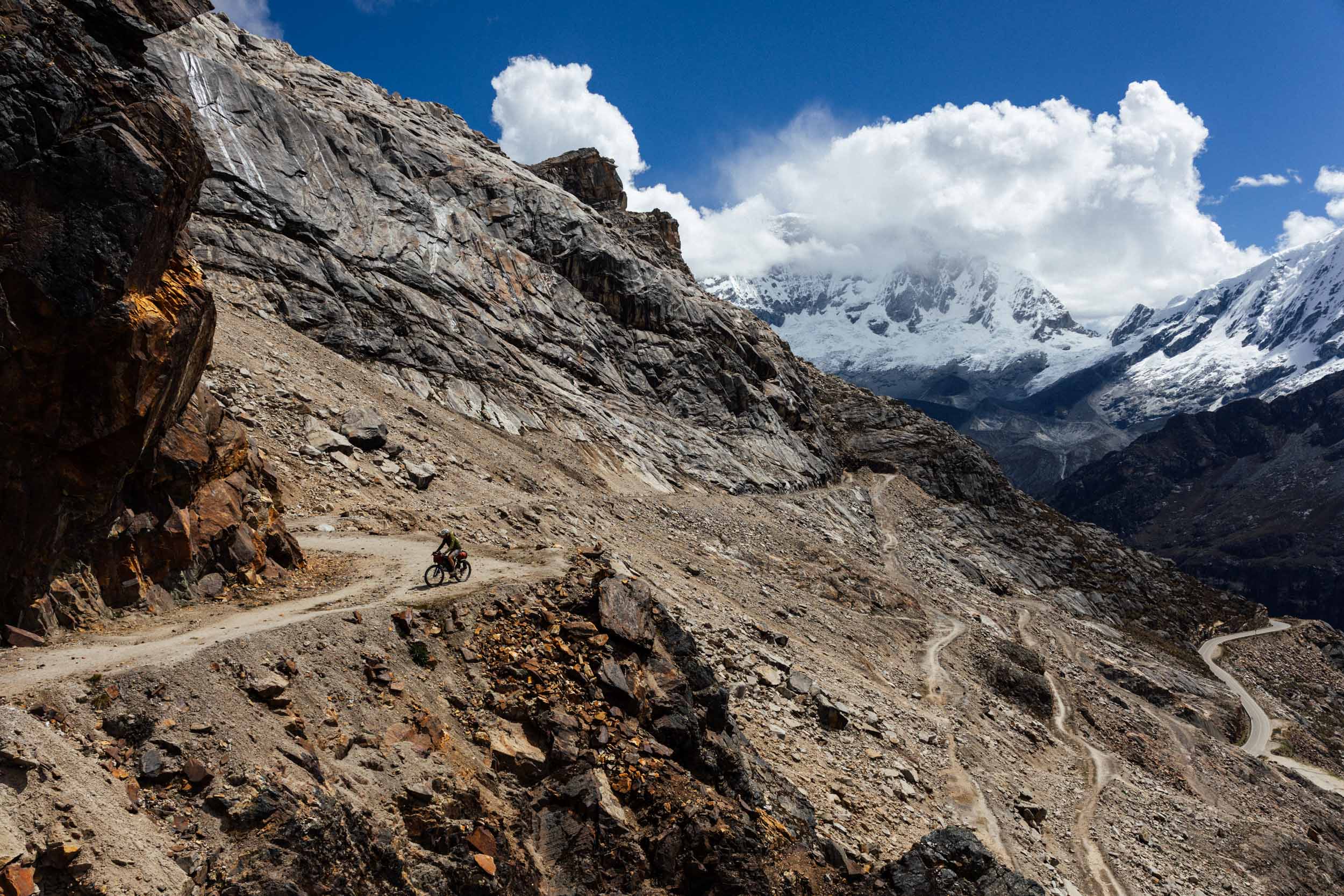
Just as I did a decade before, we bypass the tunnel’s mysteries to continue climbing, right up to 4,900 metres in elevation.
In fact, this “up and over” proves to be the highlight of the day. Tall and formidable walls of granodiorite and tonalite lend a sense of Mordor to the landscape, and we scramble over sharp-tipped jumbles of rock that threaten to pierce our tyres. As we crest the old pass, portal-like, we stop to gaze up at Nevado Ulta and snack on sweet and crunchy amaranth balls—bolitas de kiwicha—before working our way back down towards asphalt once more. Before we reach it, however, the rough and unkempt dirt road abruptly disappears completely before us, so we hoist our bikes straight down a steep and precarious embankment.
Back on tarmac, wind whistles through our helmets as we carve our way down again, one switchback after another, endlessly it seems. We need to keep our wits about us on this high-speed descent, despite the best efforts of the Yanarraju Massif above us, trying its best to steal our attention. This bleached-white glacier wall is so vast in scale that I can only wonder if I’m still on Planet Earth.
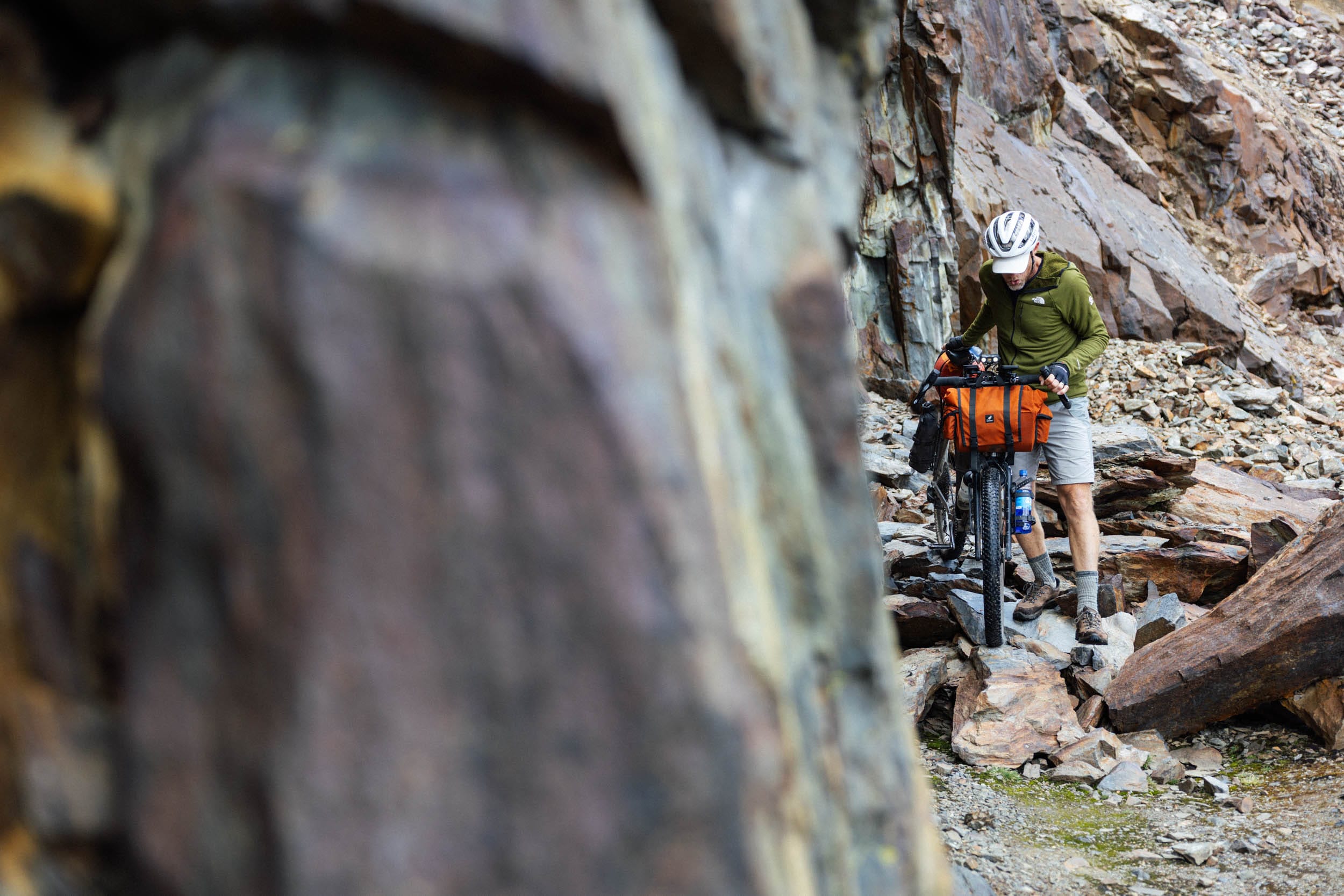
For those who enjoy their rough-stuff, Punta Olímpica’s “up and over” is a highlight of the Huáscaran Circuit.
Chacas, our destination for the day, is a small and idyllic settlement with a pristine central lawn that would be the envy of an English cricket team. It’s also a town that’s noted for its intricate wooden balconies and doorways. Back in the 1970s, an Italian priest and a group of carpenters began training impoverished youth in the art of woodwork, beginning a tradition—Artesanía Don Bosco—which is evident in almost all the buildings now and includes the export of religious art around the world.
What a lush lawn. If my cricket-loving nephew had been with us, I bet he’d have challenged the locals to a game.
Being Mr. Budget—or should that be Señor Económico—I find myself a small but homey shoe-box-style room for the night, whilst Chris settles into a more refined spot on the square. Emma and Jock are in town too, and given their recent hospital experience in Huaraz, they track down an upmarket eatery in the hopes of staving off bad bellies. I find what seems to be the town’s most popular comedor, a quirky establishment whose blue walls are either lined with rows of golden Inca Cola and cheap spirits, or posters of fluffy dogs and baby Jesus. The kitchen is a hive of activity, and it’s the place to be for dinner—everyone hunkers over hot bowls of soup before digging into fried trout and a mound of rice. I flavour mine with a hot salsa that’s presented in a teeny-tiny bowl—a sure sign to go easy on the garnish. I’m the only foreigner, and no one takes much notice of me, just the odd furtive look or smile.
Day 3
Shoe Box Chacas to Riverside Camping (56km, +1300m /-700m)
My shoe-box room suits me well. The pillow feels like a bale of hay, but the owners are friendly, and the Wi-Fi is strong. The four of us meet up for breakfast, pouring coffee concentrate into cups of hot water, as is the Peruvian way. Today is Mother’s Day, and everyone is in their Sunday best, which means it’s a great hat-spotting occasion.
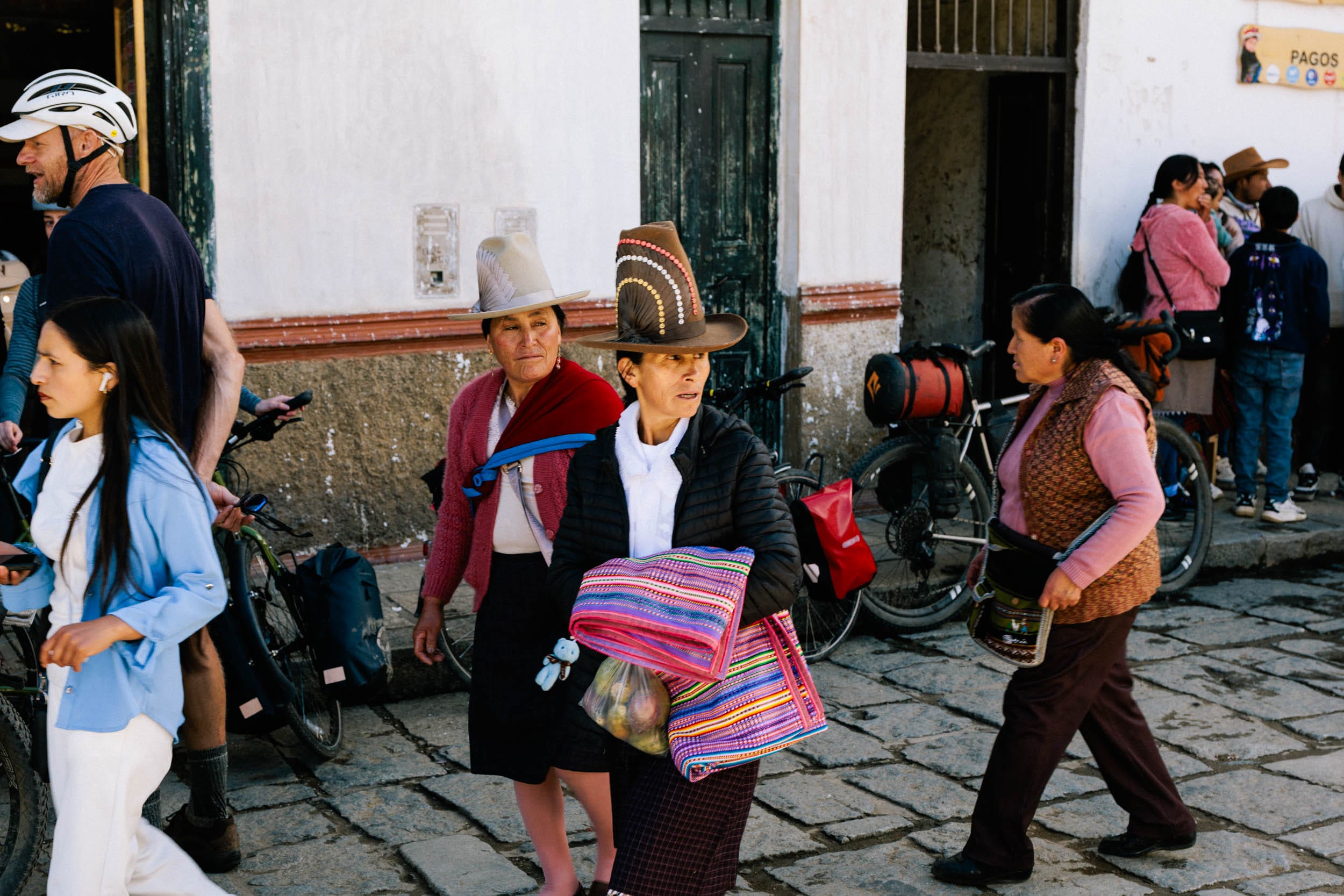
Two Spaniards appear as we prepare to leave Chacas, heading in the opposite direction, and briefly, we’re an international bikepacking posse. Note dog deterrent water pistol, too.
Jock and Emma decide to join for the morning, but from here, we’ll be on dirt, and on skinny 32mm tyres, they feel every little blemish. We all pedal onwards until our differing paces break up the group back into two. Loosely, we arrange to camp together, but as bike travellers know, life may well dictate otherwise.
Bikepacking versus traditional touring? On this occasion, it’s a resounding win for the former.
Today’s ride is less dramatic than the day prior—how could it match it, after all? Still, it’s nice to have an easy, rural stint, and our necks are grateful for a break after all the craning yesterday. Whenever we stop, passers-by stop to quiz us on where we’re from and where we are going. Is it tiring? Yes! Where do we sleep at night? We camp! My white beard is remarked upon, and I’m glad to provide some entertainment at least. As a guest in their country, I always share my appreciation for their land, extolling its beauty, the friendliness of its people, and the cleanliness of its air.
“Sí, aquí es sano,” says one lady. Here, it’s healthy, a point often made by older folk, those who remember Peru’s more unstable past. As the day draws to a close, we begin another climb, finding a billiard-table-flat clearing beside a river to pitch our homes for the night. There are no cows in sight. Excellent. It’s clouded over, but a glimpse at a white-capped peak gives us hope for a clear morning.
Day 4
Riverside Camping to Soggy Yanama (12.5km, +177m /-538m)
And yet… this is not to be. We awake to a damp and drizzly day, and soon rain is pounding on the tent. So much for the view I’d been anticipating. Both of us wait for the other to stir before we eventually do, standing out in the rain, cups of coffee in hand, like a typical Lakeland day. We stare keenly in every direction, hoping for a break in the clouds and a sign, any sign, that there might be a hope of sunshine. But nothing comes of it, so we pack up and finish yesterday’s climb before descending towards the settlement of Yanama on the other side, still 3,800 metres high. By the time we make it, we’re soaked to the skin, and it doesn’t make sense to continue, especially as it would mean missing the views we’ve promised ourselves.
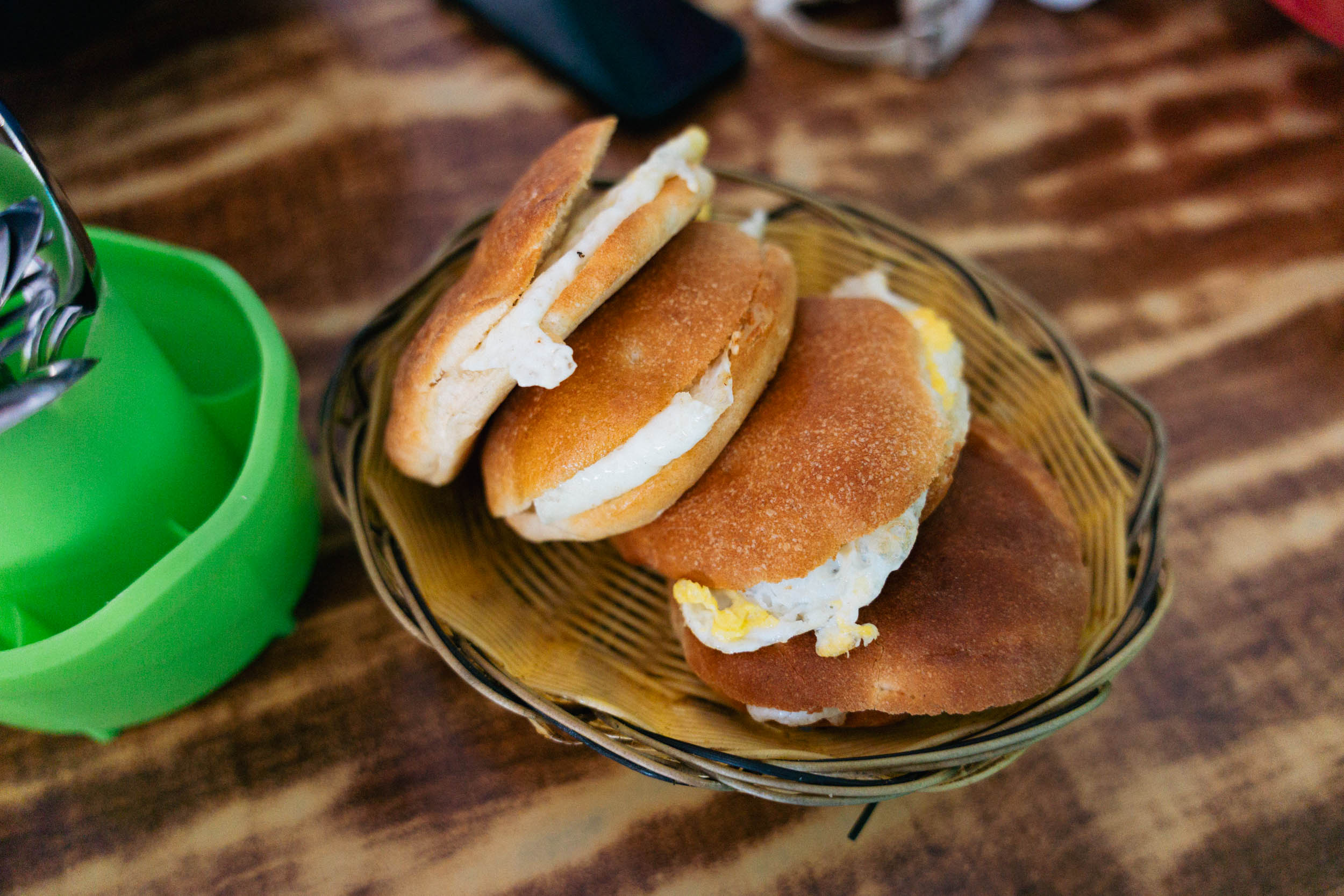
Angel’s egg butties, heirloom corn, and goblets of coffee lift our spirits no end on a miserable day.
Instead, we park our bikes outside a restaurant that turns out to be an enclave of hospitality. Angel, a keen motorbiker who has travelled all around these mountain roads, welcomes us in, and his dog Hercules sniffs at our soaked, dripping selves. Within moments we’re slurping on enormous cups of coffee, and soon after muña tea, a local herb that settles the stomach. Then choclo, sweetcorn from the family field, appears before us, as does a basket of egg sandwiches from their free-range chickens. We may be damp, but our bodies and spirits are quickly warmed. On Angel’s recommendation, we check into the simple hospedaje next door, waiting for the village professor, who also runs the establishment, to return from his school duties. Our rooms are plain but afford views of the obscured mountains beyond, and whilst we’ve only accrued a soggy 12.5 kilometres to our name, today, we’re fine with that!
Day 5
Dry Yanama to Mountain View Perch (41km, +1241m /-4308m)
I listen. Silence in this small mountain settlement. No rain! Wisps of clouds hang around majestic mountain tops like ethereal scarves that I can see straight from the open door of my room. My spirit soars at the thought of what lies ahead, my imagination filling in the gaps of my memory.
Pedalling ever upwards towards the second-highest pass of the route, Portachuelo de Llanganuco, at 4,767 metres.
We pack up, excited and very relieved to feel the sun on our bodies once more. This will be the third and last pass of the loop, a challenging col that curls its way around the valley, ever higher, past a string of lakes, pampa, and high-mountain pastures. The mountain peaks are still mostly shrouded by cloud, so once we’ve crested the pass—Paso Portachuelo de Llanganuco—we stop and linger. This patience is rewarded, as the longer we stay, the more they clear and the light show develops.
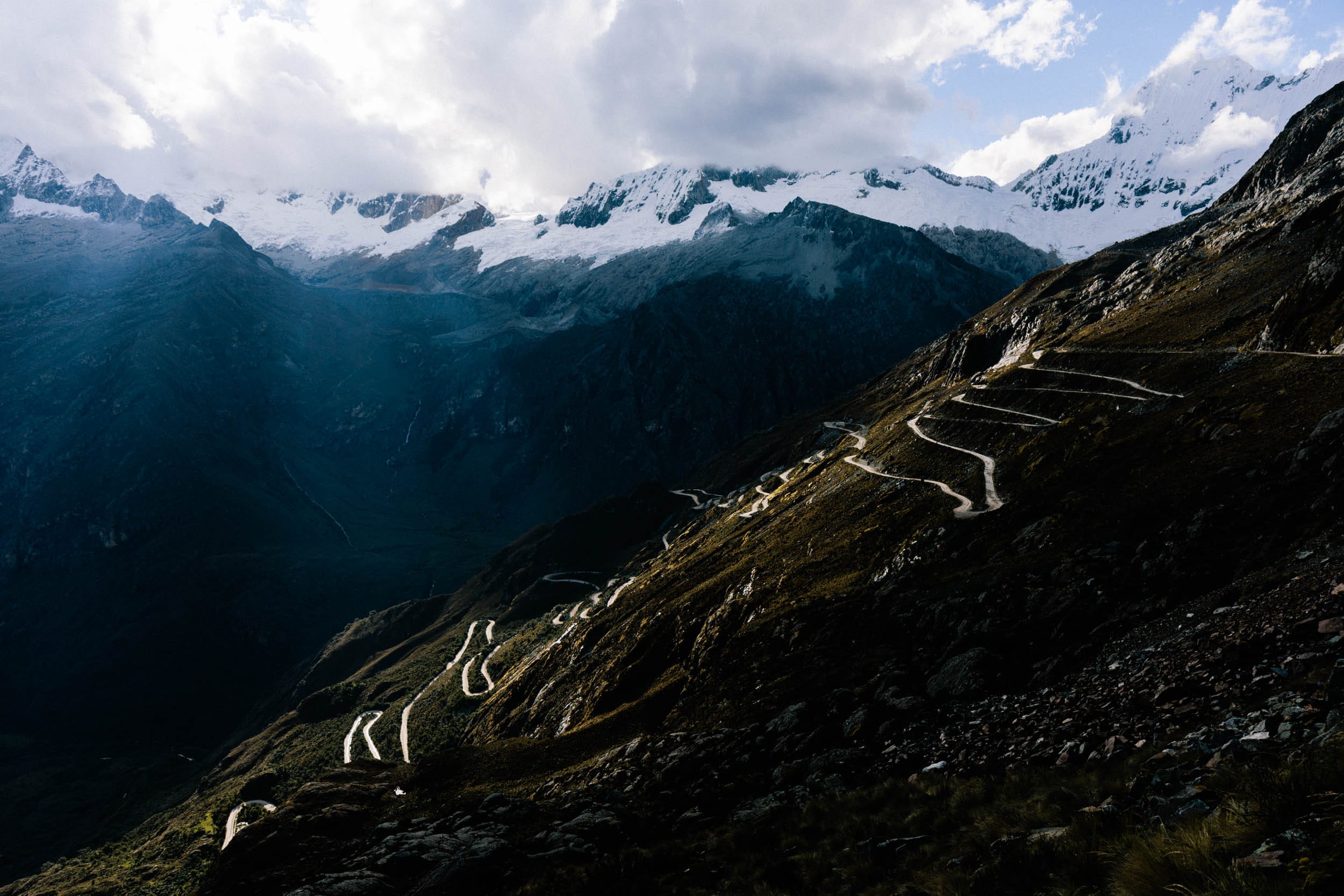
Let the light show begin!
Throughout the late afternoon, there’s a steady trickle of visitors, who also stop and appreciate the view. A couple from the Áncash coast launch a drone overhead, which we all smile and wave at enthusiastically. Two Argentinians on overland motorbikes, who have ridden here from their homeland, offer us mate from metal straws. Then, a local motorcyclist pauses only long enough for his music to echo around the pass. Then a sedan arrives with elderly Peruvian ladies bundled up in bright shawls and tall hats that hit the roof. We rustle up some coffee on our stoves, cupping our hands around our mugs and simply gazing out at the spool of thread unravelling below us. The lone nappy that’s been lobbed out of a passing colectivo (a shared minibus) is perhaps the only thing that feels at odds with the surroundings.
We splash through puddles as we race the sunset down the mountain.
We should probably get back on the bikes, but every time we consider moving on, the light show changes again, and another peak appears from the mist or sharpens into view. Our decision to linger is rewarded once more, this time by the most glorious sunset as we race down bumpy switchbacks mined with potholes and puddles. It’s rougher than I remember, and I think about Jock and Emma on their razor-thin tyres, and even Ben, a decade ago, on his 26-incher. Eventually, we reach a flat spot we’ve spied from the top, a perfect perch that we hope will set us up for a panorama finale in the morning. Aside from our Andean lupine neighbours, we have the place to ourselves—just an old truck laboriously working its way down the knot of switchbacks above us, casting a series of abstract shapes, pools of light and dark, emitting Jurassic sounds that echo off the mountains.
Day 6
Mountain View Perch to Carhuaz (59.5km, +741m /-1911m)
It’s cold at 4,300 metres, especially just before dawn, so I curl up in a ball like a woodlice, tucking in my quilt to safeguard any pockets of warm air. When I venture out, the sky is completely clear, and to the east, I can see the first beams of sunlight clip the rounded tops of Huascarán Sur and Norte. At 6,768 and 6,655 metres, respectively, Huascarán is both the highest peak in the Cordillera Blanca and all of Peru. To the west, I turn my gaze up towards a series of triangular shards, Huando, almost as tall and famed for its steep and symmetrical icy flutes. Marvelling at our surroundings and our good fortune to be here, we couldn’t have hoped for a better platform to savour this spectacle, views that just yesterday seemed so unimaginable. And when a band of sunlight does eventually seep down the mountains and coat us in warmth, we start on hearty breakfasts, knowing that this is our last day in the saddle, and there’s no need to save supplies any longer.
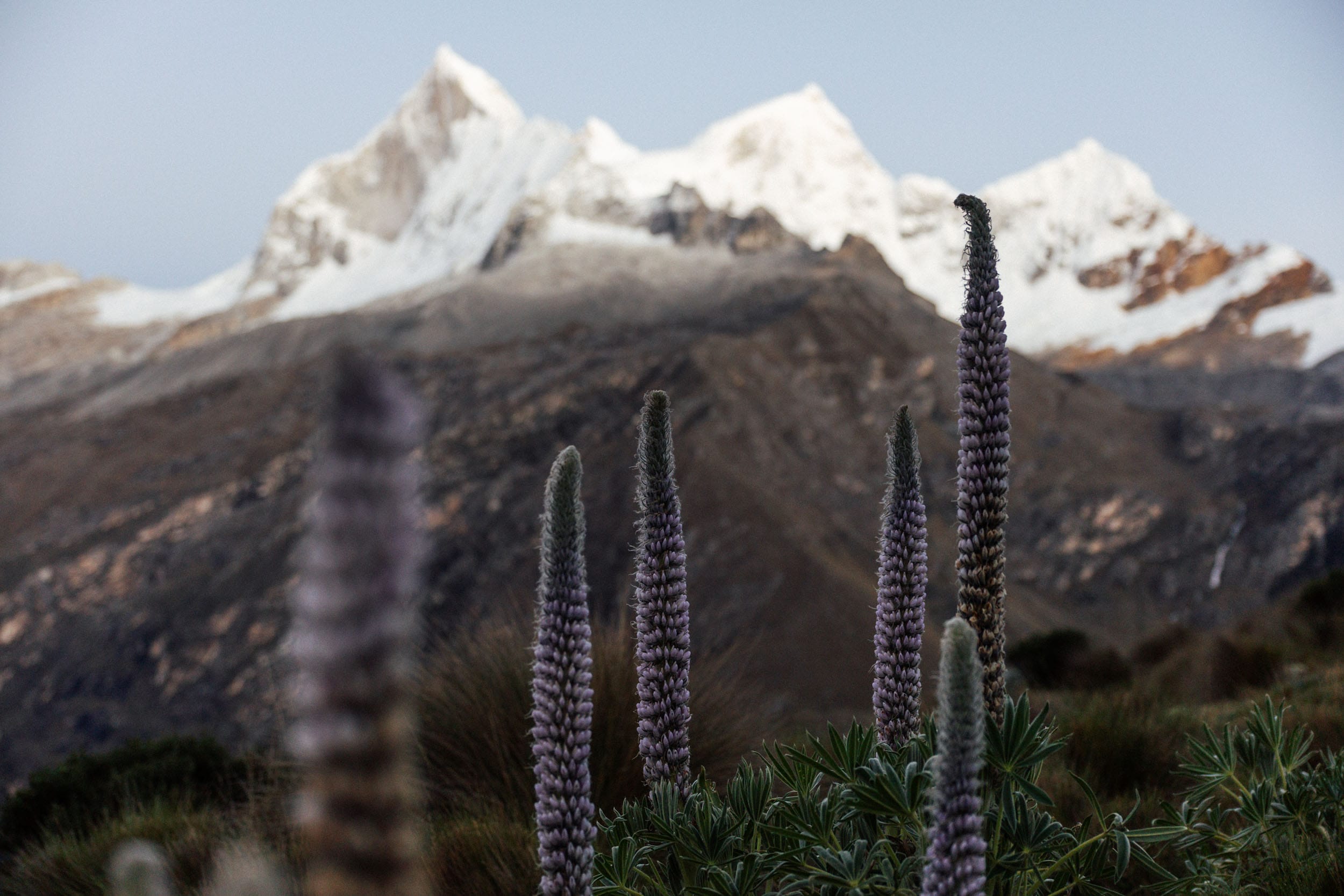
From our campsite perch, we feast on morning porridge and glorious views of Nevados Huascarán and Huandoy.
The ride back down the valley is no less impressive than anything so far, even if it becomes busier with each kilometre we pedal. Initially, we pass two turquoise lakes—Llanganuco Chinacocha and Orconcocha—hemmed by queñual trees and their distinctive, paper-like bark, where Peruvians from the valley gather for family picnics. Then, we switchback through a steep corridor of coarse-grained granite, our last quebrada of the trip until we’re back in the land of multi-coloured corn once more. Popping out on a busy road feels both incongruous and overbearingly hot, so we waste no time in dispatching the final 20 kilometres of the trip, jostling with traffic and sweating in the midday heat. In fact, we’re more than happy to dismantle our bikes and hop in a colectivo once we’ve closed the loop in Carhuaz, knowing the road into Huaraz, which we rode on our way out, will only become busier.
One last lingering look at the highest peaks in the Cordillera Blanca before we’re funnelled back down to the valley floor.
Once the bikes are extracted and bags loaded up once more, it’s just a case of riding back to our hostel. Chris and I can’t help but enthuse—it’s hard to believe how much we’ve seen in these six event-packed days. Twelve years after first riding this same circuito with Ben, it’s also affirming to realise that my memory hadn’t exaggerated the splendour of the Cordillera Blanca. And once more, I’m left in complete awe of Peru and its people. It’s a sentiment that’s overwhelming and heartwarming in equal measure, no matter how many times I ride here.
Goodbye, Huascarán Circuit. Until the next time…
A history of Ben and his Peruvian Bicycle Co-Op, circa 2013
Ben’s impetus for setting up the co-op came after noticing the state of disrepair typical of most bikes in the area, and the way kids hurtled down the lumpy dirt roads outside his house, often returning with scrapes and bruises on their way back up.
His idea was simple but elegant: to encourage the children in the village to look after their bicycles by learning to spot subtle issues before they became glaring problems, arming them with the knowledge to make the necessary repairs, and eventually the confidence to help others, too.
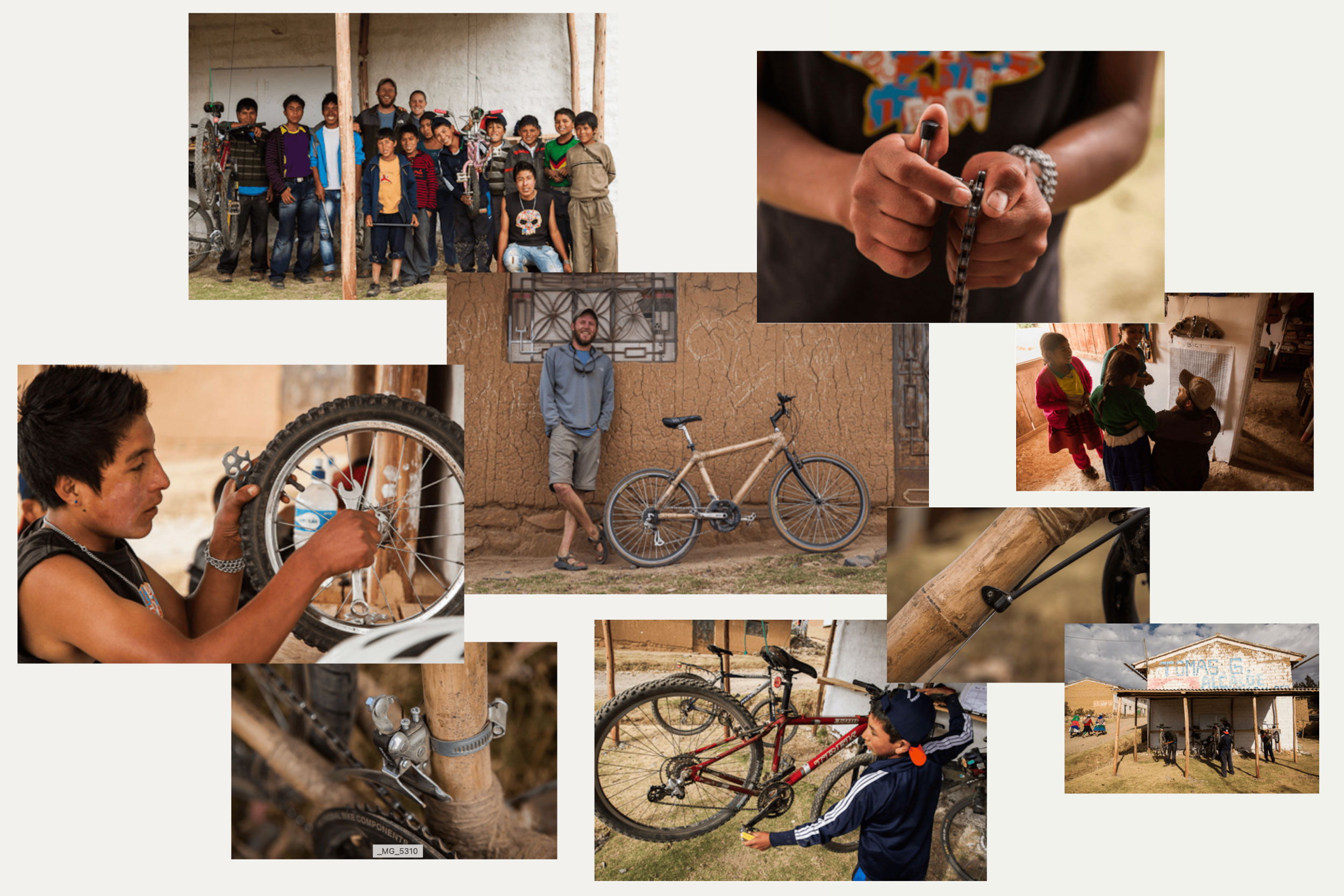
Humble in its execution but magnificent in its vision, he set up a tiered bicycle maintenance program—from novice to maestro—that drew a steady flow of local kids, three times a week, to his makeshift workshop. Under a corrugated roof, protection from the high-altitude sun in the summer and power shower rains in the winter, he taught anyone interested to learn everything from positioning a saddle to the finer arts of adjusting derailleurs, truing wheels, and maintaining hub bearings. Bicycle safety also played a part in his courses, with a small test track nearby to teach bike-handling skills.
Ben hoped news of this bare-bones co-op would spread to neighbouring villages, so he might leave behind a community of children and young adults who knew both how to ride their bicycles safely and maintain them for years to come.
The Huascaran Circuit
With clear weather, five riding days is comfortable itinerary for this route, as long as you’re mostly acclimatised—see this post for some suggested day rides. I’d recommend taking a quick colectivo between Huaraz and Carhuaz, as this cuts out some busy highway riding. On the way back, you could also pick up a ride from Yungay to Carhuaz, skipping another section of busy paved road—Yungay is a nice spot to spend the night, too, or you could treat yourself to a night in the wonderful Cordillera Blanca Lodge at the end of your ride. At the other end of the budget, El Tambo hostel in Huaraz is a great place to meet up with fellow bikepackers, or for more refined digs, Hotel Cherup is a solid option, as is Olaza’s—run by local mountain biking legend Julio Olaza.
Our route includes the “up and over,” cresting the original Punta Olímpica, which I’d highly recommend if you have an appropriate bike and you don’t mind the odd push and shove. Check up on the landslide situation, though. This segment aside, everything is rideable as long as you’re acclimatised, pack light, and have the legs for it. Many folks do ride this route on a gravel bike, but I’d advise 2.6 tyres or bigger if you’re running a rigid setup. As with all the riding in the Andes, spec your bike with appropriately low gearing so you don’t exhaust yourself. I prefer to ride it in an anticlockwise direction, making for an easier, smooth paved climb up Punta Olímpica and rough-stuff descent down the Paso Portachuelo de Llanganuco.
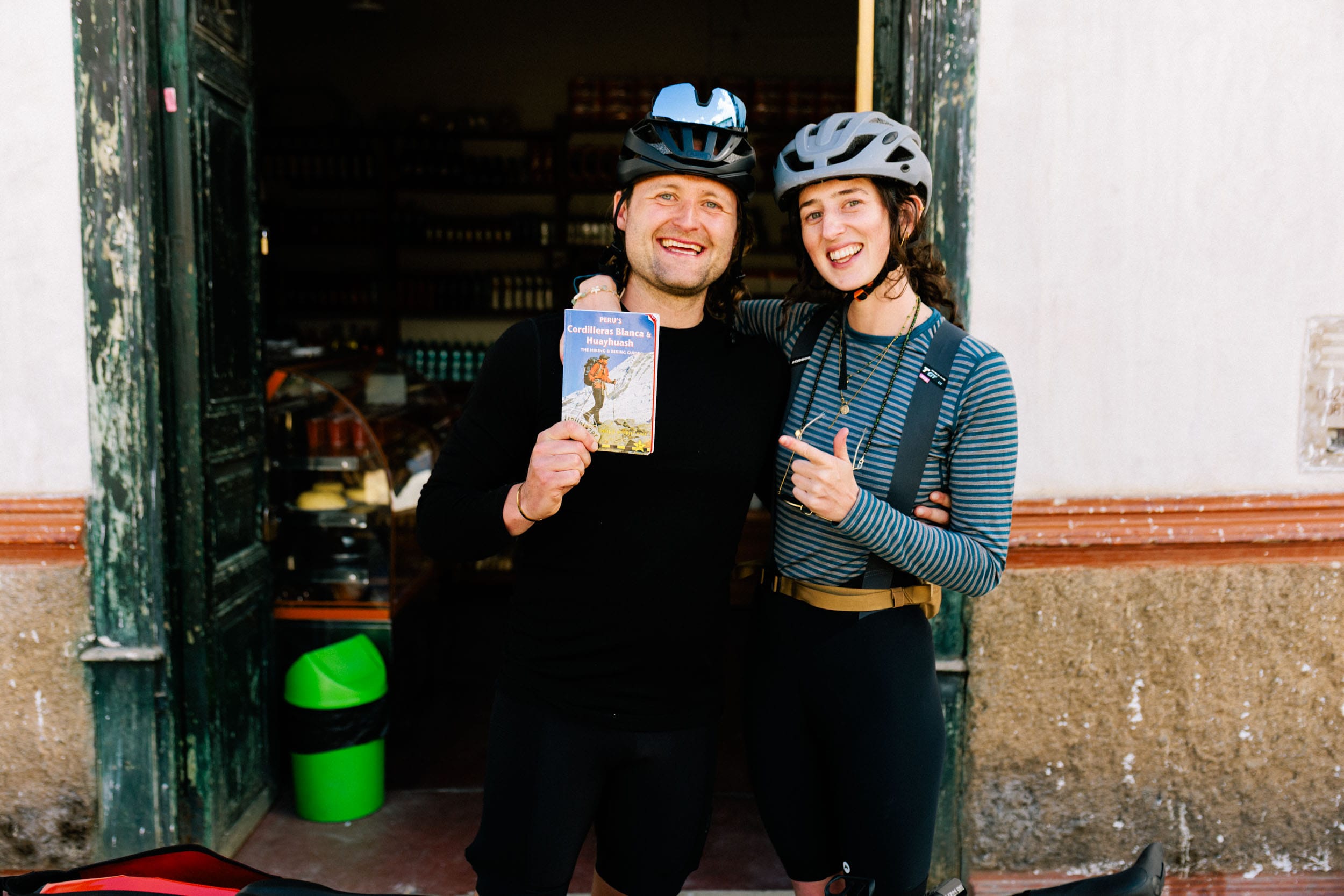
For more info about this route, and the area in general, check out the Pikes’ comprehensive Peru’s Cordilleras Blanca & Huayhuash – The Hiking & Biking Guide. It’s packed full of advice and well worth buying if you’re planning to spend a few weeks in the Cordillera Blanca.
Chris’s Complete Pack List for the Huascaran Circuit and the PGD
I have to admit that my pack lists can be a little unconventional. For instance, I love locally made woolly items like hats and socks, no matter how bulky they are, and I’ll often ride in a cotton T-shirt! With this in mind, I’ve included Chris’s more minimal pack list, honed and tested on both this loop and the Peru Great Divide. Packing light makes a significant difference to riding in the Peruvian Andes, particularly given the combined length of these routes. It’s easy to tire yourself out if you’re carrying more than you really need, especially at elevation. I’ll let Chris take over from here.
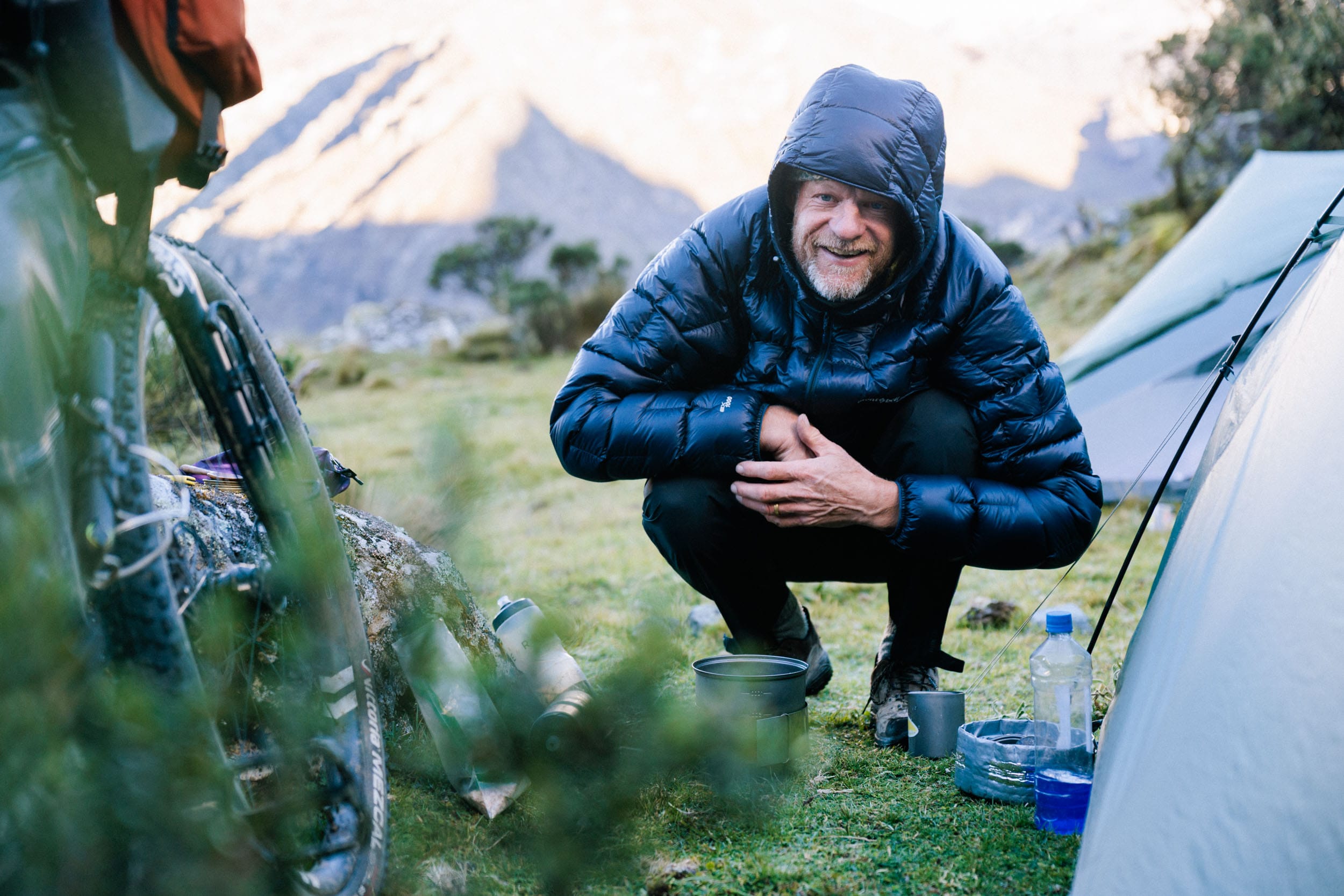
The Durston X-Dome 1+ and Victorinox 4.5” folding serrated paring knife were amongst my favourites in Chris’s pack list.
“I learned two big lessons from doing an acclimation loop around the Huascaran circuit with Cass. One, no matter how well acclimatised you are, climbing at PGD altitude is really hard. Especially day after day. I really didn’t want to pedal any more than absolutely necessary up what can be 25 kilometres long, unrelenting, loose, technically challenging, and brutally steep climbs at very high altitude. And two, when I really boiled my kit down—the actual essentials turned out to be a much smaller list than I’d first designed from the comfort of my kitchen…”
Sleeping
- Durston X-Dome 1+ plus pegs and guy lines
- Neve Gear Waratah -8C comfort quilt (Very light, warm and much less bulky than a sleeping bag)
- Nemo Tensor all-season inflatable mat
- I also have 4 sections of a folding foam mat that I use to sit on in camp, and put under the hip area of my Nemo Tensor at night on cold nights.
- Sea to Summit inflatable pillow
- Sea to Summit silk sleeping bag liner to keep my quilt clean.
Eating
- Trangia burner
- Denatured alcohol in whatever bottle it’s sold in
- SS Click stand & wind shield
- Evernew Ti 600 & 900 ml pans
- Ti double-wall insulated mug with lid
- Homemade pot cosy
- 20cmx20cm piece of thin cutting board
- Victorinox 4.5” folding serrated paring knife
- Wooden spoon
- Salt, smoked paprika, harissa in 30ml Nalgene wide-mouth bottles
- Rubber bands to reseal pasta or milk powder packets
- Lighter and backup
- Granite Gear ultra light pencil case to hold it
- Katadyn Be Free water filter and 3L Hydrapak Seeker bladder
Clothes for riding
- One set only! Be a bit smelly and wash when you can
- Merino T
- Rapha trail shorts
- Uniqlo airism undies x2 (luxury!)
- Rohan mistral jacket (It has future-fleece-like lining and a windproof outer. Brilliant!)
- Montbell Plasma 1000 down jacket (Amazing. Super warm, light, packs up to the size of an orange)
- Merino buff
- Wool riding socks x1 pair
- Shoes
- Helmet
- Cap worn under helmet to keep the sun off
- Sunglasses
Camp & Sleeping Clothes
- Long sleeve icebreaker 200 merino top
- RAB micro fleece leggings
- Warm wool socks
Rainwear
- Montbell Versalite rain jacket (Very light, breathable, pit zips, hood goes over my helmet)
- Kathmandu trailhead 2.5 layer rain pants
- Showa Temres 282-02 gloves (Waterproof, breathable, warm. Long cuff, light)
Electronics
- Nitecore NB10000 x2 (one only might be enough)
- Petzl Actik Core head torch
- Garmin 1040 solar
- Garmin InReach messenger
- Shokz headphones
- SRAM battery spare
- SRAM battery charger
First Aid Kit
- For a big trip, include some antibiotics and upset stomach prescription medication.
Toolkit & Spares
- Tubeless sealant top-up
- Chain lube & piece of rag
- OneUp pump and EDC tool kit
- Derailleur hanger
- 2x Tubolito tubes, plus patch kit
- Tyre boot
- Curved needle, strong thread & Rema Tip Top vulcanising glue for sidewall tears
- Gear Aid Seam Grip+WP and Tenacious Tape for patching sleeping mat or tent
- Tubeless plugs
- Spare brake pads
- Spare chain links x2
- Short piece of chain (6 links)
- Tyre lever
- Cable ties
- Selection of spare bolts
- Gerber Dime multi tool for pliers, scissors
- Reading glasses for close work!
Washing
- Toothbrush (I haven’t cut the handle down!)
- Toothpaste
- Contact lens stuff
- Face cloth, which also serves as a teeny tiny towel
- Earplugs
- Suncream
- Toilet roll, zip lock bag, and trowel
The bike
- Ti Curve GMX+
- Curve Dirt Hoop 40mm carbon rims
- Victoria Mezcal 2.6”
- Brooks B17
- Redshift top shelf 70mm riser bar
- SRAM AXS GX Eagle electronic
- 3OT by 52T gearing
Bags
- Wizard Works Shazam – food, sun cream, lube, glasses
- Bikebag dude custom frame bag – tent, mat, pans, head torch, water filtration, tubeless sealant
- TT bag – electronics
- Feed bags – snacks
- Tumbleweed T rack
- Sea to Summit 20L dry bag on top of rack – sleeping bag, clothes, down jacket
- Tailfin fork cargo packs 3L – Rain gear on one side; tools, first aid, and loo tool on the other.
Addendum
After reading this story, Ben told me he and his wife kept up with life in Shirapucro for some time after they left, and another volunteer helped solidify several of the projects they’d began. The kids are grown up now, and he knows that several of them are married, and started their own families. Ben and Katie brought their dog Badger with them back from Peru to live in their off grid house in Pennsylvania, and he’s still alive and kicking. “Katie says I still eat like a Peruvian. Except for potatoes. I had to take a break from those for while…”
And what about the bike co-op? “It lived on for a few years after we left, but I imagine it is just a memory now.”
If you’re looking for looking for upcycled bike bags, belts, wallets and more, made by a wonderful individual, you know where to find them! Or, pop into Recycle Bicycle Harrisburg, where Ben volunteers each week.
Further Reading
Make sure to dig into these related articles for more info...
Please keep the conversation civil, constructive, and inclusive, or your comment will be removed.








 English (US) ·
  French (CA) ·