

 14 hours ago
1
14 hours ago
1
PROTECT YOUR DNA WITH QUANTUM TECHNOLOGY
Orgo-Life the new way to the future Advertising by AdpathwayPublished August 21, 2026 09:23AM
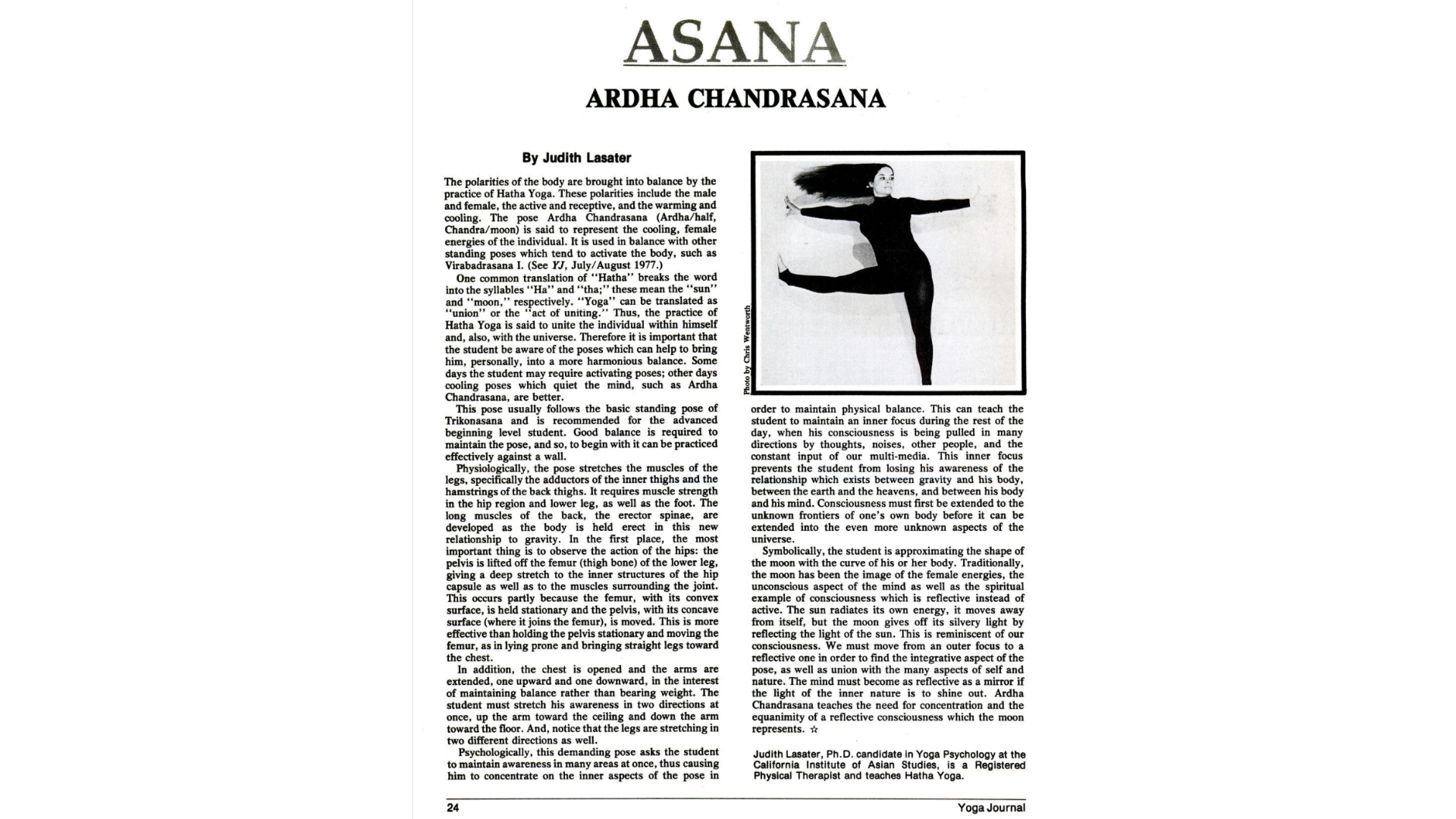
Yoga Journal’s archives series is a curated collection of articles originally published in past issues beginning in 1975. This article about Half Moon Pose (Ardha Chandrasana) first appeared in the November-December 1977 issue of Yoga Journal.
One common translation of “hatha” breaks the word into the syllables “ha” and “tha,” These mean the “sun” and “moon,” respectively. “Yoga” can be translated as “union” or the “act of uniting.” Thus, the practice of hatha yoga is said to unite the individual within himself and, also with the universe.
The polarities of the body are brought into balance by the practice of hatha yoga. These polarities include the male and female, the active and receptive, and the warming and cooling. The pose Ardha Chandrasana (ardha = half, chandra = moon) is said to represent the cooling, female energies of the individual. It is used in balance with other standing poses, which tend to activate the body, such as Virabadrasana I (Warrior 1).
Therefore it is important that the student be aware of the poses which can help to bring him, personally, into a more harmonious balance. Some days the student may require activating poses; other days cooling poses which quiet the mind, such as Ardha Chandrasana, are better.
Finding Balance in Half Moon Pose or Ardha Chandrasana
Physiologically, the pose stretches the muscles of the legs, specifically the adductors of the inner thighs and the hamstrings of the back thighs. It requires muscle strength in the hip region and lower leg as well as the foot. The long muscles of the back, the erector spinae, are developed as the body is held erect in this new relationship to gravity.
The most important thing is to observe the action of the hips: the pelvis is lifted off the femur (thigh bone) of the lower leg, giving a deep stretch to the inner structures of the hip capsule as well as to the muscles surrounding the joint. This occurs partly because the femur, with its convex surface, is held stationary and the pelvis, with its concave surface (where it joins the femur), is moved. This is more effective than holding the pelvis stationary and moving the femur, as in lying prone and bringing straight legs toward the chest.
In addition, the chest is opened and the arms are extended, one upward and one downward, in the interest of maintaining balance rather than bearing weight. The student must stretch his awareness in two directions at once, up the arm toward the ceiling and down the arm toward the floor. And, notice that the legs are stretching in two different directions as well. This pose usually follows the basic standing pose of Trikonasana (Triangle Pose) and is recommended for the advanced beginning level student. Good balance is required to maintain the pose, so to begin, it can be practiced effectively against a wall.
Psychologically, this demanding pose asks the student to maintain awareness in many areas at once, thus causing him to concentrate on the inner aspects of the pose in order to maintain physical balance. This can teach the student to maintain an inner focus during the rest of the day, when his consciousness is being pulled in many directions by thoughts, noises, other people, and the constant input of our multi-media. This inner focus prevents the student from losing his awareness of the relationship which exists between gravity and his body, between the earth and the heavens, and between his body and his mind. Consciousness must first be extended to the unknown frontiers of one’s own body before it can be extended into the even more unknown aspects of the universe.
Symbolically, the student is approximating the shape of the moon with the curve of his or her body. Traditionally, the moon has been the image of the female energies, the unconscious aspect of the mind as well as the spiritual example of consciousness which is reflective instead of active. The sun radiates its own energy, it moves away from itself, but the moon gives off its silvery light by reflecting the light of the sun. This is reminiscent of our consciousness. We must move from an outer focus to a reflective one in order to find the integrative aspect of the pose, as well as union with the many aspects of self and nature. The mind must become as reflective as a mirror if the light of the inner nature is to shine out. Ardha Chandrasana teaches the need for concentration and the equanimity of a reflective consciousness which the moon represents.








 English (US) ·
  French (CA) ·