

 1 day ago
1
1 day ago
1
PROTECT YOUR DNA WITH QUANTUM TECHNOLOGY
Orgo-Life the new way to the future Advertising by Adpathway Deer Valley Resort, photo: Jim Cummings
With bike park operations at Park City’s Deer Valley kicking off this week, locals and visitors alike will need to look out for a new fee: the bike trails at Deer Valley are no longer “free” to pedal up. Those preferring to climb rather than ride a chairlift will now need to buy a “pedal pass” for either a day or the whole season.
Was pedaling up ever actually allowed at Deer Valley?
Park City’s trail map could be described as spaghetti thrown at a wall. The area has hundreds of miles of trails, running through both private (resort) and public (city) land. However, due to the interconnectedness of the trails, it is incredibly difficult to distinguish between trails that are private and those open to the public.
Further adding to the confusion, access at Deer Valley can get a little tricky. While the resort has a bike park with designated downhill trails, it also has an extensive XC trail system. Many of these trails are multi-use and open to the public for hiking or biking, a free service Deer Valley provides. Some of them fall outside the bike park boundary; others fall within it. Though Deer Valley owns these trails, they can feel like public trails.
But they were never intended to be “pedal up,” bike park access trails.
“We’ve never really allowed people [to pedal up],” Steve Graff, Vice President of Mountain Operations at Deer Valley, told Singletracks. “How we’ve done it traditionally is through directionality of trails. So if you’re riding a trail in its proper direction, you can’t get to the top.”
But that didn’t stop everyone. While people may not be pedaling up a clearly marked downhill trail, cutting over from one trail to another wasn’t out of the question. Graff specifically noted the aforementioned Deer Crest trail as a popular trail to “cut over” into the bike park. Deer Crest connects to Mid Mountain, which runs fairly close to popular DH bike park trails such as Undertow. While riders technically should be continuing on their XC adventure, he said it isn’t uncommon for riders to cut over to Undertow and ride the final portions of the trail–nearly two miles and 700 feet of descending.
Although “pedaling up” was never allowed, access restrictions were never heavily enforced. But, as Park City has grown as a mountain bike destination, Deer Valley is now choosing to address a growing problem.
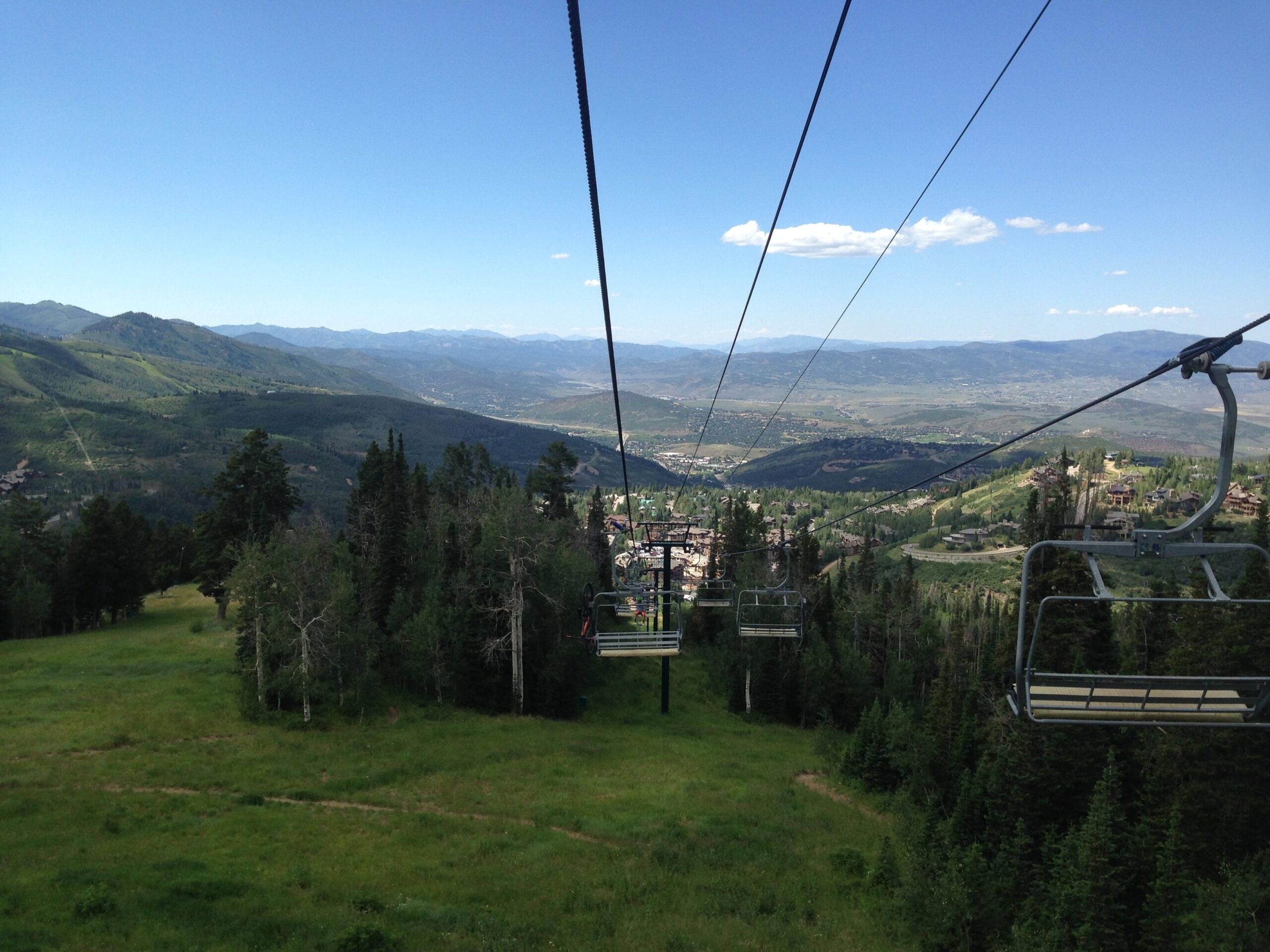 Why pay for a lift ticket when you can cut over from an XC trail? Photo credit: Greg Heil
Why the change?
Graff gave two reasons for Deer Valley’s new pedal pass. The first reason was increased usage and demand. As you might imagine, more and more people using the trails means an increased need for trail maintenance.
So, turn to the local trail organization, right? Wrong. Deer Valley’s trails are, well, Deer Valley’s. They don’t receive maintenance help from other trail advocacy groups, like Park City’s Mountain Trails Foundation, despite quite a bit of user crossover.
“The comments I get are, like, ‘oh, well, Mountain Trails maintains all these.’ No, they don’t,” Graff said. “What we’re trying to do is get people to understand that there’s no trail organization.”
There is a good chance that you are a member of your local trail organization. Each year, you renew your membership, paying perhaps $100 to the organization that builds and maintains your local trails. While it is likely only a small percentage, membership fees can and do help fund trail maintenance every year.
At Deer Valley, though, trail building and maintenance is typically funded through lift ticket sales. And with many riding the trails without buying a ticket, funding necessary trail work was becoming more difficult.
Graff mentioned that their trails builds typically cost around $100,000 per mile. With many of Deer Valley resort trails stretching a few miles, it isn’t uncommon for a flow trail to cost $300,000 to build.
“And then we spend $150,000 a summer maintaining them.” Rather than viewing the pedal pass as just another bike park fee, Deer Valley hopes riders will see it as similar to supporting a trail organization.
The other reason Deer Valley is instituting the pedal pass is over safety concerns. Especially with Park City being such a major tourist attraction, Graff has mentioned incidents of people getting in over their heads in the bike park. They set off on a mellow pedal trail like Tour de Homes and decide to take a different route down, perhaps unaware that a bike park DH trail is very different from a winding XC route.
The pedal pass
Deer Valley officially opens on June 19th, the same day the pedal pass goes into effect. The pedal pass is either $12 for the day or $50 for the season. Graff pointed out, however, that current bike park pass holders receive a pedal pass as a part of the package.
The pedal pass will cover four uphill routes. The first two, Tour de Homes and Deer Crest, start at Deer Valley’s main lodge and extend up near the termination of the Silver Lake Express chairlift. Tour de Homes is on the western side of the park, while Deer Crest, which connects to Mid Mountain, is on the eastern side.
The other two climbing routes are access roads leading to the summits of Bald Eagle Mountain and Bald Mountain. Graff said these likely don’t appear on any trail maps (at least for now), but the routes will be clearly marked on the pedal pass.
E-bikes will be allowed on the uphill routes.
As for the pedal pass itself, Graff said it is very similar to a lift pass, and riders should expect to be asked to show it. Those who don’t want to stop can display their pedal pass on the front of their bike with a “velcro hanger” courtesy of Deer Valley.
The Fox US Open of Mountain Biking will be held at Deer Valley September 11–13, 2026. Spectating for the event, which includes the final round of the Pro DH Series and the US National Mountain Bike Championship, will be free and open to the general public.









 English (US) ·
  French (CA) ·