

 9 hours ago
1
9 hours ago
1
PROTECT YOUR DNA WITH QUANTUM TECHNOLOGY
Orgo-Life the new way to the future Advertising by AdpathwayPublished August 31, 2026 03:53PM
Hope is easy to confuse with certainty. Many of us hope that something will happen, that a difficult situation will eventually become easier, that life will unfold according to our plans. But yoga has taught me a different kind of hopefulness, one that does not require us to know what happens.
My kind of hopefulness does not mean pretending that everything will be okay. It means remaining curious about what might still be possible. Because we can acknowledge uncertainty, disappointment, grief, or fear and still leave space for life to surprise us.
In Patanjali’s Yoga Sutras, we encounter the concepts of abhyasa and vairagya, which are practice and non-attachment. This means we continue to show up, to practice, to participate in our lives, while slowly loosening our attachment to a particular outcome. For me, there is something profoundly hopeful in that balance.
We experience this in yoga all the time. We do not need to decide beforehand what our bodies can or cannot experience. Instead, we become curious. We remain present and offer ourselves options, explore different relationships with movement and breath, and allow the practice to meet the version of us that is actually there in that moment.
Perhaps we can approach the future in the same way. Rather than forcing life toward one particular shape, we participate in what is. We practice, make decisions, take action, rest when needed, and remain open to possibilities we can not yet imagine.
This is where hopefulness becomes a practice. It is not passive waiting. It is the willingness to keep showing up without demanding to know whether or how things will turn out. Yoga reminds us to return to the present moment, but being present does not mean turning our backs on the future. It means meeting today with enough awareness, courage, and compassion that tomorrow has somewhere upon which we can build.
We don’t need to know what lies ahead to move toward it. Sometimes life gives us light, sometimes it gives us darkness, and most of the time it gives us some of both. So we keep practicing. We keep loving. We keep showing up for the life that is here while leaving the door open for the life that is still coming. Because as long as we are here, breathing, changing, becoming, the story is not finished. There is still something ahead of us.
20-Minute Yoga for Optimism
The world might not be okay, but you can be okay. There is a place inside of you that is always in peace, always hopeful, and we can assess that through yoga.
The following yoga practice reminds you how to embrace the unknown with hopefulness. I adapt yoga to my body, and I would love for you to take these movements and adapt them to your beautiful body and your beautiful self. If anything in the practice doesn’t feel comfortable, you can also visualize the practice or come back to Mountain (Tadasana).
You will be using props, so I would love it if you can have a small pillow, a bolster or large pillow, 2 blocks, and an extra chair within reach.
Centering
 (Photo: Rodrigo Souza)
Sit up straight and tall in Mountain Pose, raise your sternum a little, and soften your shoulders. Start breathing more consciously. If it’s comfortable for you, close your eyes or take a soft gaze to the floor in front of you. Bring yourself back here, noticing how you feel, non-judgmentally, and also recalling a time in your life when you felt really hopeful. Notice how you felt and which sensations were present back then. Let yourself be curious about how you felt.
Visualize a warming, glowing light, and immerse yourself into that light of hope. Notice how you’re breathing, and with each exhalation, soften yourself a little more and let yourself come back to your beautiful self, filled with joy, gratitude, and hope.
Gently bring yourself back to the moment, open your eyes, and maybe have a little smile.
Neck Stretches
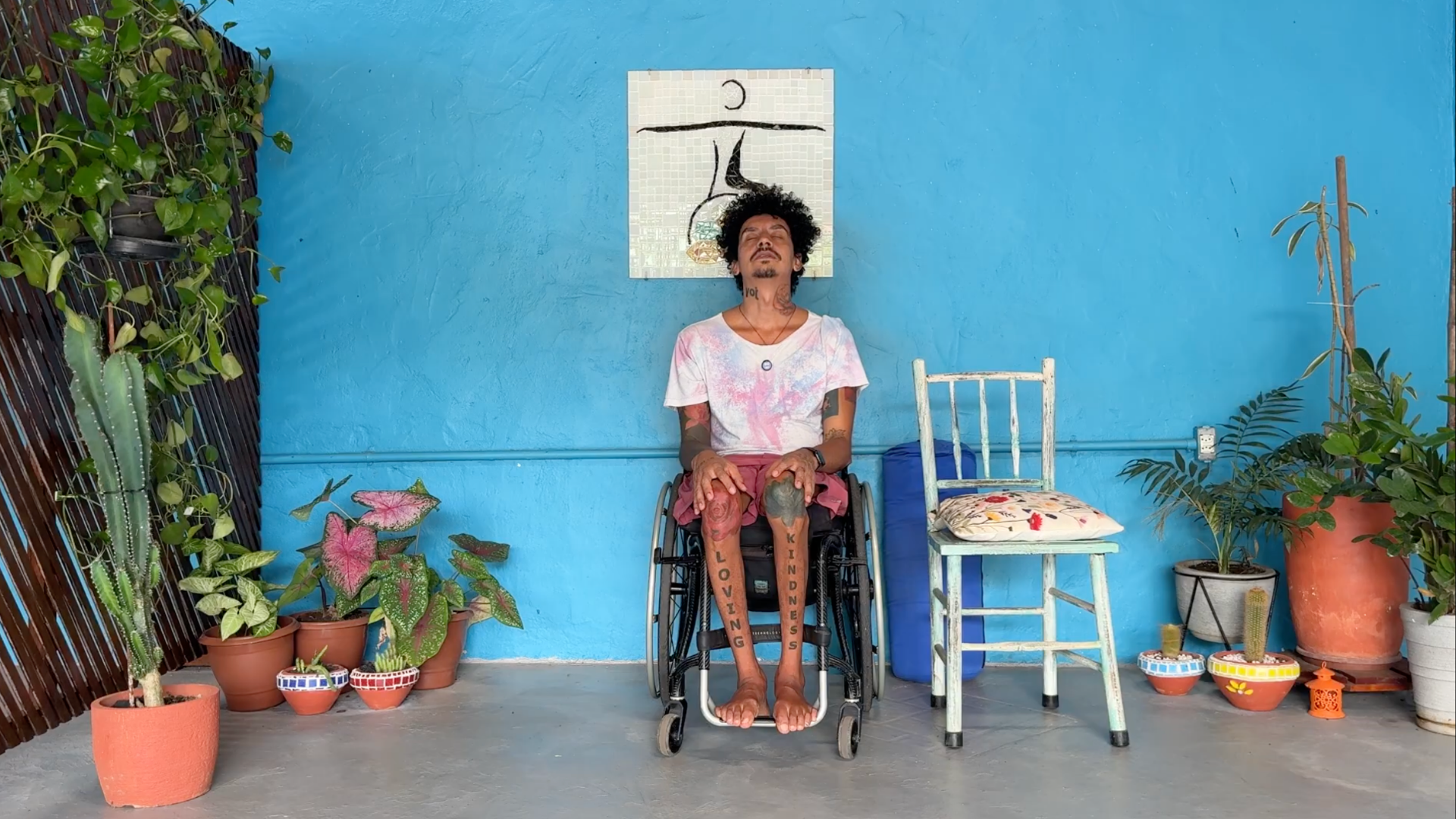 (Photo: Rodrigo Souza)
We are going to add some mindful movements. I would love for you to synchronize them with your breath, if that is available to you. We’re going to sit up straight and tall, and start with some neck movements. Ground yourself in Mountain Pose. Inhale, raise your head, and tilt your chin a little toward the ceiling, but only as far as is comfortable for you. Try not to drop your head too far back. Exhale long and soft as you bring your chin toward your chest.
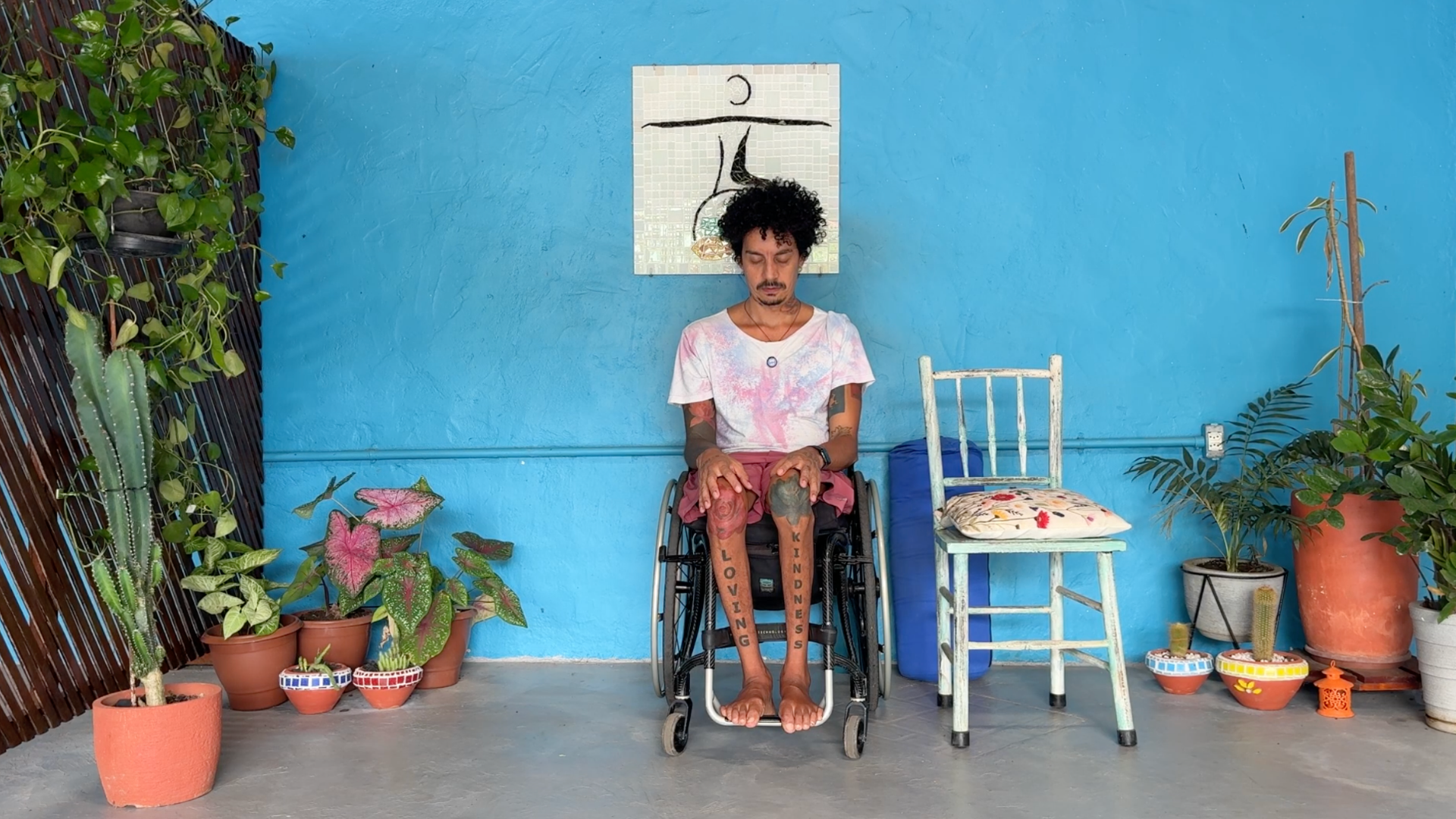 (Photo: Rodrigo Souza)
Hold here as you inhale and exhale once more. I like to inhale through the nose and exhale through the mouth, but be my guest to do whatever feels comfortable for you.
Bring your head back to center, back to the midline, and do the same thing horizontally. So ground yourself through your sitting bones. Inhale as you gaze over your right shoulder.
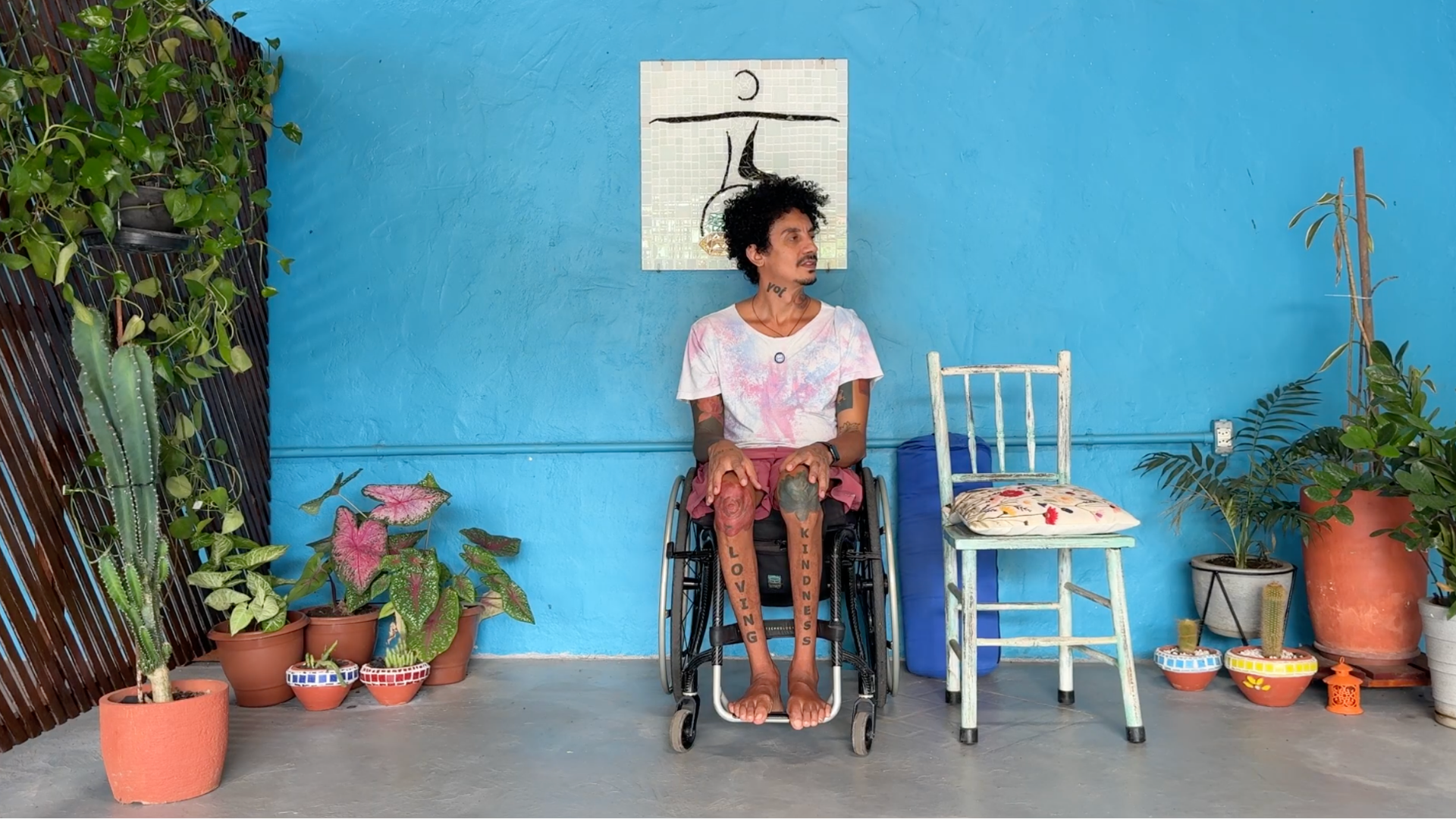 (Photo: Rodrigo Souza)
Then exhale long and soft through the mouth as you turn to gaze over your left shoulder.
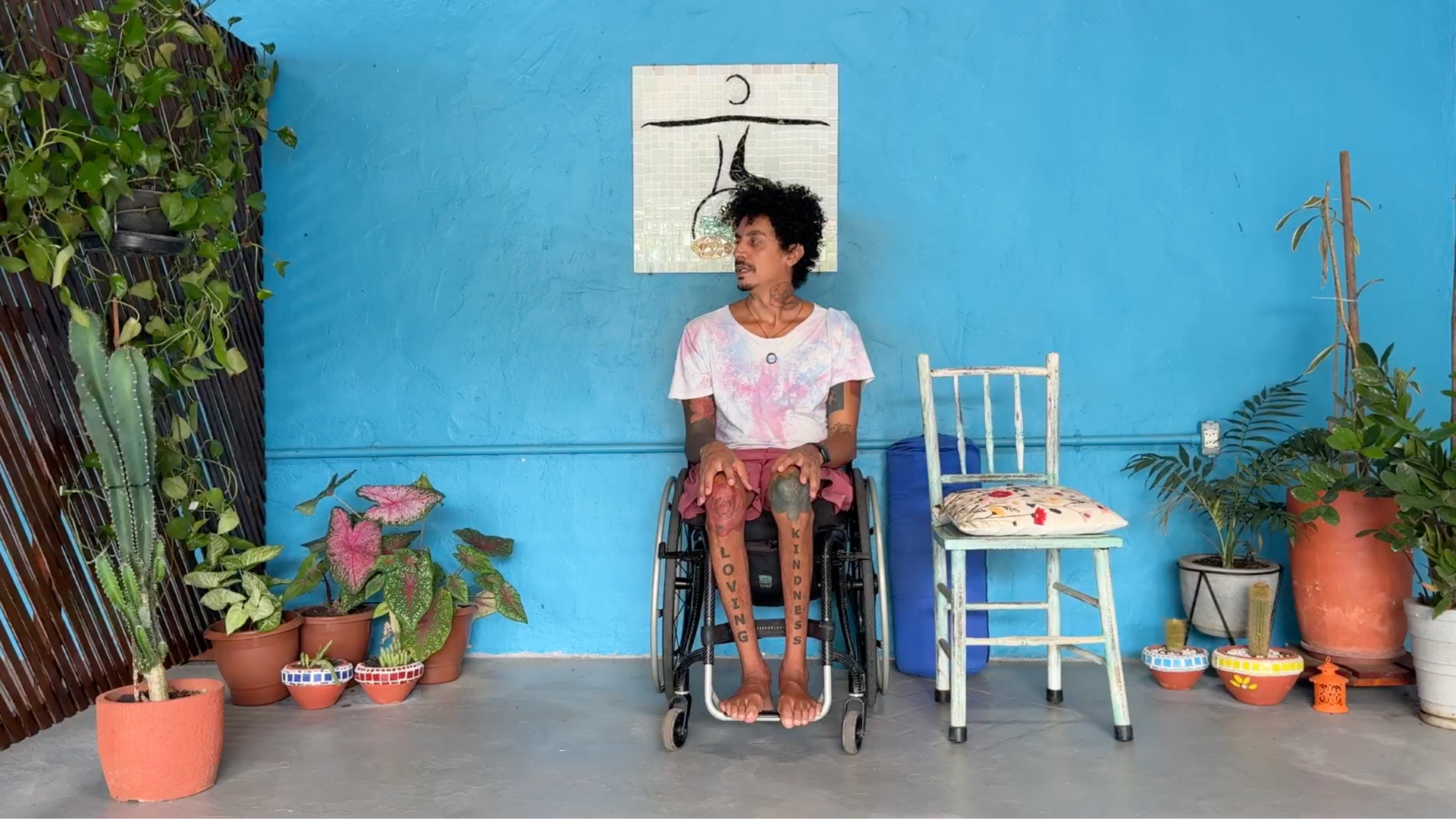 (Photo: Rodrigo Souza)
Do that one more time as you go again. Beautiful. Come back to center and release.
Shoulder Rotations
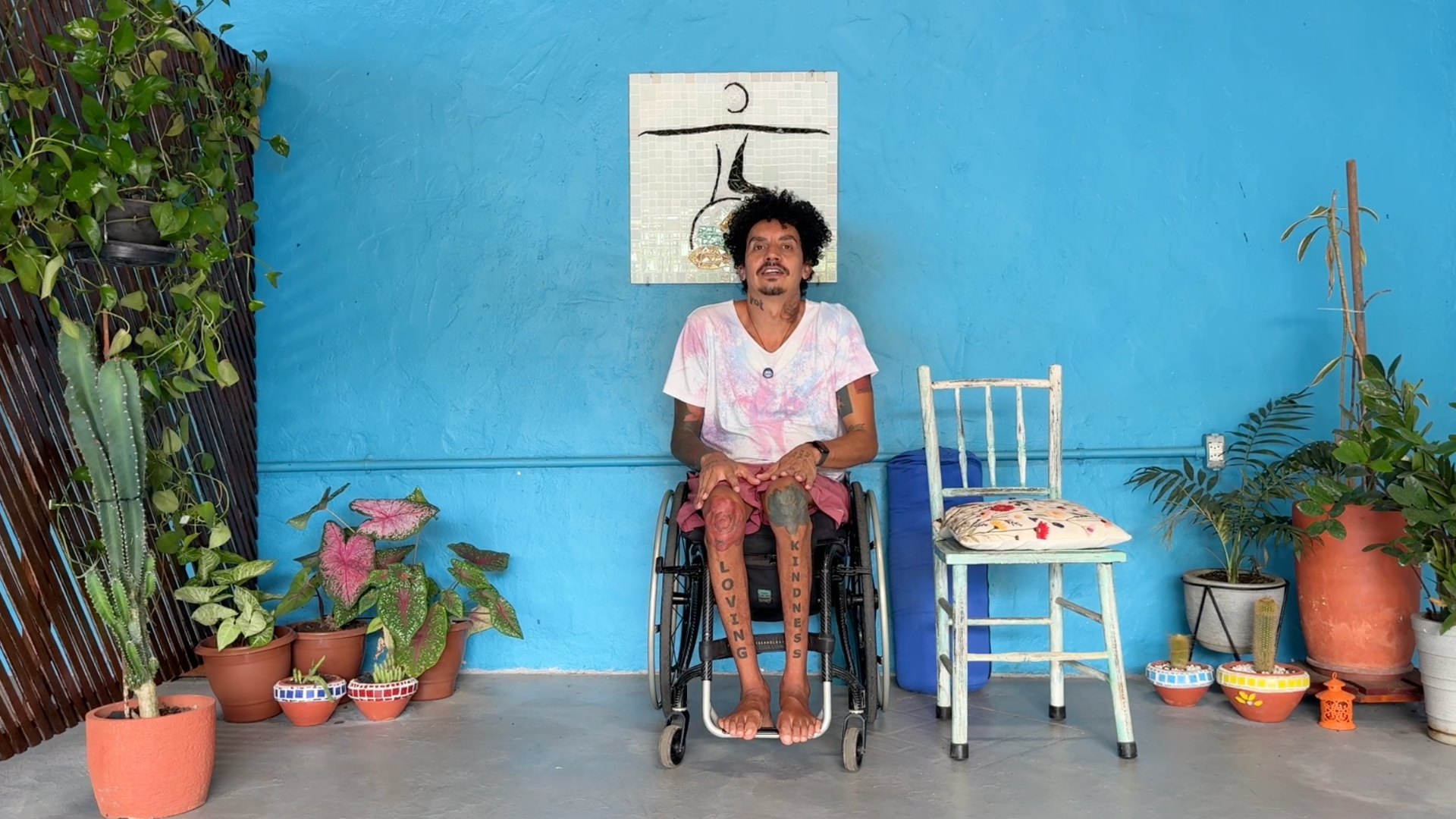 (Photo: Rodrigo Souza)
Keep your palms on your legs and take some shoulder rotation backward. You can synchronize your movement with your breath by taking it 3 times backward and 3 times forward. You can also do 1 shoulder at a time as well if that is comfortable.
Downward-Facing Dog
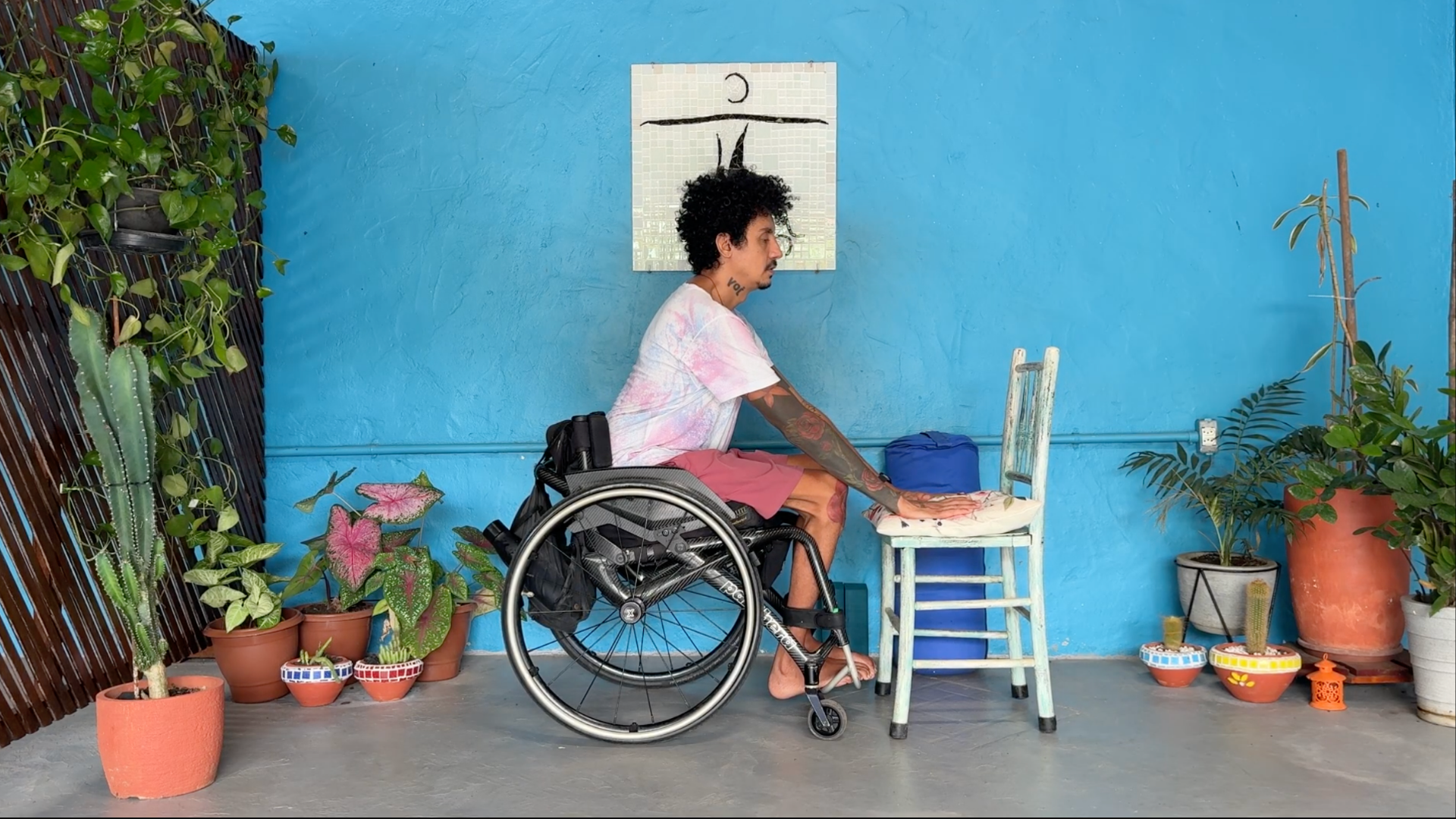 (Photo: Rodrigo Souza)
Give your arms a little shake. Now we’re going to start to use the second chair in a variation of a Downward-Facing Dog (Adho Mukha Svanasana). Okay, first thing we’re going to do is place the extra chair right in front of us, and we’re going to ground ourselves either through our sitting bones or through the feet touching the ground. Then we’re going to place our hands on the chair seat, shoulder-distance apart, and spread your fingers. Walk your hands away from you until it’s comfortable for you and your spine is engaged and elongated. You want to find a place where it’s comfortable for you but also challenging. Stay here and press your inner heels against the floor as you gaze forward. Beautiful. Once in the posture, inhale and exhale.
To spice things up, we’re going to turn the chair around for a bigger stretch on your back. So sit up straight and tall one more time. Ground yourself, bring yourself back to your body, and then hold the back of your chair and see if you can lean forward a little further, placing your ears between your arms, and hold here. Let’s take a collective breath by inhaling and exhaling here.
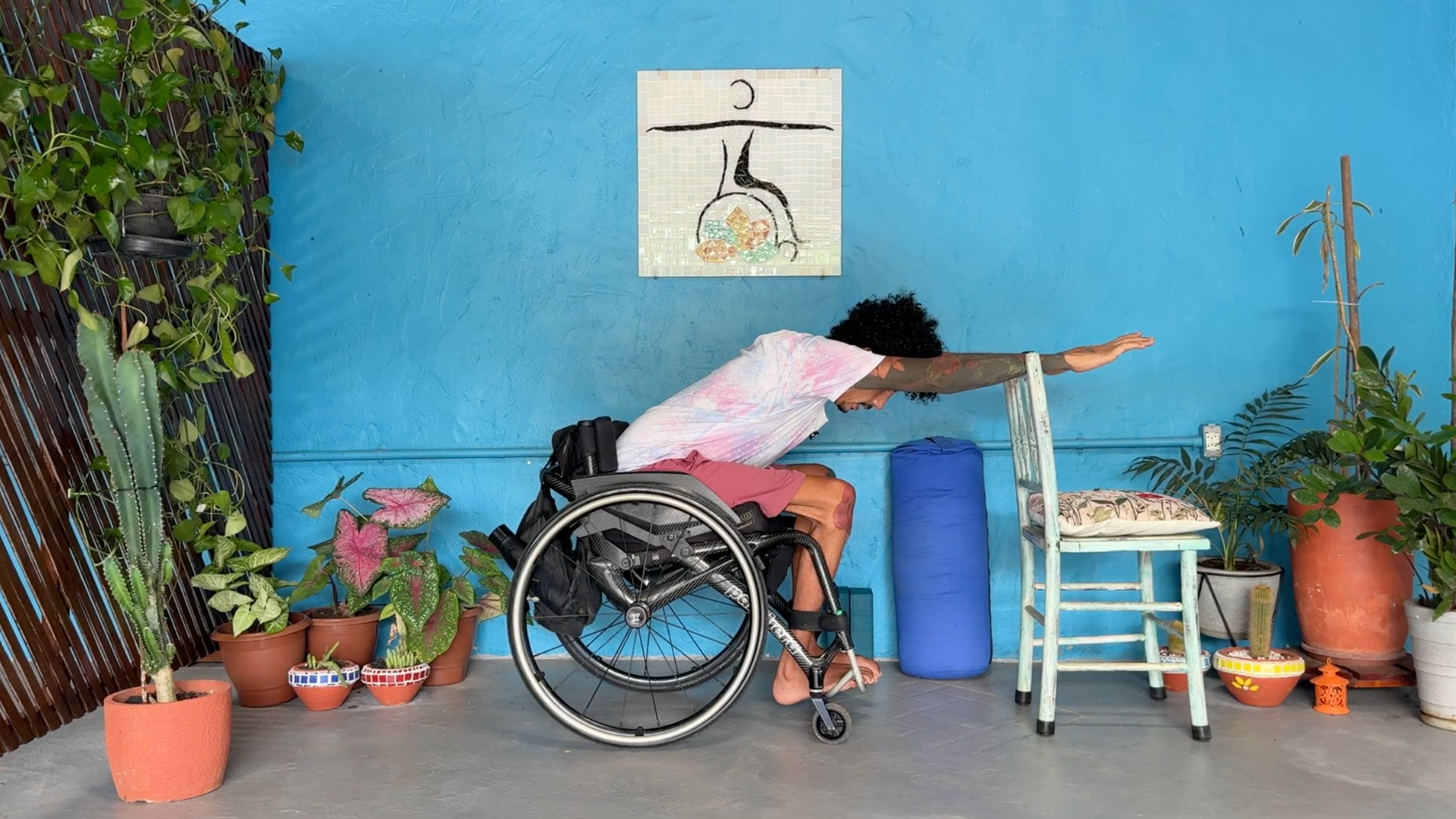 (Photo: Rodrigo Souza)
Bring yourself back to center.
Seated Forward Bend & Twist
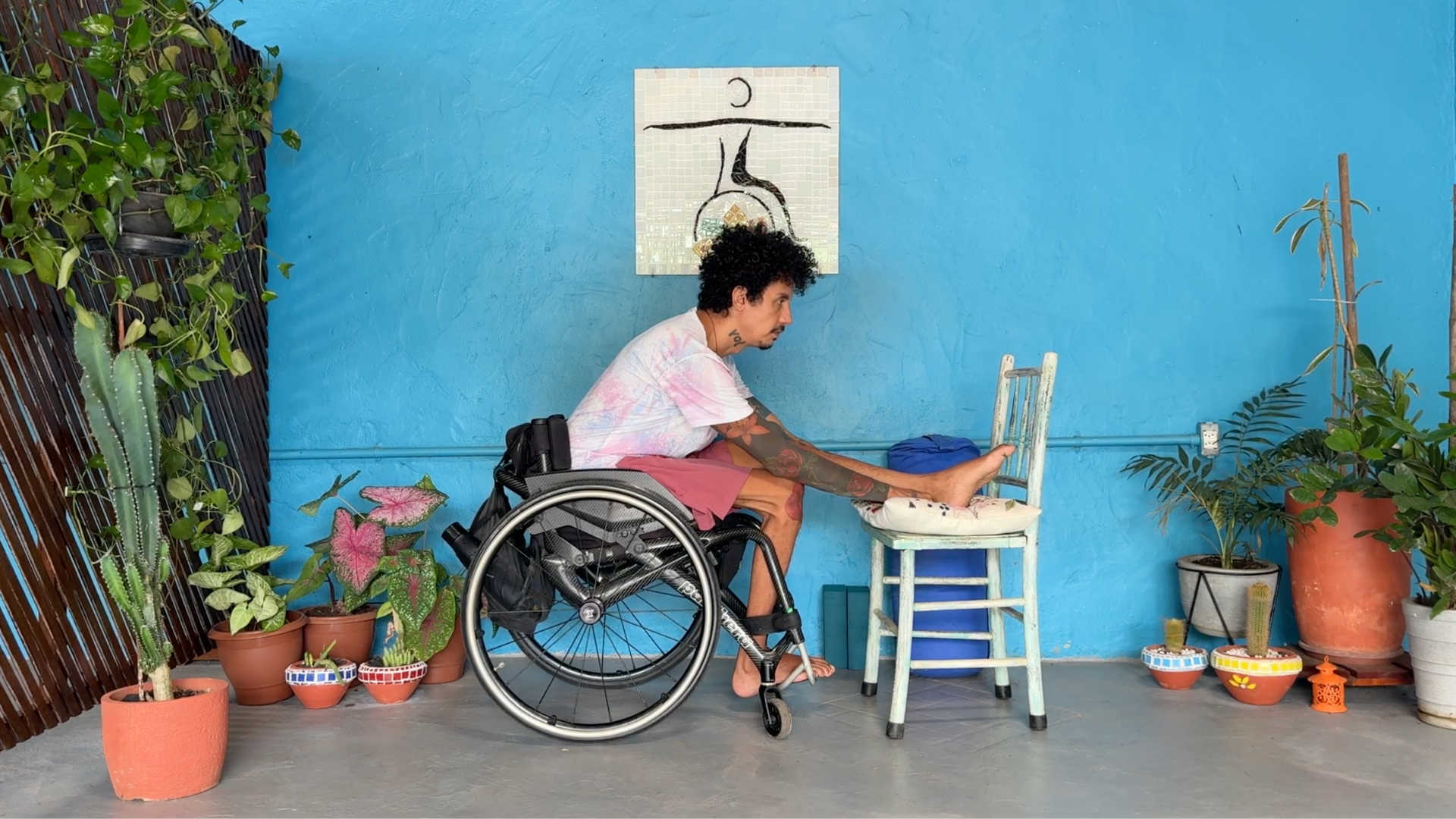 (Photo: Rodrigo Souza)
This is something that I found to be very helpful, especially as a paraplegic, because I don’t get to stretch my legs very often. You can see that they are flexed when I sit. So we’re going to do a variation of Head to Knee Pose (Janu Sirsasana). Turn the chair around again toward you. And gently take your right leg and extend it as you very gently place it on the chair. You’re going to extend your spine, and root yourself with the foot that is grounded on the floor, the left foot. Now get into a forward fold from the hip, not from the spine. Walk your hands toward your leg, toward your ankle, and try to bring your head towards the knee to whatever extent is comfortable. Don’t push yourself. Remember ahimsa.
Once you are in the shape, breathe.
Then we’re going to take a gentle twist. Keep your leg there. Inhale as you raise your arms, exhale as you take your left hand and bring it outside of your right knee and bring your right hand to the back of the chair in which you are sitting. Hold here as you gaze over your right shoulder. Feel the stretch. Notice how you feel as you breathe.
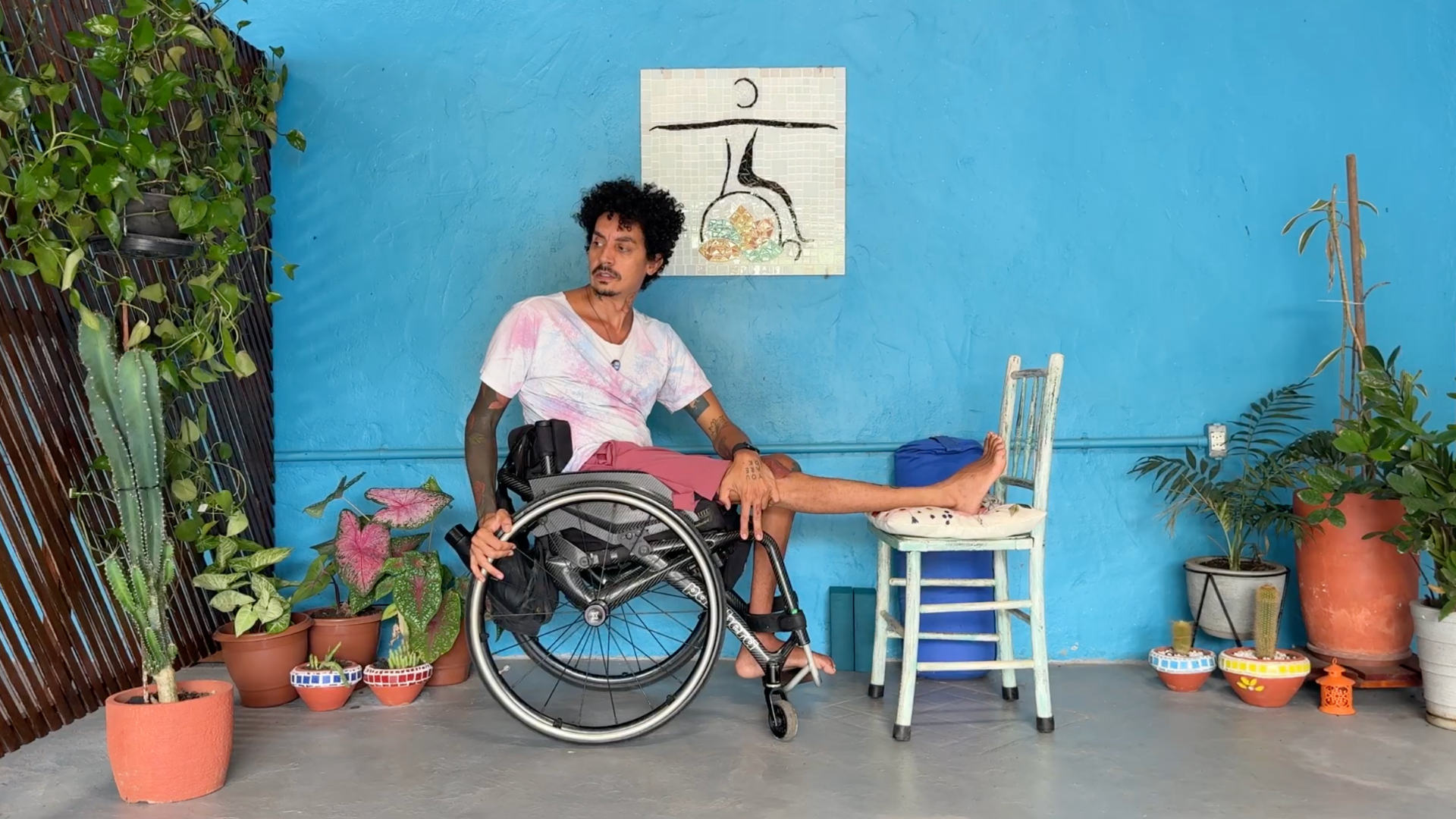 (Photo: Rodrigo Souza)
Bring yourself back to center and release your leg. Then reposition yourself in the chair if you need to, take a little time here to breathe, and we will do the same thing on the other side.
Seated Forward Bend
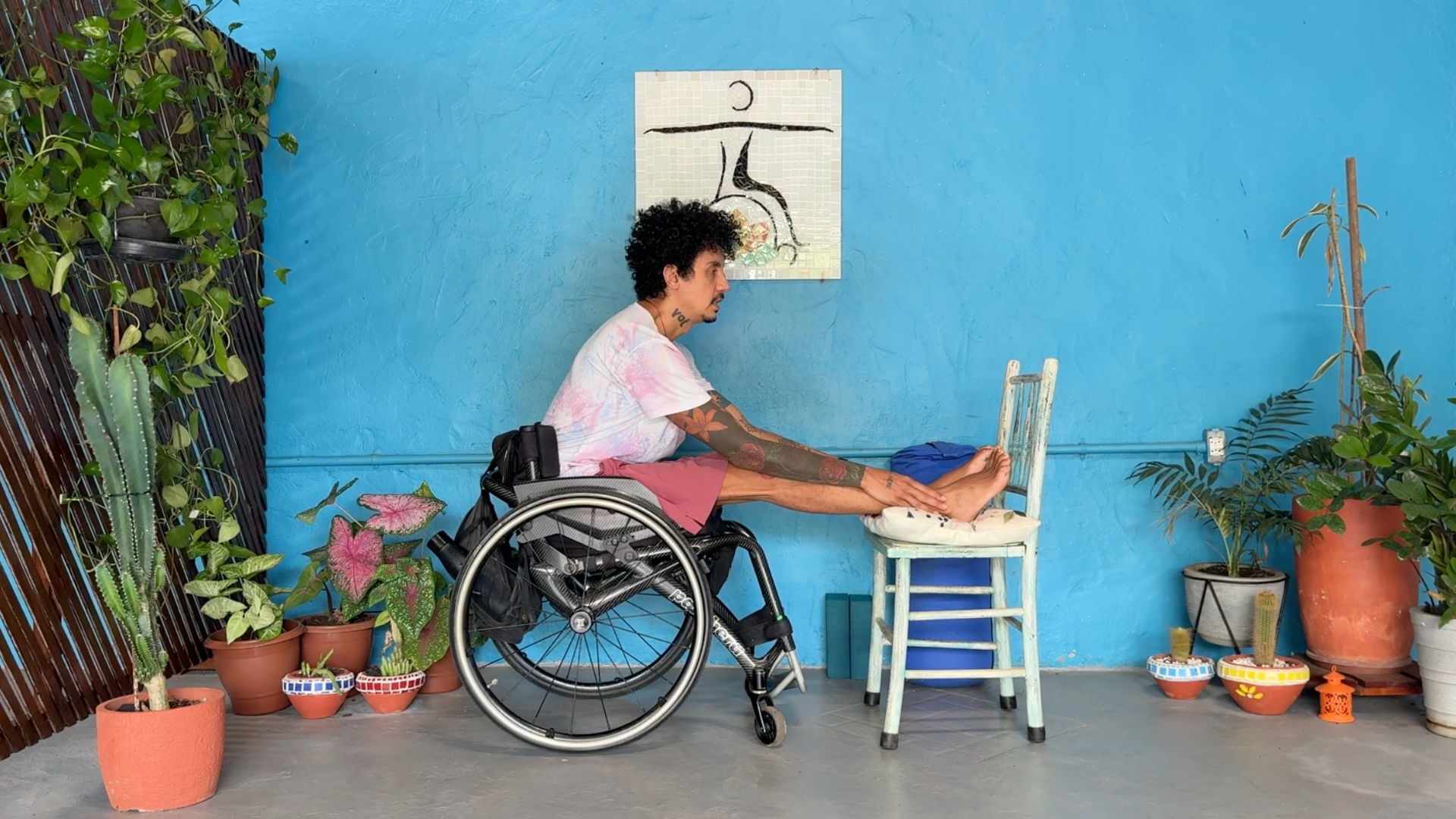 (Photo: Rodrigo Souza)
We’re going to get into a seated, supported forward fold, similar to how we just did but we’re going to do it with both legs. Sit up straight and tall here. Ground yourself through your sitting bones, folks. All right, let’s get into the posture. So we’re gonna walk our hands forward until it’s comfortable for us and forward fold from the hips in a Seated Forward Bend (Paschimottanasana). Remember that we’re not interested in aesthetics and how the posture looks, but rather how it feels. Notice how you feel. Do you feel comfortable? Do you feel conscious? Do you feel that you are in your body? Beautiful. Hold it here. Let’s take a collective breath. Inhale. Exhale. Release the stretch and release your legs.
Seated Side Bends
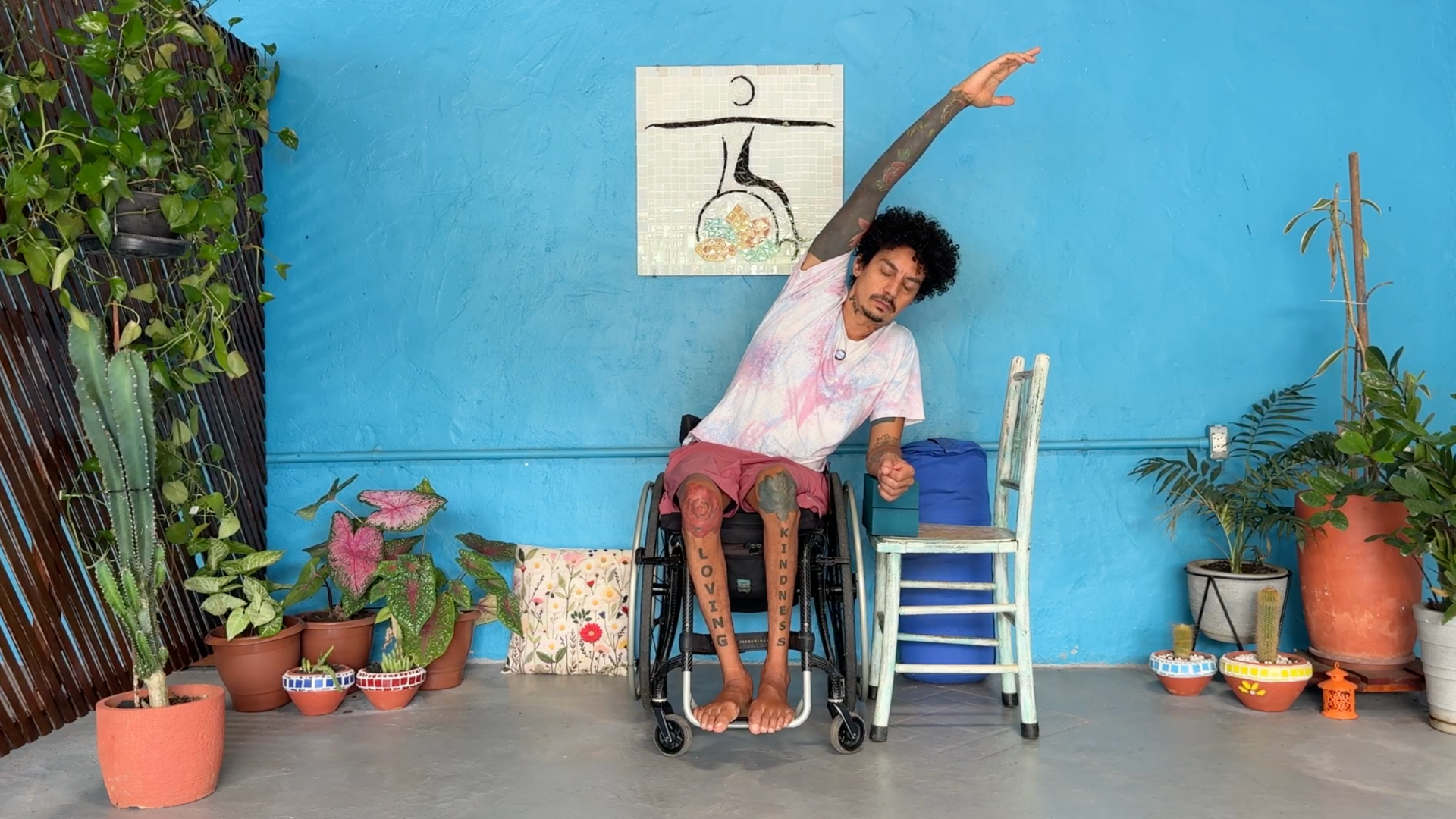 (Photo: Rodrigo Souza)
Now we’re going to get into a side bend.. We’re using the pillow, the blocks, and the second chair, although you can play around with where you place them, as my body is different than yours. So you’re gonna dance with your body.
You can put the second chair alongside your chair. I like to use two blocks on the chair for me to get a good height here. Once these two blocks are here, I ground myself through my sitting bones, sit up straight and tall, and press your feet down as well. Inhale and lean to the side as you place your elbow on the block. Take some lateral flexion here until it’s comfortable for you. Stay here as you feel the stretch along the side of your body. Maybe you try to go a little further. Then we’re going to do the same thing but change sides.
Seated Camel Pose
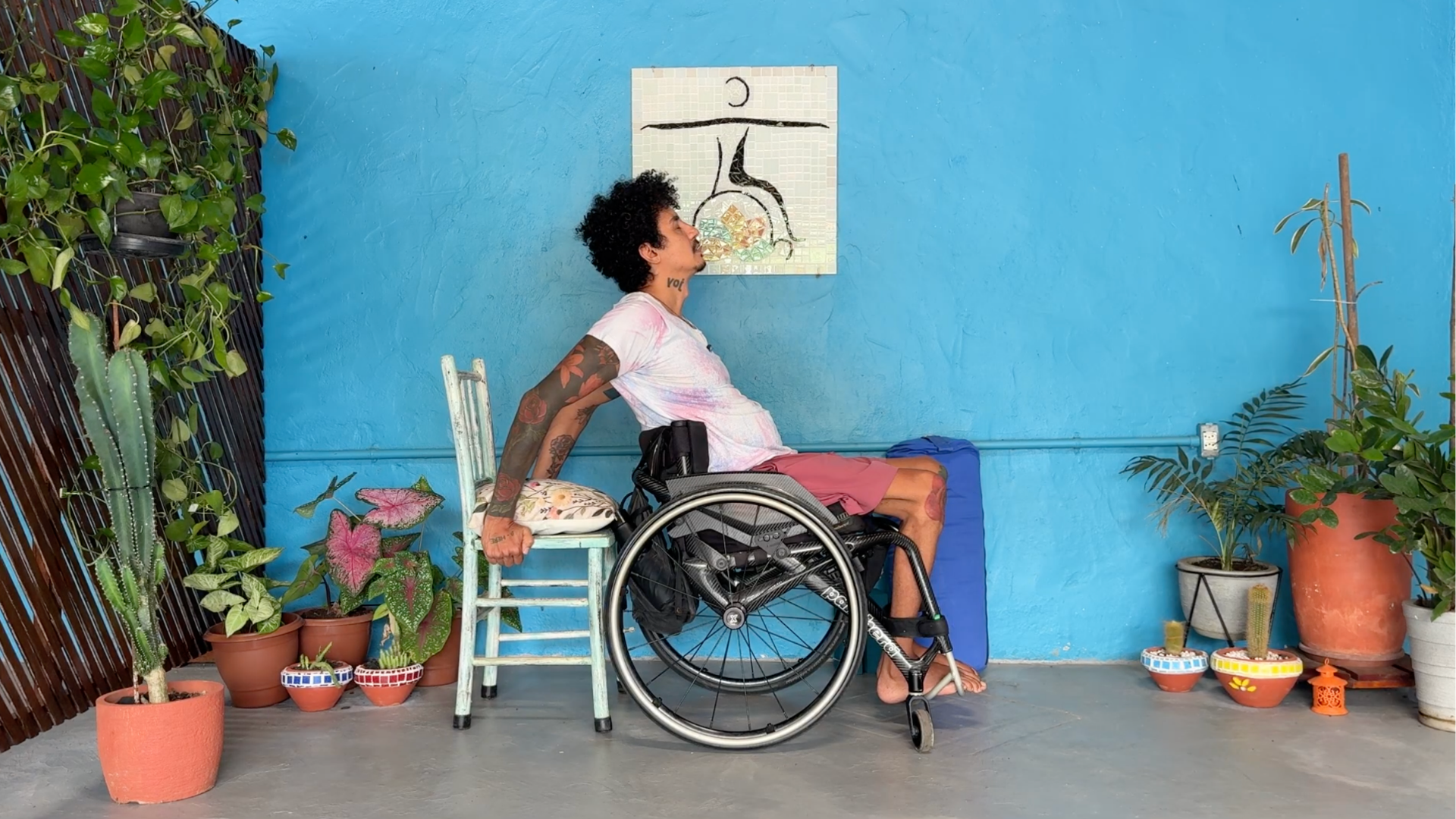 (Photo: Rodrigo Souza)
So we did lateral flexion and forward folds as well as twists in the chair. Now we need to do a backward bend. A variation that I like to do is Camel Pose (Ustrasana) with two chairs. We’re going to place the chair we are sitting in right in front of the second chair. We’re going to gaze forward and sit up straight and tall here. Ground yourself into Mountain Pose. Then we’re going to gently walk our hands backward until it’s comfortable for us as we get into a backbend. So broaden your chest here in a lovely heart opening. Feel the hope inside your heart as you inhale and exhale. Release and come back to center.
Savasana
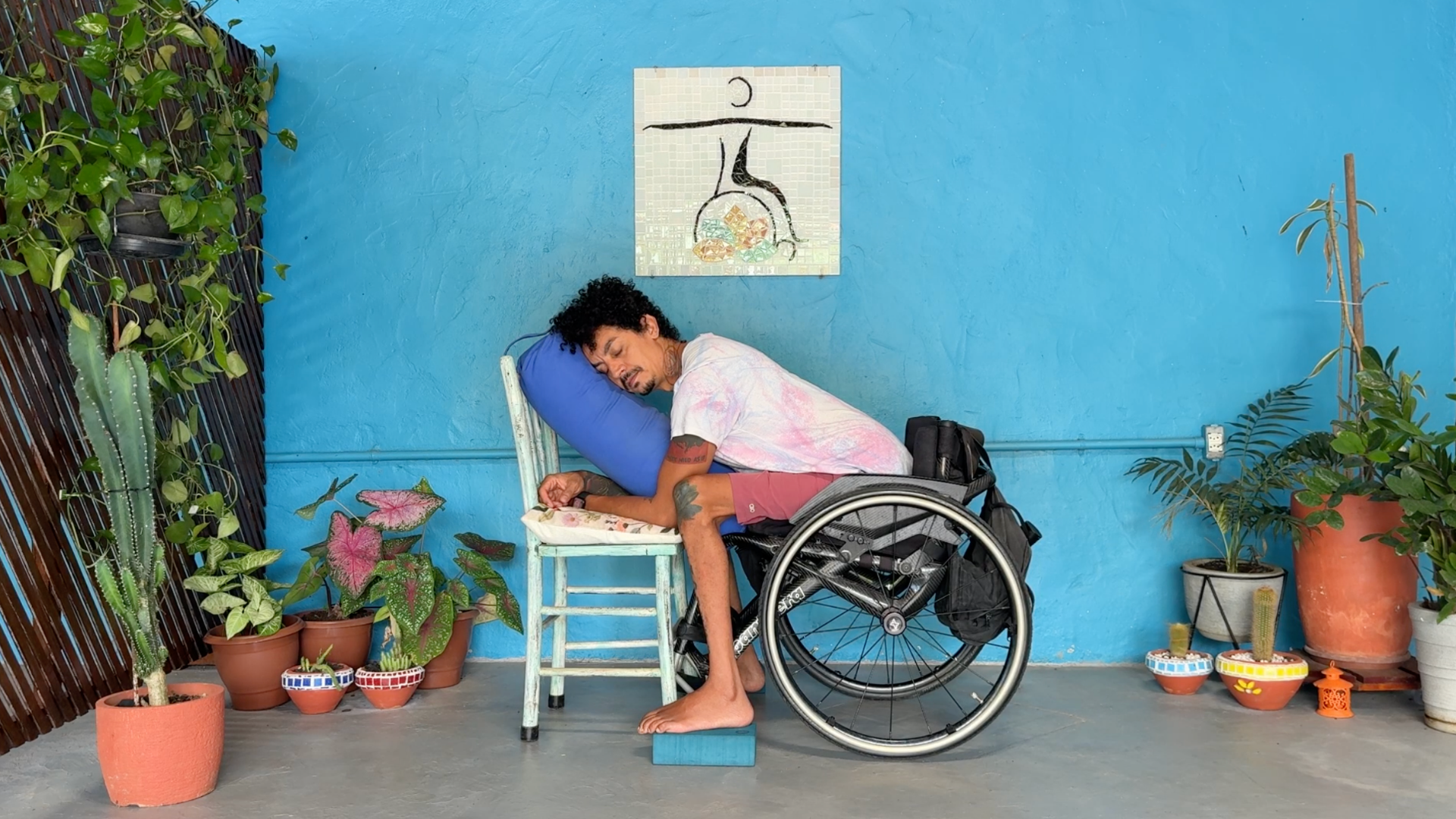 (Photo: Rodrigo Souza)
Now we’re going to go to the la la land of Savasana. We’re going to build a variation that is Supported Child’s Pose (Balasana). We’re going to take a bolster or firm large pillow in front of us. One thing that I like to do is place a block beside each of my front wheels because I’m going to take my feet off my wheelchair foot rest. We’re gonna take the bolster and place it in front of you. Okay. Lovely. Sit up straight and tall, and at your own pace, you’re going to get into a forward fold here, and you’re going to embrace the bolster to help you embrace the future. Embrace the future with hope. Find a place that is comfortable for you so it is a lovely restorative version of Balasana. Let’s take a collective breath here. Inhale. Now turn your head to the other side. Inhale. Soften the tensions in your body. Soften your eyes. Soften your shoulders. Feel hope.
When you are ready, gently bring yourself back to center now. I could stay here forever. Now reposition yourself so you are sitting in the chair. I really hope you enjoyed this class and I really hope that you embrace the future as it comes.








 English (US) ·
  French (CA) ·