

 1 week ago
23
1 week ago
23
PROTECT YOUR DNA WITH QUANTUM TECHNOLOGY
Orgo-Life the new way to the future Advertising by AdpathwayPublished May 27, 2026 10:55AM
Yoga Journal’s archives series is a curated collection of articles originally published in past issues beginning in 1975. This article about arm strength exercises first appeared in the May-June 2004 issue of Yoga Journal.
From carrying things like groceries and babies to lifting packages and suitcases without strain, strong arms make the rest of your life easier, says yoga instructor Leigh Crews. Although yoga might not be the first fitness pursuit that comes to mind when you think of strong arms, some yogis argue that it can tone and sculpt the arms as effectively as traditional arm strength exercises.
Just about any yoga posture in which you place your palms on the floor and use them as a foundation to support your body weight strengthens your arms and shoulders. Standing postures in which the arms must work to resist the downward pull of gravity develop arm strength as well.
The Anatomy of Arm Strength
Many large and small muscles help you curl your fingers, move your hands, flex your wrists, extend your elbows, and lift your arms. For everyday activities, three of the most important are the biceps, the triceps, and the deltoids. The biceps run along the front of the upper arms and are responsible for bending the elbows. The triceps, along the backs of the upper arms, extend the elbows to straighten the arms. The deltoids, which form the outer layer of the upper arms where they meet the shoulders, lift the arms to the sides; they also help lift the arms to the front, extend the arms behind, and rotate the arms inward and outward.
Yoga, however, takes a somewhat different approach than weightlifting does to building arm strength. When you curl a barbell or dumbbell, the biceps muscle contracts and shortens. That’s what physiologists call a concentric (or isotonic) contraction. It builds the explosive strength needed to perform actions such as quickly scooping up a child who is toddling into a busy intersection. If you do “negative reps”—that is, you resist the pull of the weight strongly even as the arm lowers back down to its original position—you’re doing an eccentric contraction, in which the muscle works even as it’s lengthening.
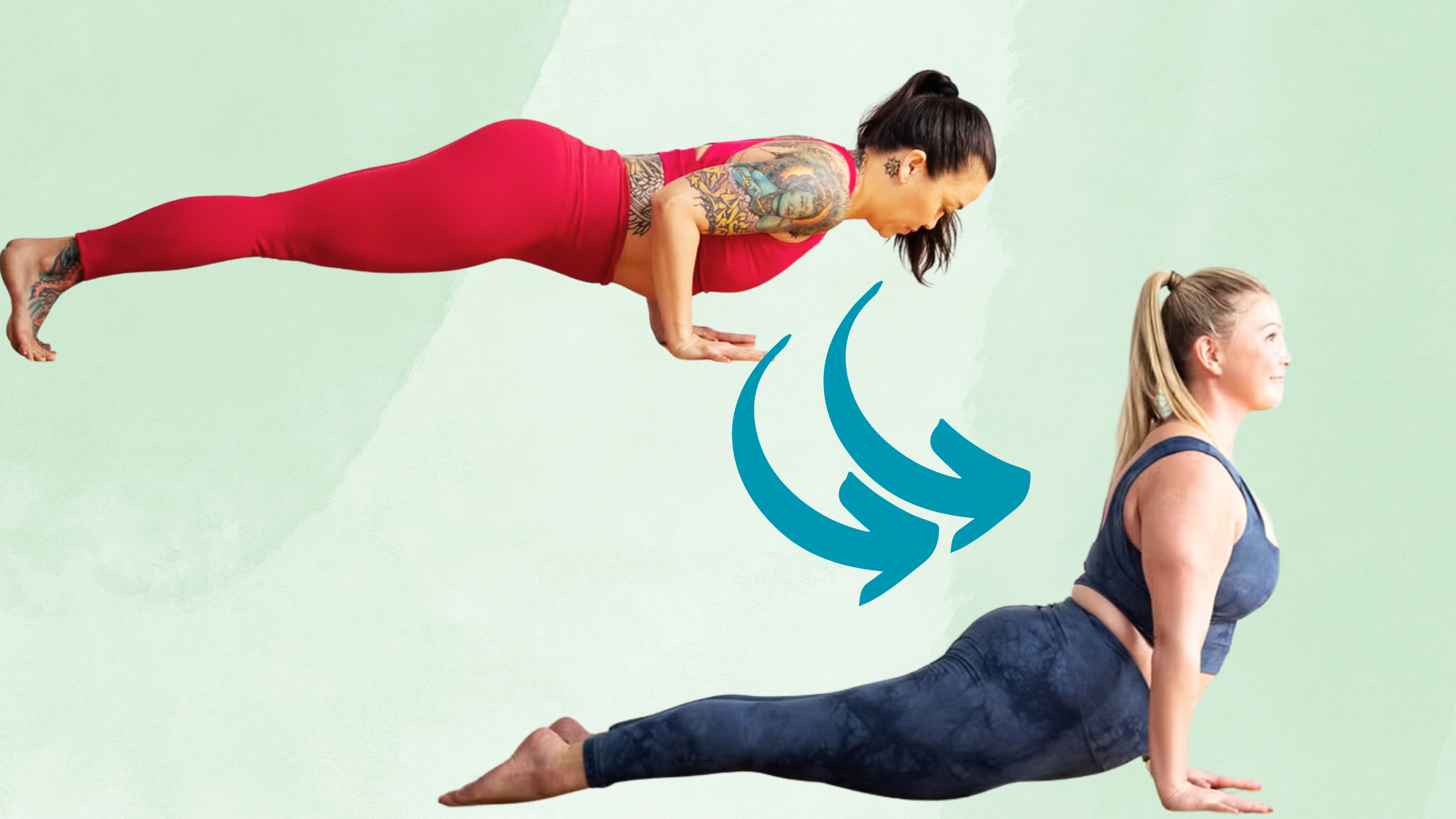
In yoga practice, you engage in both of these types of conditioning when you move from pose to pose, as in the push-up-like movement from Plank Pose to Chaturanga and back. But when you hold postures in yoga, you strengthen your muscles mostly through what’s known as isometric work; that means the muscle is activated but its length remains the same. Isometric work builds the kind of muscle endurance that helps you hold a child in your arms as you wait for the traffic to cease.
If your current yoga practice does not emphasize the upper body, you can change that by shifting your focus within postures you already practice and by adding arm-strengthening asanas to your routine. In standing poses, concentrate on keeping your arms firm and straight, reaching out expansively. And include plenty of poses that challenge the arms, like Plank, Chaturanga, Downward-Facing Dog Pose (Adho Mukha Svanasana), and Side Plank Pose (Vasisthasana).
You can alternate strategies for practicing these poses: One day, concentrate on holding them as long as possible; another day, move in and out of them repeatedly. A traditional version of the latter strategy is a Sun Salutation (Surya Namaskar). There are a number of variations of this series of poses, but most include Plank, Chaturanga, Downward Dog, and Upward-Facing Dog Pose (Urdhva Mukha Svanasana).
As you gain strength, Handstand (Adho Mukha Vrksasana) and Headstand (Sirsasana) also become excellent ways to build even stronger arms and shoulders. (Make sure you learn Headstand from an experienced teacher who can monitor the safety of your neck in the pose.)
Yoga and Weight Training
As a complement to your yoga practice, consider a weight-training routine for the upper body that includes exercises for the front of the upper arms (biceps curls), the backs of the upper arms (triceps kickbacks and presses), and the deltoids (lateral raises, military presses). Make your free-weight session just as meditative as your yoga practice by bringing your awareness inside your body, feeling each muscle contract and relax, and matching your breath to each of your movements, suggests Lauren Eirk, group fitness director at the Louisville Athletic Club in Kentucky and a national fitness and yoga educator.
“Free-weight training is very complementary to the practice of yoga,” Eirk says. Yoga can lengthen the muscles, which in turn gives bodybuilding yogis the potential to lift heavier weights. Conversely, weight lifting helps yogis build the strength needed for challenging postures such as Handstand and more advanced arm balances.
Because weight training requires contracting specific, isolated muscle groups, it also increases body awareness. “When you combine yoga with weight training, it gets easier to stay in poses for a longer period of time and focus on what you want to focus on without thinking, Oh, my gosh, I want to get out of this,” Eirk says.
Muscles need 24 to 48 hours to recover from any strength-building session, whether you’ve worked them in the weight room or on the yoga mat. If you tax your arms and shoulders every day, you may end up tearing and injuring them rather than strengthening them. You’ll have to use a trial-and-error approach to discover just how much downtime between sessions is optimal for you, but in the beginning, it’s a good idea to sequence your workouts so you don’t focus on your arms two days in a row.
Although arm-strengthening exercises can be challenging, rest assured that your body will grow stronger over time, regardless of your fitness level or age, Crews says.
In her yoga classes for seniors, Crews heavily modifies traditional arm-strengthening postures to match the abilities of her students. “Gradually, I show them how they can move from modified versions to the complete pose,” she says. “One day, I saw this lady who is nearly 70 in full Side Plank. Her form was excellent, and she was so proud of herself. There was no way that she could have done that initially. But she worked at it slowly and progressed gradually. Now she can do things she could never have done before.”
4 Poses for Arm Strength
If you’re focused on building stronger arms, these yoga poses double as arm strength exercises.
1. Half Handstand with Wall
How it helps: Strengthens almost all the arm and shoulder muscles.
Half Handstand is a great way to build the power in your arms and core (not to mention the courage and balance) that you’ll need for full Handstand.
How to do it: Sit with your legs straight, feet against a wall. Then turn away from the wall, coming onto your hands and knees with the heels of your hands exactly where your sitting bones met the floor and with your shoulders directly over your wrists. (If your shoulders are fairly tight, you may need to place your hands a tiny bit farther from the wall.)
Walk your feet up the wall until your thighs are parallel to the floor. Press firmly into the floor, lift your hips toward the ceiling, and try to create a strong, straight line running from hands to shoulders to hips. If you can’t keep your arms straight, you can place a yoga strap around your upper arms to hold them in place.
How to stay safe: Draw your shoulder blades away from your ears and keep your neck long and relaxed. If you feel yourself falling, lift your head, bend at the waist and knees, and bring your feet to the ground.
2. Plank Pose to Chaturanga
How it helps: Plank Pose strengthens the chest and entire shoulder girdle (the muscles that stabilize the shoulder blades. Chaturanga strengthens primarily the anterior deltoids (the front of the shoulders), the triceps, and the pectorals (the major chest muscles).
How to do it: Start at the top of a push-up, hands directly under your shoulders. Reach back strongly through your heels and forward through the crown of your head, creating a strong, solid feeling that extends through your whole body. Then, keeping your elbows in close to your ribs, exhale as you slowly bend your elbows until your upper arms are parallel to the floor. Push back up or hold for a few breaths.
How to stay safe: Don’t let your shoulder blades hunch toward your ears; draw them firmly down your back. Keep your body level; don’t bow your spine. If you lack the strength to hold these alignments, practice with your knees on the floor.
3. Downward-Facing Dog
How it helps: Strengthens almost all the arm and shoulder muscles-especially the triceps and deltoids.
How to do it: Kneel, bringing your buttocks to your heels and your chest to your thighs. Extend the arms forward, palms to the ground. Coming onto the balls of your feet, exhale as you push your hands into the ground, lift your hips to the ceiling, and straighten your arms. Descend your heels as you lift your sitting bones. Ground down through your hands as you draw your thighbones back, lengthening your spine.
How to stay safe: Don’t push the shoulders or lower ribs toward the floor. Instead, draw your shoulder blades down your back (don’t let them hunch up toward your ears) and lightly draw the lower ribs into the body; focus on lengthening the spine. Allow the neck and head to relax toward the floor. If your elbows tend to bend, place a strap around your upper arms to help you extend them.
4. Side Plank Pose
How it helps: As well as strengthening the arms, this pose especially strengthens the shoulder girdle (the muscles that stabilize the shoulder blades).
How to do it: Start at the top of a push-up, hands directly under the shoulders. Shifting your weight into your right hand, roll onto the pinkie-toe side of your right foot. Stack your left foot and leg directly atop your right. Extend strongly through the heels and the crown of the head, creating a strong line through the whole body, as in Plank Pose; to assist with this, lift the sternum toward the chin and lightly draw the tailbone toward the heels.
Extend your left arm straight up toward the ceiling and turn your head to look at your left thumb. Return to Plank, then repeat on the other side.
How to stay safe: If you can’t prevent your shoulder joint from collapsing onto your arm or your hips from sagging toward the floor, you need to develop a bit more strength before practicing the full pose. If that’s the case, try this modification: With your right hand on the floor, step your left foot in front of the right thigh to help support your body weight. Or try the full leg position but place the elbow and whole forearm, not just the palm, on the floor.
3 Ways to Elevate Your Arm Strength Exercises
To develop the explosive strength that weight training creates without lifting a dumbbell, try these yoga moves.
1. Yoga Push-Ups
From Plank Pose, complete several “yoga push-ups,” lowering to Chaturanga and lifting back into Plank while keeping your legs and torso in one long, straight line.
2. Adjust Your Hands
Periodically modify your hand position when you lower into Chaturanga. The traditional posture with the fingers pointing forward tones the front of the deltoids, the triceps, and the pectorals (chest muscles). If you reverse your hand position (point your fingers toward your toes) and place your hands closer to your feet, your biceps muscles will kick in as well.
3. Plank to Side Plank
From Plank, move into Side Plank, back to Plank, and then to Side Plank on the other side. Side Plank helps build stability in the shoulders and strength in the triceps. If possible, repeat the sequence several times.







 English (US) ·
  French (CA) ·