

PROTECT YOUR DNA WITH QUANTUM TECHNOLOGY
Orgo-Life the new way to the future Advertising by Adpathway
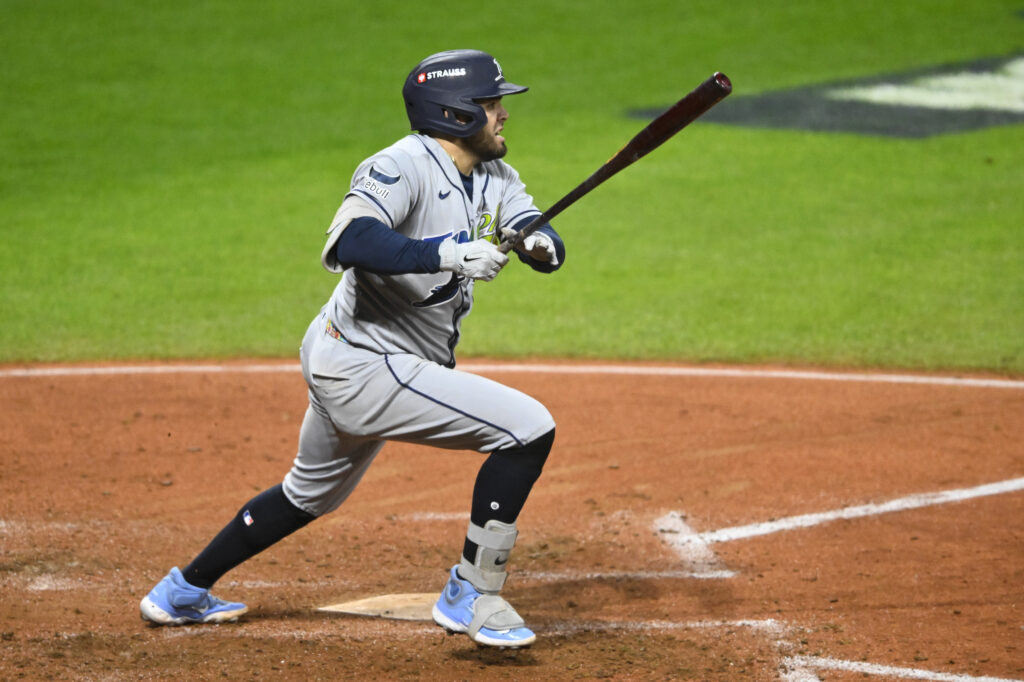
Image credit: IMAGN IMAGES via Reuters Connect
This postseason has left us with plenty to unpack. There was the shameful playoff picture in the American League, with the Astros looking like a shell of their former glory, the Yankees hitting a glass ceiling once again, the contrasting faces of excitement and exasperation in the differently colored Sox, and the Guardians proving once again that no one outdoes them in the field of making overachieving feel painful. In the National League you had the Phillies grasping for straws as the unyielding claws of Father Time come ever closer, the good but flawed Braves and Cubs being outdone by superior competition, the Padres proving once more that momentum doesn’t really carry over, and the Dodgers looking surprisingly outmatched against a younger, faster, and perhaps fated team.
Logically, most of the attention will be aimed at the final two, even now that we’ve swiftly determined—or perhaps confirmed—that Milwaukee was simply better than Tampa Bay. The 2026 World Series was brief; it’s not impossible to craft a compelling narrative in five games, but you really have to hit all your story beats in good order if you’re going to do that. The final round of this year’s postseason did not do that. It had all the ingredients in theory: two franchises aiming for their first title, teams built heavily around speed and run prevention, star power on both sides, plus the philosophical threads linking these two exceptionally well-run franchises together. (Funnily enough, some made themselves believe that this was supposed to be the anti-analytics World Series. No comment.)
The dynamics of the World Series itself can be analyzed ad nauseam, of course, as can the public’s peculiar relationship with “analytics” as a word—what it means to some versus what it actually means, the spirit of data-driven processes, etc. And perhaps I may do that at some point. For now, however, I want to look at some hard data fresh out of the oven.
***
Pitchers throw harder in 2026 than they used to. Shocking, I know. But since we have precisely measured and adjusted data since 2008, it’s always good to point this out because it’s almost hard to believe how hard pitchers are throwing now.

The league-wide velocity increase is actually more interesting than a simple steady progression. It’s obvious that velocity slowly but steadily moving upwards in the early-to-mid 2010’s played no small role in the increasingly low-scoring nature of those years, of course—part of it was the proliferation of deeper bullpens, part of it was more data, and part of it was the effects of a league whose talent pool had not been thinned out by expansion or anything of the sort in over a generation. I can’t help but note the presence of a fairly lengthy period of stagnation in the second half of the previous decade, which essentially coincides with starting pitcher usage dropping precipitously and the rise of the juiced ball era. Is there a direct correlation? Probably not. Pitching changed a ton between 2009 and 2019, but we were merely scratching the surface of the possibilities that modern data might bring.
It’s often said that pitching has changed more over the previous six or seven years than it did during the 30 years that directly preceded them. This can be seen in many forms, from the way teams understand spin and the physics that surround it, to the relentless optimization of every pitch mix out there. Few arenas are better proof of the rapid and sometimes dizzying rocketship that is modern pitching scouting and development than raw velocity; after stagnating for a while right around 93 mph, league-wide velocity has seen a giant spike directly following the shortened 2020 season.
Perhaps most interesting—or unnerving, depending on your outlook—is that there are no hints of this trend reversing course anytime soon, as velocity is actually rising at an even faster pace over the last two seasons. (The average right-handed four-seam fastball in the big leagues in 2026 was 95.3 mph.) Secondary pitches are spiking in velocity as well; sliders are averaging just under 88 mph, whereas curveballs have long ago cleared the once magical 80-mph barrier and are nearing 81 mph.
You probably knew all of this already, though. Anyone who watches a ballgame these days and isn’t in a perpetual state of denial about the radar guns (which they don’t even use now, funnily enough) can see that pitchers are exerting themselves with a level of force that is both entirely unprecedented and the shiniest double-edged sword in sports today. What I really wanted to focus on was this:





 English (US) ·
 French (CA) ·