

 1 week ago
22
1 week ago
22
PROTECT YOUR DNA WITH QUANTUM TECHNOLOGY
Orgo-Life the new way to the future Advertising by Adpathway Cole Carlon Photo: Joseph Rondone/USA Today Network via Imagn Images
This year, I’ve mostly been focused on minor league coverage — those pesky lists don’t write themselves — but with the draft on the horizon and four conference tournaments happening in one metro, I flew down to Phoenix last week. Eric split his time between the Mountain West, West Coast, and WAC tournaments while I sat on the Big 12’s signature event in Surprise. It was a strange week in some respects. The top two, and maybe even top three, guys on my pref list aren’t eligible until next year’s draft, thanks in part to injuries that knocked a couple of the league’s best prospects out of the tournament entirely. Moreover, the relatively brief nature of a single-elimination tournament means I didn’t come away with a complete impression of a lot of players, including guys who will presumably be drafted relatively early.
With that in mind, I encourage you to consider this a rundown of what I saw rather than a definitive list of the top prospects from the league. These are just my observations from the field, and do not reflect a more holistic evaluation process. Eric and I will do more work on the Draft Board as we get closer to July, a process which may shift how I or we think about some of the players covered below, and we’ll likely add other players from the Big 12 into the mix. With a nod to how short the look was in some cases, where applicable, I’ll share the questions I have about some of these players going forward alongside my notes.
2026 Draft Class
As mentioned above, a few of the league’s top dogs were stuck in the kennel. Sawyer Strosnider, arguably the Big 12’s most projectable hitter, missed TCU’s one-and-done after injuring his ankle in practice the week before. His teammate Chase Brunson, another potential high pick, missed the game with knee trouble. Finally, Kansas was able to lift the trophy without first baseman Brady Ballinger, who was nursing a hamate injury. He’s a power hitter who entered the season with draft helium, though he has seen his stock take a bit of a tumble after only hitting seven homers as a junior.
And now for my pref list.
1. Cole Carlon, SP, Arizona State, 45+ FV
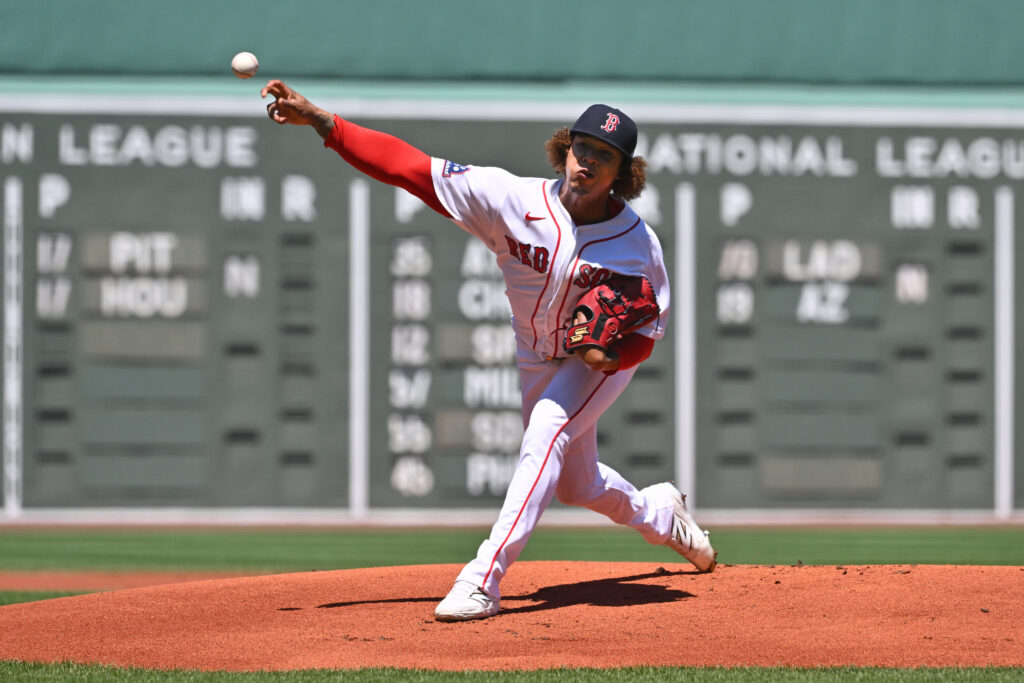
Carlon is a lefty starter with an XL frame. A reliever for most of his career at ASU, he’s been the Friday guy for the Sun Devils this season and has blossomed into a likely first-round pick. Despite the size and a herky-jerky delivery with a lot of moving parts, he throws strikes. Last week, he primarily used his fastball, which has touched triple digits this year and sat 93-96 in this outing, along with a power slider, which is plus with late downward break. He’ll also throw an occasional curve and change, almost as if to remind scouts and draft evaluators that he has them. His fastball plays beneath the number, which leaves him heavily reliant on the slider. Carlon is able to run that pitch on and off the plate with consistent sharp break and pretty good feel for moving it around the zone, which gives him a chance to start even if everything else in the holster is pedestrian. I’d put his chances of staying in a rotation at a little better than 50/50, with late-inning upside in relief.
You Aren't a FanGraphs Member
It looks like you aren't yet a FanGraphs Member (or aren't logged in). We aren't mad, just disappointed.
We get it. You want to read this article. But before we let you get back to it, we'd like to point out a few of the good reasons why you should become a Member.
1. Ad Free viewing! We won't bug you with this ad, or any other.
2. Unlimited articles! Non-Members only get to read 10 free articles a month. Members never get cut off.
3. Dark mode and Classic mode!
4. Custom player page dashboards! Choose the player cards you want, in the order you want them.
5. One-click data exports! Export our projections and leaderboards for your personal projects.
6. Remove the photos on the home page! (Honestly, this doesn't sound so great to us, but some people wanted it, and we like to give our Members what they want.)
7. Even more Steamer projections! We have handedness, percentile, and context neutral projections available for Members only.
8. Get FanGraphs Walk-Off, a customized year end review! Find out exactly how you used FanGraphs this year, and how that compares to other Members. Don't be a victim of FOMO.
9. A weekly mailbag column, exclusively for Members.
10. Help support FanGraphs and our entire staff! Our Members provide us with critical resources to improve the site and deliver new features!
We hope you'll consider a Membership today, for yourself or as a gift! And we realize this has been an awfully long sales pitch, so we've also removed all the other ads in this article. We didn't want to overdo it.
Questions: Can he find a way to generate more miss on the fastball? Can he develop an average changeup? He experienced arm fatigue recently and saw his velo drop throughout this outing — is that anything to worry about?
2. Dee Kennedy, SS, Kansas State, 40+ FV
Kennedy was the most fun player to watch last week. He’s a shortstop, a little short but not at all small, with at least plus wheels, a plus arm, and lightning quick transfers on defense. The metal bat complicates the offensive evaluation, but he hit 20 bombs this season and has bat speed; I’m projecting average power. Whatever raw he has, he should get to it in games. This isn’t a guy using the trampoline bat to poke pitches out the other way. Kennedy has a lofted stroke, and tends to get out front and pull the ball. The bigger question is how much he’ll hit. Kennedy is vulnerable to spin, both in the zone and down and away, where he’s liable to chase. He hasn’t seen a ton of good velo in the Big 12 either, so the blend of better breaking balls and harder fastballs looms as a real test for a player who struck out a ton on the Cape last year.
Questions: Will he hit velo? Can he fight spin to a draw? Most of the action he saw defensively was of the routine variety: How far can he range and how are his hands when he really has to move?
3. Logan Hughes, OF, Texas Tech, 40+ FV
Hughes is a strong, if boxy, corner outfield prospect. After a good summer on the Cape, he hit .375/.510/.735 in Lubbock this spring, with 50 walks and only 33 strikeouts in 257 plate appearances. My look at him was short, but Hughes is clearly a talented hitter and he looks extremely comfortable in the box. As BYU mostly pitched around him, he spat on a couple of close pitches that dipped out of the zone. He also homered on a fastball on the inside corner, a 461-foot moon shot to right. It was impressive to see him ambush that pitch, particularly since he got very little else near the zone. He’ll have to hit, because he’s a below-average runner with a below-average arm in left. He’s a drifty route runner, and on one occasion, he played a single into double with a cautious path toward the ball.
Questions: Is there any projection left? Can he play a 45 corner outfield? Can he hit pro-quality lefty stuff enough to potentially play every day?
4. Tommy LaPour, RHP, TCU, 40 FV
After missing most of the year, Lapour was healthy and available to start TCU’s only game of the tournament. He’s an average athlete with a large frame, more powerful than loose, with a clean enough arm stroke to start. He doesn’t get a ton of extension and isn’t especially deceptive. Lapour sat 94-96 and touched 97, and often reared back for more after giving up a knock. He showed some feel for moving the fastball, and missed a couple bats up with it. He doesn’t have great feel for spin, and the length on his curve ball was more challenging for hitters than the slider, which is fairly firm in the upper 80s but isn’t especially sharp. He missed a few bats with his changeup, but he slows his body on the pitch in a way that I had no trouble picking up. Good arm strength and a four-pitch foundation make LaPour an intriguing prospect, but there are enough questions regarding his secondaries to consider him a likely reliever at the end of the day.
5. Maxx Yehl, LHP, West Virginia, 35+ FV
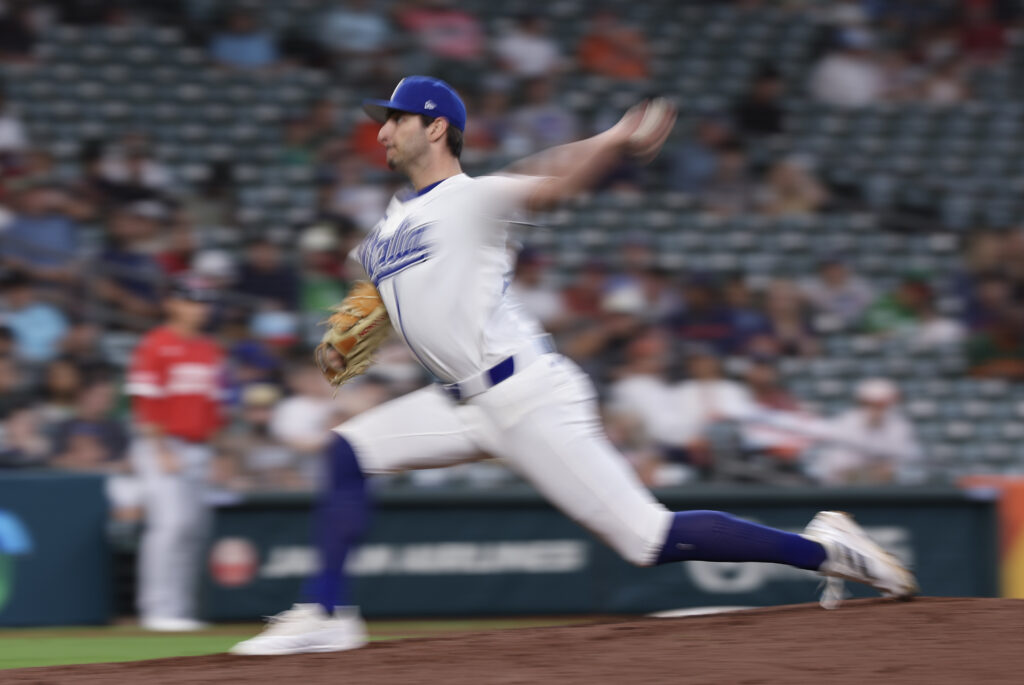
Arguably the toughest player to project from the tournament, Yehl is a deceptive lefty with below-average arm strength but good feel to pitch. He gets on top of the ball even with a three-quarters slot, and with his back foot in the middle of the rubber, he strides at nearly a 45 degree angle toward the first base dugout. He lands clean and straight on, and is able to command the ball effectively even with the huge crossfire. Hitters, lefties in particular, looked uncomfortable. His fastball generates above-average to plus carry even with a relatively low slot, and with little tail. He missed several bats up with the four-seamer — he threw a couple sinkers too — and saved his best bullet for late in the game (he sat 89-91 and touched 92). His slider is mostly horizontal, and he has pretty good feel for spinning it. Yehl can find the back foot and back door against righties, and likes to run it off the barrels of a lefty. He’ll flash an average curve as well. I don’t know how well this will work against hitters more accustomed to outlier release points, but college bats barely touched him this year. Yehl isn’t particularly projectable, but there are a couple paths forward and he’s effective enough to be worth an early-round flier. You can dream on a backend starter.
Questions: Can he develop a change up? Is there any untapped velo? How hard could he throw in shorter stints?
6. Jack Natili, C, Cincinnati, 35+ FV
Natili is perhaps the player who most obviously requires further examination. By reputation, he’s a glove-first catcher with strong defensive chops, and some of that was on display. He deadened several balls nicely, framed a couple pitches well, and had the authoritative presence you like to see in a college backstop. He also clanged several pitches, and a few balls you’d have expected him to catch went to the backstop. The context suggests grace is warranted: This game started after 8:30 PM local time, which was nearly midnight on the Bearcats’ body clock, hardly optimal playing conditions. At the plate, Natili had average bat speed with a fairly steep path and an otherwise low-maintenance load and swing.
Questions: How is his receiving normally? How does he handle velocity, both at the plate and behind it?
7. Andrew Williamson, OF, UCF, 35+ FV
Williamson is a hitterish lefty and a good athlete. He also has one of the ugliest loads I’ve come across, almost a reverse bat wrap where he waggles the bat toward the third base dugout nearly parallel to the ground before he starts his swing. Once he gets going, I liked his bat speed and barrel feel, and the speed gives him a shot to stick in the middle of the diamond. I wish I’d had more than the one game with him.
Questions: Will the load make it hard for him to hit good fastballs? Can he get to average power with wood?
8. Dominic Voegele, RHP, Kansas, 35+ FV
Despite an ERA just north of 6.00, Voegele is a pretty interesting pitching prospect. He has a clean delivery, average present control, and some feel for moving the ball around the plate, particularly in elevating the fastball. He sits and comfortably holds his low-to-mid-90s velo, and he gets a little carry on the pitch. He has plus feel for spin (2,900-plus rpm on some of his sliders) and missed bats with a low-to-mid-80s slider. The evidence would suggest he’s a little too hittable to project as a starter, but it’s worth developing him that way for now, and you can see a pretty clear path to middle relief if it doesn’t work out.
Questions: He doesn’t throw his change a ton: Is there more in that pitch, or a different grip to try? There’s some variation in his slot: Is that helping hitters sit on him a bit?
9. Tyson LeBlanc, SS, Kansas, 35+ FV
Like most of the KU lineup, LeBlanc is a small school transfer. He had a good season at the plate, but I’m a little concerned about how his blend of a bottom-hand swing and average bat speed will translate to the pro game. I liked his pitch recognition, and how he can adjust off the fastball and bend and hit spin hard. Defensively, LeBlanc has good hands and clean, if not notably fast, actions. He has an above-average arm and can make throws from a variety of angles. He’s an interesting utility prospect with some punch in the bat.
10. James Guyette, RHP, Kansas State, 35+ FV
Guyette is a short-striding sidearming righty. He transitioned from relief into the rotation this year and did fairly well: A 5.56 ERA in the Big 12 isn’t bad, though the 19 HBPs and 35 walks are a little concerning. He can reach back for 96 in starts, which suggests he’ll be able to live mid-90s in shorter stints. Hitters took a bunch of bad and uncomfortable wings against his two-plane slider, which spins well and moves a ton out of a low slot. He also has a projectable change. He’s an interesting relief prospect.
Questions: Can he get down the mound a little farther? Is there a way to rein in some of the non-competitive misses? How hard can he throw in short stints?
Quick hits in no particular order: Kollin Ritchie (Oklahoma State) is a patient hitter who blasted 29 bombs this year, but the swing is long and he expands a lot with two strikes. He’s faster than he looks and has a shot to stay in center. If the power translates, he’s got a fourth outfielder chance. Lucas Davenport (Baylor) is a tall-and-fall righty who came out of the chute sitting in the mid-90s before settling into a 92-94 mph velo band. He throws strikes, but I didn’t love his secondaries. Perhaps pro instruction helps him find a viable breaking ball. Sean Fitzpatrick (Arizona State) is almost 23 and tops out at 93 mph. Still, he’s a sidearm lefty with good feel to spin it, and he struck out nearly 16 per nine this season. You don’t need to spend an early pick here — you might not need to draft him at all — but he should draw some interest, as he has the look of a deceptive reliever who could move quickly. Kyeler Thompson (Texas Tech) has a funky swing and not a lot of pop, but he performed at the plate this year. More pertinently, he’s also a 70 runner and a fearless defender in center. Built like a fire hydrant, Ian Korn (West Virginia) put up big numbers in relief in his first Division I season. He has plus control of a sinking fastball and good feel for spin. He could be a 95-and-a-slider guy. Alex Overbay (Arizona State) and Logan Addison (Texas Tech) could be as well. Garrison Sumner (BYU) is a stretched out righty with an otherwise similar profile, though his best pitch is a curve, not a slider.
2027 Draft Class
Hey, we’re only 2,300 words in here, so let’s keep it rolling. The following three players won’t be eligible until next season, but each has a chance to go in the first round. The top two names in particular are potential top 10 picks.
1. Gavin Kelly, C, West Virginia
Kelly is a plus athlete, twitchy with barrel feel and electric hitting hands. His lofted swing plane leaves him a little vulnerable to well-located heat upstairs, but he otherwise covers the plate well. He has a little power, though the damage he’s doing in college might oversell his pro potential in that category, as he isn’t a huge guy and he’s hitting for power to right center in a way that’ll be difficult to replicate with a wood bat. He moves well behind the plate, where he’s a good blocker, regularly posts pop times in the 1.90s, and does a good job of leading the band. I came away very excited about the tools and athlete, but also wonder whether he can hold up physically behind the plate over a long season. He’s such a loose, fast, and fluid athlete, it almost feels like a waste to subject him to the wear and tear of a job that will sap those attributes more quickly than anywhere else on the diamond.
2. Landon Hairston, CF, Arizona State
Hairston, son of Scott Hairston and relative to all the other baseball Hairstons, is one of the top bats in the 2027 class. Like Kelly, he isn’t a big guy, but he has a fast bat and strong, fairly short levers. He gets the bat head out early, has barrel feel, and does a ton of damage to the pull side. He doesn’t have monster raw power, but he looks like a guy who will get to all of what he has. Defensively, Hairston reads the game extremely well in center field. He’s fast and fully leverages that speed with a quick first step and clean routes to the ball. The only blemish is his arm, which is 40-grade right now, though even there, his accuracy and feel for where to go with the ball stands out.
3. Ethan Lund, LHP, Oklahoma State
Lund is a high-waisted, high-slot lefty with a clean arm swing. He isn’t consistently synched up, which leads to occasional scatter from pitch to pitch, but when he’s aligned, the stuff is quite good. In my look, he sat 93-95 and held that velo all throughout his outing; his 113th pitch was a well-located 94-mph fastball for a strikeout. He has two buckling breaking balls, one that sits either side of 80 mph and another that lives in the mid-80s, and both lefties and righties missed these by a foot when he hit his spot. This is an enviable blend of velo and spin from the left side, and while he can be a little rough around the edges, he also struck out 127 hitters in 77 innings this year. He’s one of the top southpaws in his draft class.








 English (US) ·
  French (CA) ·