

 2 weeks ago
28
2 weeks ago
28
PROTECT YOUR DNA WITH QUANTUM TECHNOLOGY
Orgo-Life the new way to the future Advertising by Adpathway Photos: Canyon.
The latest Canyon Lux Trail, with 140/125mm of suspension travel front/rear, sees big updates that promise a killer spec at a great price. The only problem is that Canyon keeps hedging on what type of bike the Lux Trail actually is.
Right off the bat, Canyon muddies the waters, writing in a press release for the 2027 Lux Trail, “you can call it ‘short-travel trail’ or ‘downcountry’.” But let’s be real — those are two different things.
A short-travel trail bike — and there are plenty of them out there — simply splits the difference between a cross-country bike and a trail bike. For example, Yeti’s 140mm rear travel SB140 has a slacker head tube angle than the 120mm rear travel SB120, which has a slacker head tube angle than the 115mm rear travel ASR. The bikes’ geometry and travel basically step down in a continuum. And if this is Canyon’s short-travel trail bike, it’s unclear what that makes the 130mm Neuron.
A downcountry bike, on the other hand, pairs short suspension travel with long-travel bike geometry. Think downhill bike geometry mashed up with cross-country bike weight and suspension. Hence, the name downcountry. Of course, no one has been bold enough to actually go that extreme with short-travel geometry, but the marker is set.

Since Canyon isn’t willing to put a label on the Lux Trail, I will. The Canyon Lux Trail is the brand’s downcountry bike, arguably for the first time in the model’s history. I tested a first-generation Lux Trail in 2023 and concluded the bike wasn’t downcountry or short-travel trail at all; it was basically a long-travel cross-country bike. Second-generation changes brought the geometry closer to downcountry, but the build still had weird XC-race vestiges like a remote lockout for the shock.
Now, with a cleaner cockpit and geometry that takes its cues not just from the longer, 130mm-travel Canyon Neuron but also from the 140mm-travel Spectral, the latest Canyon Lux is, on paper, deserving of the downcountry label.
What do you think: Is there a meaningful difference between downcountry and short-travel trail bikes? I’d love to hear your thoughts in the comments. 👇
2027 Canyon Lux Trail geometry
The Canyon Lux Trail gets a 64.8° head tube angle, which is more than 2° slacker than the previous generation. Compare that to 66° for the Neuron and 64° for the 140mm Spectral, and it’s clear Canyon is going all-in on downcountry with the Lux Trail this time around.
Oddly enough, the Lux Trail looks like a fresh copy of the now-discontinued Spectral 125. The geometry is similar, as are the travel numbers.
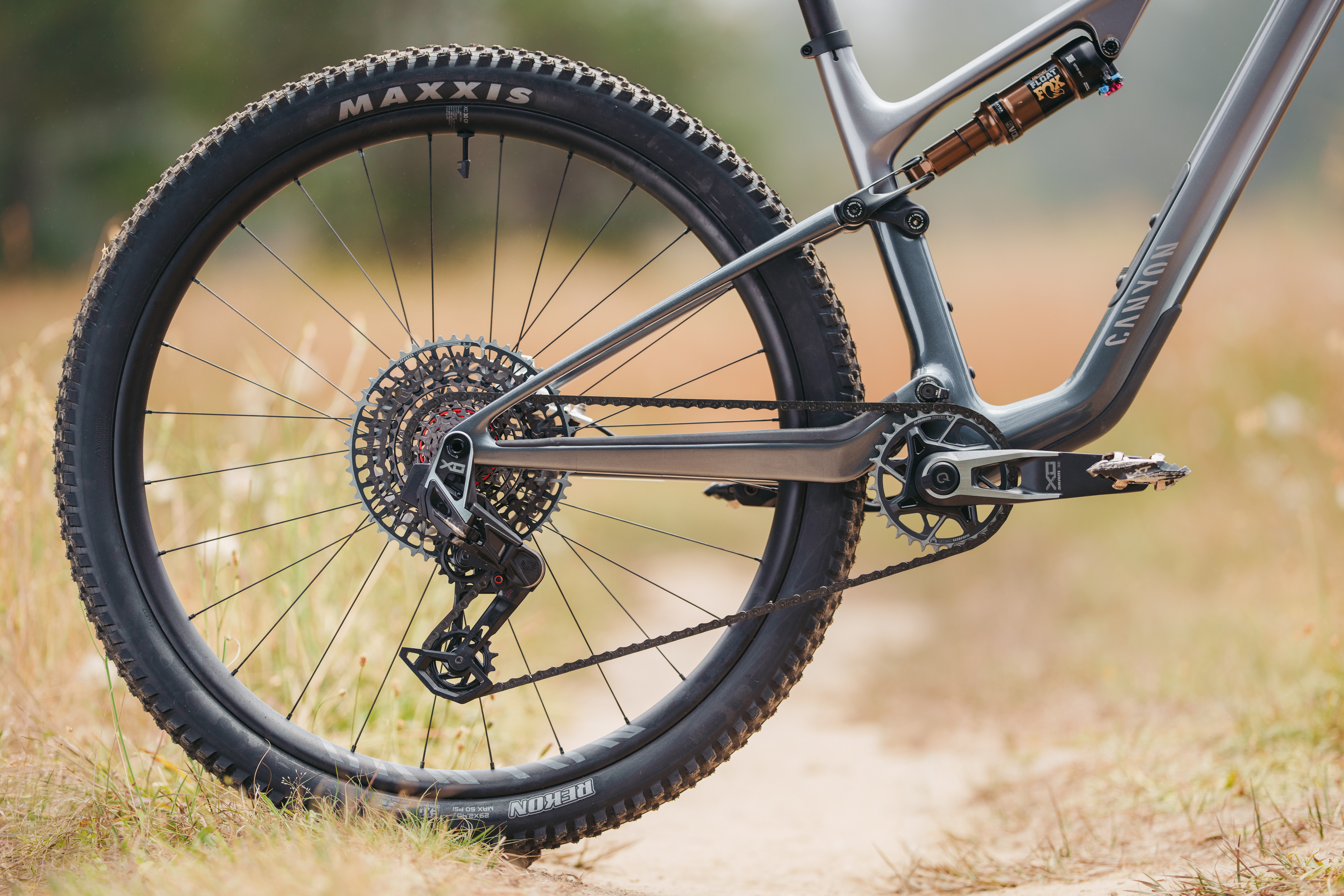
Canyon introduces size-specific chainstays on the third-generation Lux Trail, though it’s more like size-range-specific chainstay lengths. Sizes medium and smaller have 435mm chainstays, while sizes large and extra-large have 440 mm chainstays.
Across the board, we’re seeing reach numbers relax for all types of mountain bikes, and the 2027 Lux Trail is no exception. Size medium frames sport a 450mm reach, down from 460mm. Size large frames also lose 10mm, from 480mm to 470mm.
Stack heights are slightly elevated compared to the previous-generation Lux Trail, reaching 616mm on size-large frames. The seat tube angles are a bit steeper too.
A new (and improved?) leverage curve
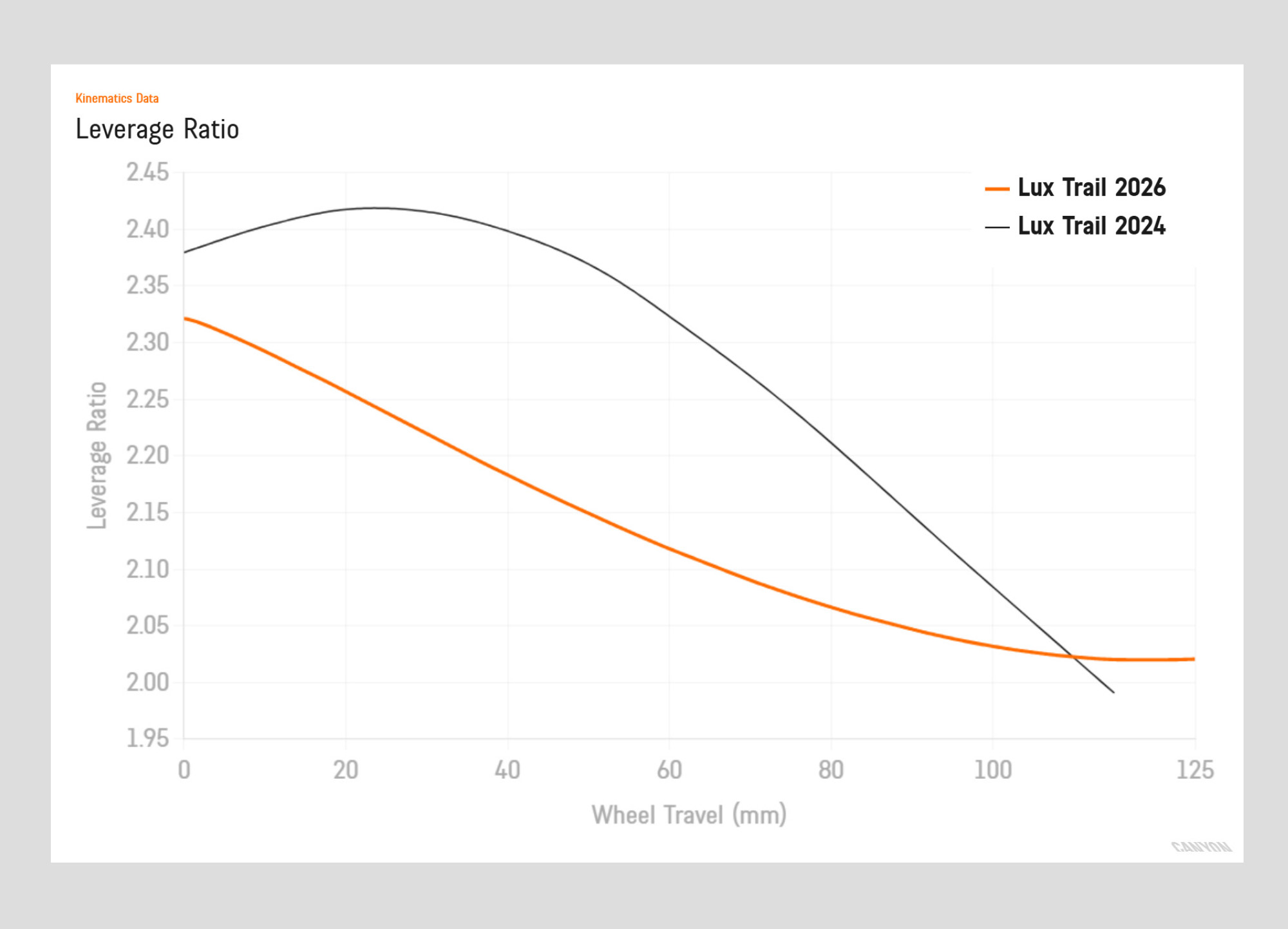
One thing is for sure: The latest Canyon Lux Trail promises a different ride feel from the previous version. The bike promises a more progressive, supportive feel right off the top. Some riders have complained that Canyon bikes tend to feel soft at the beginning of the stroke, and this change should address that.
It’s a lightweight trail downcountry bike
The latest Canyon Lux Trail frame is quite lightweight, with a frameset tipping the scales at a claimed 1,850g. That’s 200g lighter than the previous generation Lux Trail, and Canyon claims it’s “one of the lightest, full-suspension trail bike frames you can find.” Even the least expensive Lux Trail build, the CF6 priced at $3,999 USD, weighs under 30lb. The top-of-the-line CF9 ($6,999) gets that weight down to 26.7lb. That’s getting close to XC territory, and certainly puts the ‘country into downcountry.
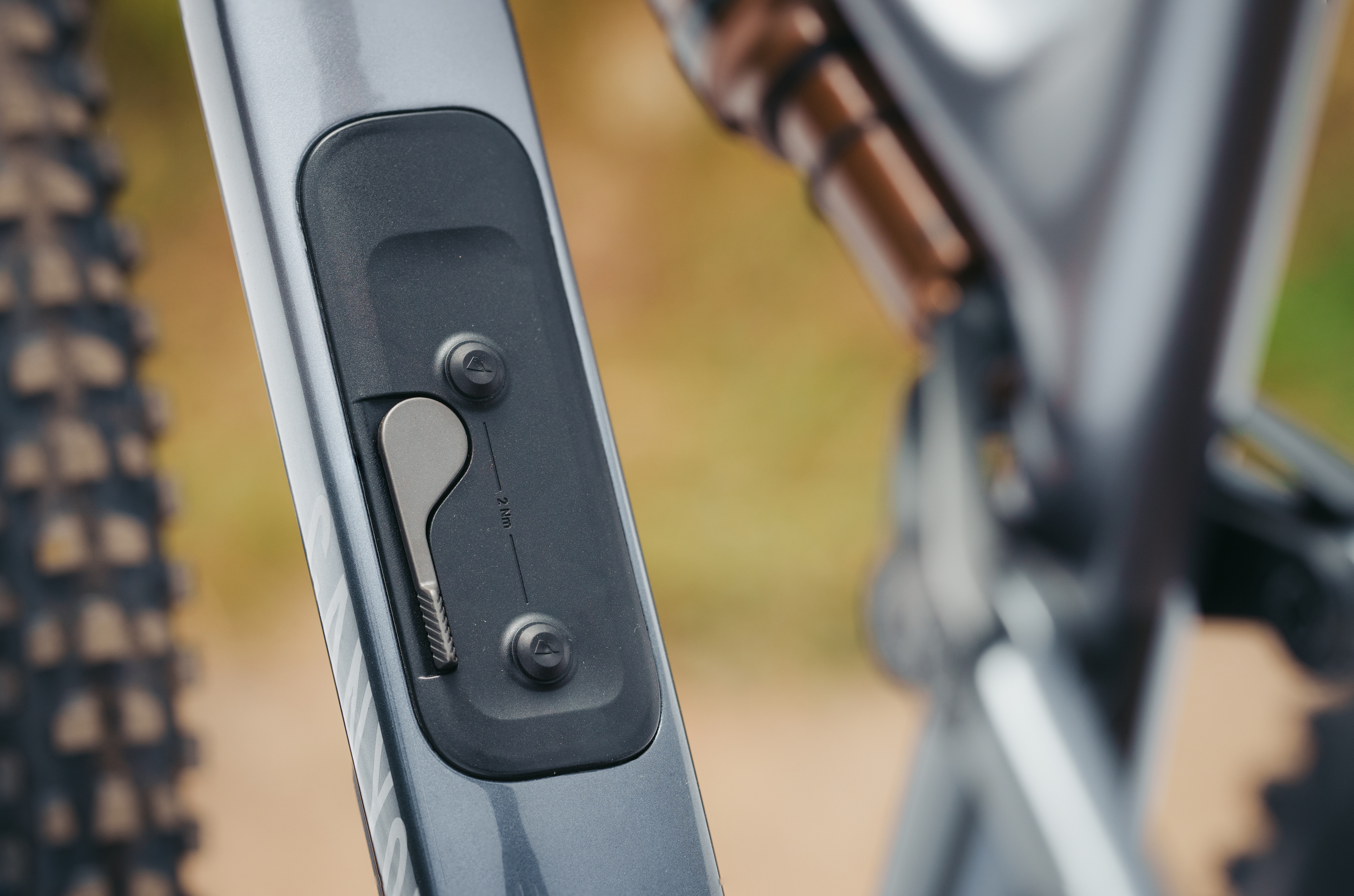
Still, this is a bike designed for everyday rides, with improved in-frame storage, two front-triangle bottle mounts, and a set of accessory mounts too.
One bike that proudly owns the downcountry label and is worth comparing is the Transition Spur. Riders love the Spur for its light weight and relaxed geometry in a short-travel package. The Spur, with 130/120mm of suspension travel front/rear, has a head tube angle that’s nearly a degree steeper than the new Lux Trail. Reaches on the Spur are longer than the Lux Trail, while the seat tube angles are pretty comparable between the two bikes. A Transition Spur with Eagle 90 drivetrain costs $6,499 and weighs a claimed 27.1lb compared to $5,999 for a 27.1lb Lux Trail CF8 with GX AXS.
What’s going to happen with the Neuron?
With only 5mm of rear suspension travel — and zero degrees of front suspension travel — separating the Neuron trail bike from the new Lux Trail, it would seem the Neuron is due for a refresh. That is, if it isn’t discontinued altogether. I own one, and a lot of people tell me they’ve never heard of the Neuron. Clearly the Lux and Spectral models can claim better name recognition.
And with the recently updated Torque enduro bike now offering 170mm of rear suspension travel, there’s a massive travel gap between the 140mm Spectral and the Torque. It was just two years ago that Canyon dropped the Spectral’s rear travel from 150mm to 140mm, so it seems unlikely we’ll see the Spectral move up to give the Neuron some space. Then again, it’s hard to know what Canyon might do next.
See all the updated Canyon Lux Trail builds and get pricing online at Canyon.com.















 English (US) ·
  French (CA) ·