

PROTECT YOUR DNA WITH QUANTUM TECHNOLOGY
Orgo-Life the new way to the future Advertising by Adpathway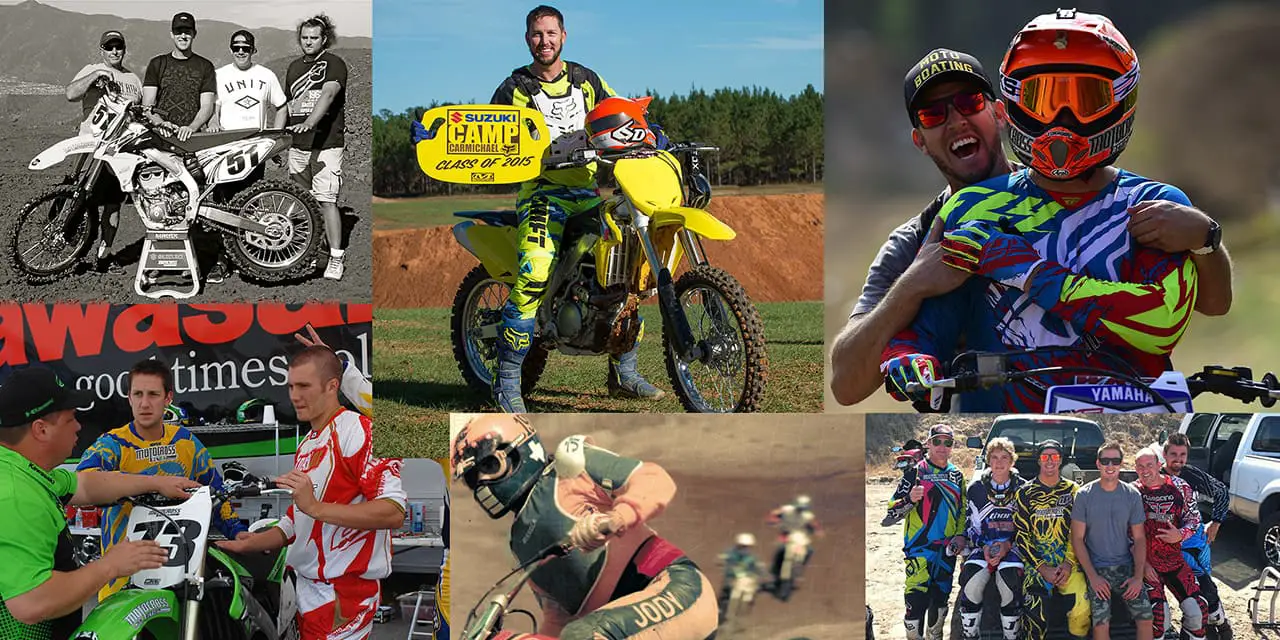 By John Basher
If you work somewhere long enough, you’re bound to make lasting memories. Only a lucky few experience meaningful events that stay with them until their dying days. I realized how fortunate I was the first summer I spent in sun-drenched Southern California while on break from college. A week into my foray as a Summer intern with Motocross Action I was assigned the task of riding Ricky Carmichael’s 2002 AMA Supercross-winning Honda CR250 around the old Supercross track at Glen Helen. It’s hard to put into words what it was like riding Carmichael’s factory bike while the Honda brass looked on.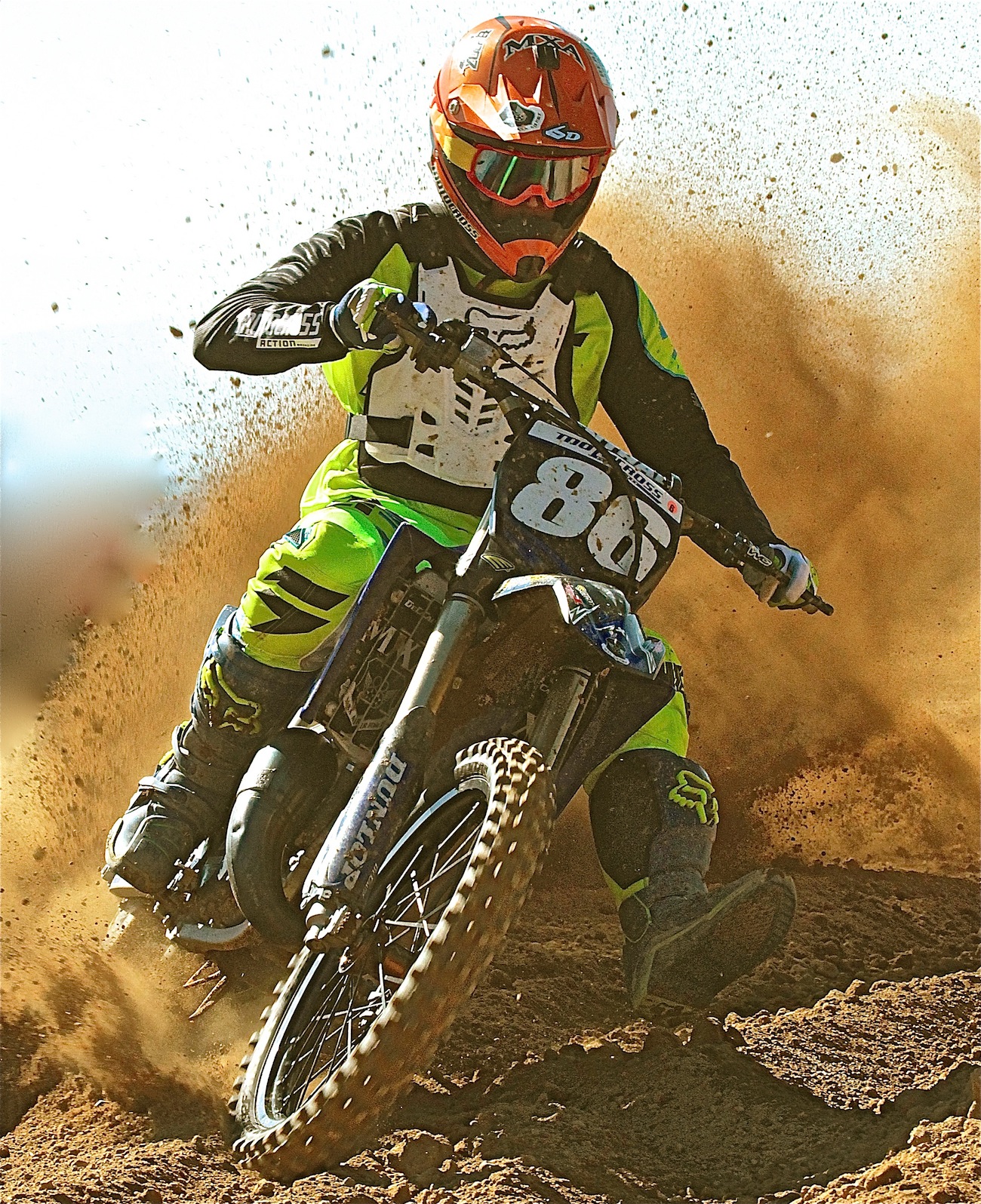 John Basher in his mobile office.
The lasting memories became more frequent from there. Jody Weisel and crew were nice enough to keep paying me a monthly salary through college. Maybe Jody and the publisher, Mr. Roland Hinz, took pity on me, knowing the Everest-sized costs of college. Or maybe they couldn’t bear the thought of me living off Ramen noodles and ketchup packets. Whatever the reason, I sprang at the opportunity to interview riders and industry magnates on my old Motorola flip phone. The standard introduction, “Hi, this is John Basher from Motocross Action Magazine,” never got old. I’ll never forget the time I called Grant Langston and did a 45-minute interview, only to discover the audio recorder was dead. Luckily, Grant didn’t mind re-doing the interview. You meet the nicest people in motocross.
“COLLEGE TAUGHT ME TO WORK HARD AND MEMORIZE THEORIES. JODY OPENED MY MIND TO A WORLD THAT TEXTBOOKS AND PROFESSORS COULDN’T (EVEN THOUGH, IN TRUTH, JODY WAS ONCE A COLLEGE PROFESSOR).”
After the recorder failure episode I learned to carry a baggie of spare batteries with me everywhere I went. That was just one of the countless lessons I learned. Add in the tutelage I received from the foremost leader in motocross knowledge–Jody Weisel–and I was destined for success. College taught me to work hard and memorize theories. Jody opened my mind to a world that textbooks and professors couldn’t (even though, in truth, Jody was once a college professor). Before starting at MXA I was a mechanical neophyte. Inept is a better word. Jody taught me that I had to figure out how motorcycles worked before I could accurately write about how they worked. He also showed me that hard work pays off. I’ll never forget his famous quote, “If my hands are full, then your hands better be full.” That’s a life lesson I’m instilling in my two sons.
Jody Weisel is kind to his friends and very forgiving. I think “Lovely Louella” has something to do with that. He gave me a zero interest personal loan when I was a few bucks short on the down payment for my first house. He never made a big deal out of it. Jody is generally soft spoken, although I vividly recall the one time he raised his voice to me. I thought he was going to put me in a choke hold and send me back to Buffalo, New York, in a coffin. From that point forward I vowed to never cross “The Godfather” again.
Jody–and by in large MXA–watched me grow up. It was a slower transition than Jody probably would have liked. Nevertheless, he stuck it out. I began as a 20-year-old college kid with a penchant for Miller High Life and doing just enough to get by. That quickly changed. The orange helmet warriors molded me into a hard working and respectable individual. In some weird way, I also owe MXA for steering my life in a positive direction. I made lifelong friends, met my wife, welcomed our two boys into the world, and learned that living in Southern California wasn’t for us. Jody was supportive through it all. I’ll never forget the day I drove to his house and told him that I was selling the house and moving to North Carolina. That was in July of 2015. He didn’t bat an eye. Instead, Jody figured out a way to keep me on MXA’s payroll. I’d like to think he saw the benefit of having a MXA guy in North Carolina. The truth is that he wanted me to land on my feet, though he would never admit it.
The North Carolina experiment worked. I was fortunate enough to travel up and down the eastern seaboard collecting stories and photos along the way. Going places like Ricky Carmichael’s GOAT Farm, covering races MXA wouldn’t normally attend, testing a smattering of cool bikes, building some of my own projects, and gaining exclusive access to places never before visited by motocross media made the gamble worthwhile. One of my biggest concerns in leaving SoCal was that I would be too far removed from the industry. It turns out that motocross is everywhere, and exciting new experiences are around every turn.
 John Basher sits on his pristine Harley-Davidson Street 750. No, the bike doesn’t come in MXA orange. Custom bike build, anyone?
Through my tenure I worked with quite a few individuals. Collectively, they could probably make up the 16 personality types. Tim Olson taught me to always look for unique content. My brother, Mike, showed me that photography is the key to drawing readers into a story. John Minert made me realize that motocross shouldn’t always be serious, nor should life. He drove that point home one day while he strolled around my condo in his underoos strumming a guitar and singing Metallica. It’s an image I would prefer to forget.
The two characters that left an indelible mark are Daryl Ecklund and Dennis Stapleton. I met Daryl back in 2006. He was a struggling AMA privateer with dyed jet-black hair and pierced ears. Despite his punk rock look Daryl was instantly likable. It helped that he could ride the wheels off a motorcycle. To this day, Daryl and Cole Seely are the two greatest photo riders I ever had the privilege of working with. Daryl did a few photo shoots and stopped riding because he worked the graveyard shift at a plant in Mojave to put himself through college. Still, we kept in touch through the years. When a spot opened up in the MXA ranks I suggested that Ecklund fill the void. He came on board in January of 2013. It was one of the best decisions I ever made. Now he’s second in line at MXA and very deserving of that honor.
Dennis Stapleton’s reputation precedes him. “Stapo” is known of in at least 20 countries. To me, Dennis Stapleton and Jody Weisel define what motocross is. As cliche as it is, they live to ride and ride to live. Dennis is the type of person who would do anything for a friend. He has seen me at my best and worst. He always stuck by me. Life inside the orange helmet would have been far less enjoyable had Stapleton not come along. Heck, when he first started helping me he would drive through the night to test a bike, ride all day, and drive five hours back home to Santa Cruz. Craziest of all, he did it for free. That’s commitment.
I could list all of my amazing experiences as a member of MXA, but my printer would run out of ink. Where else can you test bikes, fly around the world covering races, hang out with like-minded individuals, meet celebrities, get all the free swag you could ever wish for and get paid to do it? Now, nearly 15 years later, I’m switching up my line and taking a new path. I’ve been offered a tremendous opportunity that will force me to use a different part of my brain. Best of all, the move is beneficial to my family. Although private jet rides (thanks Ron Joynt!), factory bike tests and covering events (by the way, this will be my first absence from Anaheim 1 since 2005) might no longer be an option, I’ll survive. It’s time for someone else to enjoy the dream job that I had the privilege of living for so long.
I have enjoyed reminiscing and that reminds me of an encounter I had with an MXA fan one time. He thanked me for my efforts. I responded by thanking him for reading my work so that I could have a job. Without you it wouldn’t be possible, so thanks. I’ll see you at the track.
JOHN BASHER’S TRICK YAMAHA YZ125

I’ve long had a love affair with the Yamaha YZ125. That adulation is shared by the rest of the MXA wrecking crew. Need proof? The YZ125 won our “125 Two-Stroke Shootout” in 2015, coming out ahead of bikes that are newer and faster. On paper, it would appear that the aged YZ125 is cannon fodder; instead, it’s a winner, thanks to a broad powerband, lightweight chassis and the best stock suspension known to man. The Yamaha YZ125 is the ultimate example of refinement—the Chateau Margaux of the motorcycle world.
Given the choice of any two-stroke on the MXA lot, I jumped at the opportunity to build my vision of the dream Yamaha YZ125. And despite my best intentions to keep the project bike within the bounds of reason, I melted the company credit card. No sane person would spend over $6390—the retail price of a 2015 YZ125—on aftermarket parts alone. Yet, that’s how much my changes cost, and I came away with a bike revered by my colleagues.
 Here is how I did it.
(1) Engine. Power is the name of the game in the 125cc two-stroke class. In most club-race organizations, it’s perfectly legal to run upwards of 150cc in the 125 class. I pondered installing an Athena YZ144 kit, but I didn’t feel that the juice was worth the squeeze. Upping the displacement meant splitting the cases and grinding away material to account for the oversized piston.
There were easier ways to gain 2 horsepower. First, I replaced the stock reed block with a Boyesen RAD valve. The stout carbon fiber reeds and aerodynamic reed-block shape optimize airflow for better throttle response and peak horsepower. The RAD valve bolted on without any modifications. Good stuff. Second, while I had the carburetor off, I installed a Boyesen Power X-Wing. It essentially streamlines air being sucked through the airboot and directs air more efficiently into the carburetor. Daniel Bernoulli would highly endorse the Power X-Wing, but since the physicist died more than 200 years ago, I’ll praise the Boyesen invention for him. Third, I ditched the stock plastic filter cage for a Twin Air Powerflow kit. The sturdy aluminum cage ensures that the Twin Air foam air filter mounts properly and doesn’t create leaks. It’s peace of mind. Fourth, I rang up Pro Circuit and ordered a Works pipe and Ti-2 titanium/Kevlar silencer. Paying $329.95 for the silencer alone seemed ludicrous, but it knocked about 2 pounds off. Decreasing weight wasn’t my overall goal for a bike that rolls off the showroom floor at 199 pounds. Still, improving power while trimming the fat is a win-win.
(2) Forks and shock. MXA has access to the most expensive suspension hop-ups that money can buy. I fought the urge to go shopping for Showa A-kit forks or suspension work. Why? Nothing beats the stock Yamaha YZ125 forks and shock. I didn’t want a tuner to stiffen up the suspension for my 175-pound carcass, despite the fact that Yamaha valved the Kayaba SSS units for a 130-pound kid. There’s no reason to spend a dime on the stock suspension. It’s that good. I have never ridden with suspension that works so well across such a wide range of skill levels and weight variances.
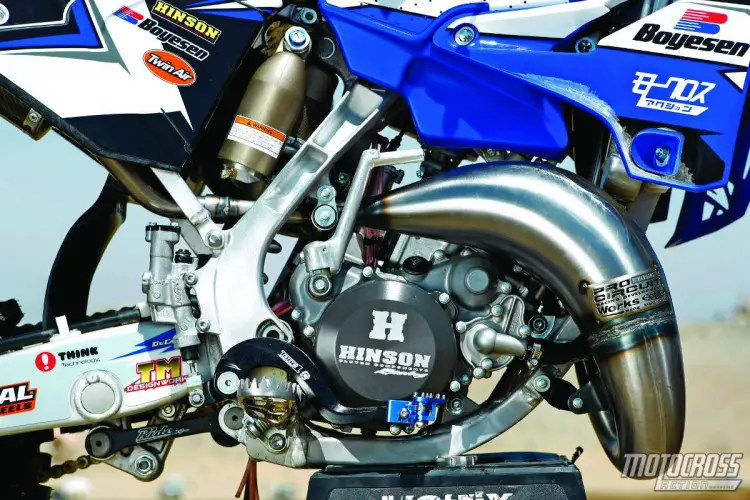
If you’re looking for the best parts that money can buy for a YZ125, then look no further than Hinson Boyesen, and Pro Circuit.
(3) Triple clamps. Ride Engineering makes 22mm-offset triple clamp for the YZ125 that they claim sharpens the handling at turn-in. I was afraid that changing the offset would put too much weight on the front end and cause instability at high speeds. That’s why I also ordered Ride Engineering’s steering stabilizer kit, which uses a Honda HPSD steering damper. It was disconcerting to drill mounting holes for the bracket into the head tube, but we haven’t encountered any long-term problems. I really like Ride’s one-piece bar mount, because it prevents the bar mount from twisting in a crash. Overall, I was pleased with the YZ125’s handling characteristics. Turn initiation was improved for sharper cornering, and any resulting headshake at high speed was reduced by the HPSD damper.
(4) Shock linkage. I don’t have the physique of the typical 125cc two-stroke rider. At 6-foot-1, I tower over the YZ125, which means that I put a lot of stress on the Kayaba shock. I could have jumped up a spring rate, but that would have taken away from the performance benefits achieved by Yamaha’s R&D crew. Instead, I opted for a Ride Engineering performance link. The 1.5mm-longer arm stiffens the initial part of the stroke for better control and less wallowing. It lowers the rear of the YZ125 by 5mm, which allows me to ride more aggressively in rough terrain, particularly when loading the shock pounding through whoops. As a result, the rear wheel sticks like the Tron Light Cycle.
 The Ride Engineering 22mm offset triple clamps helped with handling, while the steering stabilizer kept the front end from feeling loose at high speed.
(5) Wheels. The manufacturers have beefed up their rims to the point where wheel failures are becoming rare. In truth, I’m not that hard on rims and don’t need stronger wheels for my YZ125, but what I do need is a second set of wheels mounted up and ready to go in case I get a flat or want to use different tires. Dubya wheels aren’t cheap, but they are indestructible. I especially like the aftermarket wheel spacers and spline-drive spoke nipples. The YZ125 comes with bland-looking silver rims. Given the option, I chose black rims and spokes with magnesium-colored hubs. Very nice.
(6) Controls. Anyone would be happy with the stock YZ125 levers, but I wanted to give my project bike a personal touch. First, I got Works Connection on the horn. I have always loved their clutch perch, and now that they make manufacturer-specific clutch-throw leverage ratios, I like the perch even more. Second, the black, forged Works Connection brake lever is durable, with a rounded edge along the blade that fits my right index finger like a glove. Third, Renthal 997-bend TwinWall handlebars are my favorite bend, with the added bonus of having a crossbar. (I have a psychological fear of riding with handlebars that don’t have a crossbar.) Fourth, I used Renthal Kevlar dual-compound tapered grips. They are absolutely the best grips made. Fifth, I called up Torc 1 Racing and ordered a rear brake pedal and shifter. The forged brake pedal has a wide tip with sharp teeth to ensure that I don’t miss the pedal, with the added bonus of running a brake snake. A knurled tip on the forged aluminum shifter makes it easy to grab gears, even in wet and muddy conditions. Sixth, I ditched the stock footpegs for Pro-Pegs 60mm-wide titanium footpegs. They can also be used as meat cleavers.
 How sweet it is! Pro Circuit’s carbon fiber Ti-2 Shorty silencer knocked nearly two pounds off the YZ125 while improving throttle response and overall power.
(7) Seat foam. Many factory teams run Think Technology seat foam, although you wouldn’t know it. That’s because the average person can’t stroll into Monster Kawasaki’s pit area and remove their race bike’s seat. It’s shocking to feel the weight difference between the stock seat foam (1.25 pounds) and the Think Technology Lite seat foam (0.25 pounds). While I had Think Technology on the phone, I ordered a lightweight crossbar pad that weighs 0.4 ounces (a Renthal pad is 1.6 ounces).
(8) Clutch. My riding style changes drastically when I hop on a two-stroke. Normally, I’m gentle on my clutch, because a four-stroke has enough torque to propel me out of corners without touching the clutch lever. Unfortunately, my two-stroke technique is not so smooth. I hammer the clutch in order to stay on the pipe. As a result, I burn through clutch plates faster than a pyromaniac at a Lincoln Log factory. Rather than spend my time between motos putting in new fibers, I bit the bullet and ordered a complete Hinson clutch. It wasn’t cheap, but it’s reassuring to know that my YZ125 clutch will last longer than the bike itself.
 Not much needs to be done to a YZ125 engine, because it’s so good stock.
(9) Brakes. Any bike not made by KTM or Husqvarna could stand to have a stronger front brake. The YZ125 is incredibly light and doesn’t produce much power, but a stout front brake is always nice to have when you get into a pinch. I’ve had success with the Moto-Master oversize Flame rotor kit. It improves stopping power without ruining modulation. I prefer to run stock brake pads, because they provide the best feel. While I was at it, I also installed a Moto-Master rear brake rotor.
(10) Aesthetics. Yamaha updated the YZ125 plastics for 2015, which moved the bike out of the prehistoric category. Perhaps you noticed that I use black plastics on all of my personal project bikes. It’s my calling card, so to speak. This time around, however, I couldn’t go the all-black route, because the aftermarket companies hadn’t finished making their specialized molds. Cycra Racing came to my rescue by shipping out a PowerFlow black front fender, Stadium front number plate and fork guards. The black front end made my YZ125 look stealthy, with the added benefit that the PowerFlow fender improved airflow to the radiators. DeCal Works tied the package together with a semi-custom complete graphics kit. It was the equivalent of outfitting my girl with a Vera Wang gown.
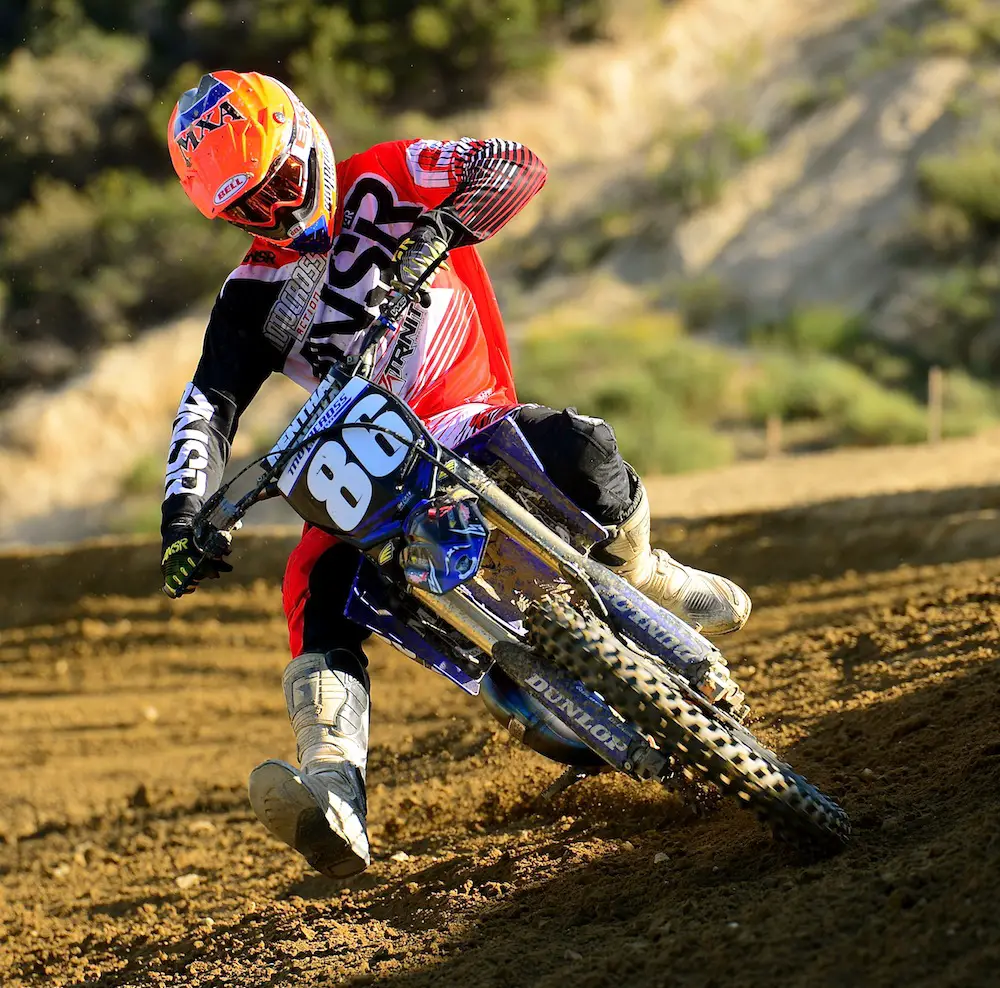 Johnny Jelderda (86) borrowed John Basher’s YZ125 and rode it to a two-moto sweep of the 125 Pro class at the 2015 World Two-Stroke Championship.
(11) Final words. An argument can be made that my YZ125 borders on extravagant. Yet, every test rider who rode my prized YZ125 agreed that the improved performance was worth the investment. It was so good that it won the 125 Pro class at the 2015 World Two-Stroke Championships. Put that in your pipe and smoke it.







 English (US) ·
  French (CA) ·