

 3 weeks ago
31
3 weeks ago
31
PROTECT YOUR DNA WITH QUANTUM TECHNOLOGY
Orgo-Life the new way to the future Advertising by Adpathway Rhona Wise and Kiyoshi Mio-Imagn Images
Geraldo Perdomo makes me happy. He’s a really good player with an interesting skill set, and he seems like a pleasant person. Last year, he hit .290 with 20 home runs, 27 stolen bases, and more walks than strikeouts. Combined with even adequate shortstop defense, you’d think that would make him one of the most valuable players in the league, and you’d be right.
In a world without Shohei Ohtani, we could’ve had a fun multidirectional NL MVP discussion involving Perdomo, Juan Soto, Kyle Schwarber, Trea Turner, Corbin Carroll, and maybe even Paul Skenes. As it stands, Ohtani won in a walk and Perdomo finished fourth. But it’s an honor to even be in the discussion.
What do I want? More Perdomo. We kind of got that last year with Maikel Garcia’s breakout season, but I wasn’t satisfied. Last November, I went on a search for the next Perdomo. I identified young players with elite contact skills, elite plate discipline, rock-bottom bat speed, and the athleticism to play up the middle.
My reasoning was pretty straightforward: Perdomo and Garcia already had the eye and the hand-eye coordination to become impact hitters, and both had made that leap after swinging just hard enough to do damage. The difference between a Punch-and-Judy hitter and a top-five MVP finish can be as subtle as a one or two miles per hour of bat speed.
I found three candidates who looked poised to make the leap: Xavier Edwards, Liam Hicks, and Caleb Durbin. And I talked about it a lot. I heard from friends across… at least two fantasy baseball leagues who reached for one or more of these players based on my recommendation. I don’t play fantasy baseball, but I am in a Diamond Mind league that lags one year behind the real world, and the Perdometer had a big impact on our draft. My former podcast co-host Zach Kram swiped Durbin out from under my nose, and I got so angry I called the kindest, gentlest man in sports media a compound expletive that starts with the letter M. Not my proudest moment.
But Zach and I weren’t the only people interested in Durbin; the Red Sox acquired the hydrant-shaped third baseman as the centerpiece of a six-player trade with the Brewers and anointed him the heir presumptive to Alex Bregman. At the time, I thought they’d robbed the Brewers blind. (I did not know then that Kyle Harrison would be baptized in the holy waters of the Menomonee and emerge sanctified, and with an unhittable breaking ball. Turns out it’s dangerous to be on the same page as Craig Breslow.)
You Aren't a FanGraphs Member
It looks like you aren't yet a FanGraphs Member (or aren't logged in). We aren't mad, just disappointed.
We get it. You want to read this article. But before we let you get back to it, we'd like to point out a few of the good reasons why you should become a Member.
1. Ad Free viewing! We won't bug you with this ad, or any other.
2. Unlimited articles! Non-Members only get to read 10 free articles a month. Members never get cut off.
3. Dark mode and Classic mode!
4. Custom player page dashboards! Choose the player cards you want, in the order you want them.
5. One-click data exports! Export our projections and leaderboards for your personal projects.
6. Remove the photos on the home page! (Honestly, this doesn't sound so great to us, but some people wanted it, and we like to give our Members what they want.)
7. Even more Steamer projections! We have handedness, percentile, and context neutral projections available for Members only.
8. Get FanGraphs Walk-Off, a customized year end review! Find out exactly how you used FanGraphs this year, and how that compares to other Members. Don't be a victim of FOMO.
9. A weekly mailbag column, exclusively for Members.
10. Help support FanGraphs and our entire staff! Our Members provide us with critical resources to improve the site and deliver new features!
We hope you'll consider a Membership today, for yourself or as a gift! And we realize this has been an awfully long sales pitch, so we've also removed all the other ads in this article. We didn't want to overdo it.
So Durbin’s not working out great so far, but it’s early.
It is not too early, however, to take a victory lap over Hicks and Edwards. I’m calling it. I was right — they’re both awesome now.
Hicks was perfectly competent last year; he posted a 98 wRC+ in 119 games and 390 plate appearances. He hit for zero power — a .099 ISO — but he got on base at a .346 clip, which is good for anyone, especially a catcher.
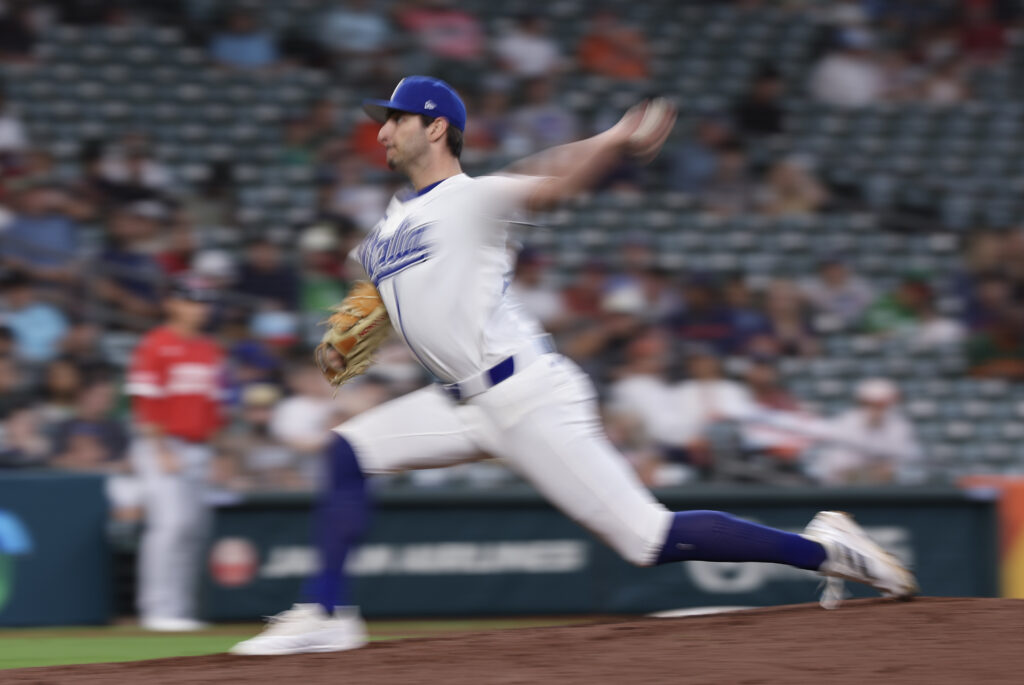
As of Thursday morning, Hicks is hitting .295/.354/.527. He set a new career high with his seventh home run of the year on April 29, in his 29th appearance out of 31 total Marlins games. He’s cooled off a little since then, but in his first 11 games of May, he still has a .162 ISO and two home runs.
Is Hicks’ offensive breakout a BABIP illusion? Is he sacrificing that once-pristine contact rate to sell out for dingers? No on both counts. Hicks’ BABIP is just .259, and his strikeout rate has actually dropped even further, from 14.4% to 8.2%. That last figure is in the 99th percentile for hitters, as is his 9.6% whiff rate.
Edwards is probably still most famous in some circles for the unfortunate sobriquet Blake Snell lavished upon him in December 2019. Snell wasn’t happy that the Rays had traded Tommy Pham (and a very young Jake Cronenworth) to San Diego; not to worry, Tampa Bay sent Snell himself that way a year later.
Ironically, “slap” would’ve been a good modifier for Edwards’ offensive game up until this season. From his debut in 2023 through the end of 2025, he played in 239 games for the Marlins, in which he registered almost exactly 1,000 plate appearances. His .298 batting average and .358 on-base percentage made him a valuable table-setter, and his 63 stolen bases in that span brought back memories of important Marlins infielders of days gone by.
But of the 402 other hitters who batted at least 500 times over those three seasons, only six produced a lower ISO than Edwards. In almost two seasons’ worth of playing time, he produced only four home runs and total 49 extra-base hits. A high OBP, good baserunning, and positional value got Edwards over 2.0 WAR in each of the past two seasons, but there’s a limit to what can be accomplished by a hitter with so little power. As Perdomo discovered before his breakout.
In 43 games this year, Edwards has as many home runs (four) as he hit in his first three seasons in the majors. He’s hitting .318/.406/.484, with the highest walk rate and the lowest strikeout rate of his career, and he has already put up 1.8 WAR. At his current rate of production, Edwards is going to cross 2.0 WAR by this time next week, with a new career high to follow soon after.
Here’s a fun bit of trivia: Both Hicks and Edwards still have terribly slow bats. The two teammates have nearly identical average bat speeds (68.0 mph for Hicks, 67.9 mph for Edwards), placing them in the fifth percentile among all hitters. Junior Caminero leads all hitters with an 80.0-mph average swing speed; by the time the Marlins guys have finished dragging their bats through the zone, Caminero is already coming back for seconds.
Are the Marlins’ Little Guys Swinging Differently?
| 2025 | 17.6% | 55.3% | 93.1% | 67.4 | 2.6% | 41.3% | 48.7% |
| 2026 | 24.6% | 65.1% | 97.0% | 68.0 | 1.4% | 41.5% | 52.2% |
| 2025 | 25.6% | 67.7% | 93.5% | 66.9 | 2.4% | 35.7% | 34.2% |
| 2026 | 20.9% | 57.5% | 93.0% | 67.9 | 0.4% | 47.0% | 52.3% |
Source: Baseball Savant
As you can see on the above table, both Hicks and Edwards have made subtle improvements in bat speed, but both were already so far to the left side of that graph it was like adding a “subtle” dab of sour cream to a scorpion pepper.
The changes in Hicks’ game aren’t quite as apparent in this table, so I’ll start with Edwards. It looks like he is more selective this season; if that were the result of a concerted effort to hunt for his pitch, we’d probably see a greater increase in fast swing rate. But that’s not really the case so far.
It’s important to remember that Edwards is a switch-hitter, and sure enough, he has made changes to his stance — but only on one side. From the left side, where he has taken three quarters of his swings this season, he’s setting up about four inches back in the box compared to last year, and swinging with a markedly higher attack angle — nine degrees, up from four. Taking the left side in isolation, he has improved his ideal attack angle rate from 38.9% to 59.6%.
Edwards is swinging the bat harder, at least from the left side. Fast swing rate is the percentage of competitive swings over 75 mph; Edwards has just fallen into a methodological gap.

If you look at this chart of his bat speed, last year and this year, from both sides of the plate, you’ll see that he’s sawed off a bunch of super-slow swings from the left side and moved the bell curve right. That’s the same advance Perdomo made; the difference is, Edwards’ faster swings are coming in the 70-to-75 mph range, so Baseball Savant’s fast swing bucket doesn’t pick them up.
You probably also noticed something weird about Edwards’ right-handed swing speed graph: It’s got two humps. It’s a bimodal distribution, unless you’re a camel, in which case it’s Bactrian. So he is getting more hard swings off — just not fast enough to register for fast swing rates — but there are still plenty of instances of him just sticking the bat out there and hoping for the best.
Right now, Edwards is getting better results from the right side than from the left, but the underlying numbers make me skeptical that will continue. He has a 14-degree average launch angle and a 1.46 walk-to-strikeout rate from the left side, with a launch angle of -1 degrees and a 0.57 walk-to-strikeout rate as a right-handed hitter. He’s genuinely productive as a lefty, but he’s just staying alive as a righty.
Which is fine, to be honest. Edwards is going to take most of his at-bats as a left-handed hitter anyway.
Hicks is also swinging the bat a little faster and addressing the ball at a better angle, but the change in his game is visually obvious. Here’s Hicks’ stance from last year.

And here it is this year, from the same center field camera angle.

OK, “obvious” might’ve oversold things. Look at his feet. In the still from 2025, Hicks’ right foot overlaps with his left heel. In 2026, there’s daylight between the two. He has opened his stance by 16 degrees from 2025 to 2026, which does one or both of the following: It helps you see the ball better and/or it forces you to hit the ball to the pull side.
I can’t speak to the former, but Hicks is doing the latter. His overall pull rate is up five percentage points from last year, and his in-air pull rate has leapt from 14.9% to 21.6%. (MLB average is 16.8%.) Pull-side liners and fly balls are where damage gets done, and Hicks is hitting a ton of them this year.
I mentioned Hicks’ BABIP earlier, but I committed a lie of omission in doing so. Hicks is outperforming his xSLG by 71 points and his xwOBA by 21 points. I’m not terribly worried about that, however, because expected stats don’t account for batted ball direction, and Hicks is eating good on cheap pull-side home runs. He has nine home runs, all of them not just to the pull side, but to the right of the right-center field power alley. And with the exception of one absolute tank that landed halfway up the second level in loanDepot park… actually, just for fun, let’s watch that one.
Jeez, that was a bomb. What was I saying?
Oh, yeah, none of Hicks’ other eight home runs traveled 400 feet. Again, that’s totally cool, because it’s only 335 feet out to straightaway right in Miami, and that’s where Hicks hits most of his fly balls.
The power gains that Edwards and Hicks have made this season are modest, by any standard. But for guys with short swings, great plate discipline, and great bat control, it doesn’t take much power to turn an average hitter into an impact hitter. Just ask Perdomo or Garcia.









 English (US) ·
  French (CA) ·