

 8 hours ago
2
8 hours ago
2
PROTECT YOUR DNA WITH QUANTUM TECHNOLOGY
Orgo-Life the new way to the future Advertising by AdpathwayPublished September 4, 2026 08:57AM
In Yoga Journal’s Archives series, we share a curated collection of articles originally published in past issues beginning in 1975. This article about Hand-to-Big-Toe Pose (Utthita Hasta Padangusthasana), first appeared in the March-April 2002 issue of Yoga Journal. Find more of our Archives here.
The Yoga Sutras of Patanjali states that an asana is to be practiced with stability and comfort (Chapter II, verse 46). A posture should not be just steady and not just comfortable; both qualities should be equally present. To me, this verse says that the feeling of a yoga posture needs to be clear in the mind and happy in the heart. If we bear this in mind as we practice, our yoga asana practice can become a path to a more joyful experience of life.
All the different asanas have been given to us as tools for observing the qualities of our minds. In balancing poses like Utthita Hasta Padangusthasana (Hand-to-Big-Toe Pose), for example, we discover that we must maintain a concentrated focus on a single point or we will be unable to balance and stay steady. This focusing of attention on a chosen point is called dharana (concentration), one of the eight limbs of Patanjali’s classical yoga system. Dharana leads us eventually to dhyana (meditation), where the attention is unwavering. This state is addressed in the next verse of the Sutra (II.47), which says the posture is perfected when we are steady and comfortable, when we let go of struggling and forcing, and when our attention is fixed on the infinite.
One of the definitions of yoga is “to unite.” The third and final verse (II.48) in Patanjali’s Sutra that comments directly on asana practice states that a yoga posture is perfected when the pairs of opposites no longer affect the practitioner. In physical terms, this means the spine is straight and firm and the posture balanced, front and back and side to side. When the body is aligned correctly, the channels of energy flow better, the mind relaxes, and a sense of quiet comes to the inside. The opposites become one whole, and there is no more struggle. When the body, mind, and soul are one, the practitioner is in a state of yoga.
When we practice asanas with a sense of devotion to this higher purpose, they can transform us. As we realize that the asanas are simply a vehicle to something more profound, we can relax and become more authentic and receptive in our practice. Building good habits in our daily asana practice—working patiently and honestly with proper alignment instead of just trying to force the body into the outer form of the poses—is the key.
The Core of All Poses
To being learning any asana, we need to understand Samasthiti (Equal Standing). Sama means “equal” and sthiti means “steady,” and in Ashtanga Yoga, Samasthiti is not just a pose name but also a command to attention. Also called Tadasana (Mountain Pose), Samasthiti is the core of all other postures. In a difficult pose, recreating the essence of Tadasana in the mind brings a sense of poise. The movement of the body naturally follows.
Within the body there are three areas that serve as platforms. Correct work and alignment in each of these platforms protects the vulnerable parts of the body above them. In Samasthiti, the feet serve as the first platform of the body, the foundation for the rest of the pose. Correct work of the feet protects the knees as well as the spine.
While standing with your feet together, spread your toes wide and reach them forward. Become aware of the four corners of your feet: the ball of your big toe, the ball of your little toe, and the two sides of the heels. Press these points down evenly, deepening your connection with the Earth, and lift the arches and ankles. As the arches draw up, let the lift ignite the energy through the core of the body. As the feet ground down, the kneecaps lift toward the ceiling. Move the front of the thighs back toward the hamstrings, balancing the weight of the body over the front of the heels.
Your next platform is the pelvis, which serves as an anchor for the spine. To maintain the natural curve of the lower back, the pubic bone should point straight down. You don’t want to tip the pelvis because doing so adversely affects the alignment of the spine: Tipping the pelvis forward excessively arches the lower back while tucking the pelvis under flattens out the natural lumbar curve.
To bring the pelvis to neutral, move the front of the legs back toward the hamstrings, and in opposition to this, move the sacrum forward into the body. In yoga, when two opposing actions come together, we call this “dual action.” As you work in this way, you will begin to see that the principle of opposites taught in Patanjali’s Sutra applies to your asana practice as well. You are seeking to unite, to find balance, and to make one undisturbed line of energy.
Another component of Samasthiti that must be incorporated in the balancing poses is the firming of the side hips. This action stabilizes you and creates a lift in the core of the body. The side hips are just to the side of your front hip bones. Draw them in toward the center of the body without tightening or rotating the buttocks, as these actions will cause the pelvis to tilt. Let both sides of the waist, as well as the front and back of the body, lift up off the pelvis evenly. Relax your shoulders and reach the arms toward the floor.
The third platform is the shoulder girdle, which protects the neck. Spread across your collarbones as you lift the top of the sternum up. It is easy to do this mechanically, using your outer musculature. Rather, do it from the inside, from the core of your body. Let the sides of the neck lift out of the shoulders evenly so that the crown of the head lifts and the chin is level with the earth. Gaze straight ahead. Let the eyes be soft and steady. Breathe smoothly and evenly.
 (Photo: Yoga Journal 2002)
Actions vs. Movements
I teach my students that it’s important to understand the difference between an action and a movement. Movements are gross motions involving the big muscle groups in the body; they’re concerned with moving the body, but not so much with how that’s accomplished. Actions are refined, specific activities. More difficult than movements, actions require focused effort that creates quiet attention inside. A movement done without sensitivity to actions can excite the mind and actually make us less attentive. When you see someone moving with no attentiveness to actions, the movement looks chaotic. When you see a person incorporating actions into their movement, the motion seems relaxed. There is a quality of effortlessness, even if the work is difficult. In asana, the goal is to do each movement with the focus of an action.
In order to learn the proper actions in a pose, sometimes we need to modify it and temporarily remove some of the obvious challenges. Once we master the actions, we can restore the inherent challenges of the pose. In Utthita Hasta Padangusthasana, for example, balancing is one of the greatest difficulties. So it’s a good idea to work with the support of a wall while you learn the actions necessary to stabilize the pelvis, open the hamstrings, and elongate the core of the body. The balance is the final touch, not the first thing to concern yourself with.
Stand facing a wall, preferably one that has a ledge. (You can also use a countertop or a stable piece of furniture.) Place your right foot on the ledge, directly in front of you. Place your left foot directly underneath you so that the heel and the sitting bone form a straight line perpendicular to the floor. Since the standing foot tends to turn out, look down and make sure that your second toe is pointing directly forward. Place your hands on your hips and align your torso directly over your pelvis. If you could see yourself from the side, you would want to see a straight line from the center of the ankle to the center of the hip to the center of the shoulder.
Work the standing foot and leg exactly as in Tadasana. The action of the left thigh moving back centers the weight over the front of the heel. The front of the thigh lifting up protects the knee and hamstring. If you are unable to lift your front thigh, you may have hyperextended legs. You can detect this in two ways: The calf will bow past the heel, and there will be a visible indentation below your kneecap. For students with hyperextension, moving the front thigh back locks the knee too much. Instead, they need to pay particular attention to the work of the calves. The calf muscle of the standing leg must press toward the shinbone rather than bowing back. It is this action of the calf that eventually allows you to lift the front thigh, realigning the muscles and supporting this new placement. All students can benefit from this dual action.
Now place your hands on the hips and notice if they are level. You must look for levelness on three different planes. First, you need to check the up-and-down level to see if one hip is higher than the other. Next, check side to side to see if one hip is forward or back: The hips should make a straight line parallel to the wall they face. Finally, you must balance the front-to-back plane. As in Tadasana, you create a tuck or excess arch in the lower back if you tip the pelvis either backward or forward. All of the planes in Utthita Hasta Padangusthasana can and should be level.
To bring your hips into symmetry, begin with the up-and-down level. Drop the right hip down so it is the same height as the left hip. As you do this, draw the left hip toward the midline to prevent it from collapsing outward. This is another dual action. Side to side, make sure the hips face straight forward. A common error is to take the right femur so deep into the hip socket that the groin tightens and the right hip moves too far back. At the same time, you don’t want to go to the other extreme, where the femur moves out of the hip socket and drags the right hip bone forward of the left. Look for balance: The right groin should be soft, the right thigh releasing down, and both front hip bones forming a parallel line with the wall in front of you.
For the front-and-back plane, keep the pelvis neutral and the pubic bone pointing straight down, just as in Samasthiti. This is possible only with correct actions in the legs. You have already established these in the standing leg. Now repeat them in the raised leg. Reach out through the right heel and the ball of the foot. Spread the toes. Keep the right knee facing straight up to the ceiling, so that the leg does not roll in or out. Drop the upper right leg thigh toward the floor to keep the right hip released down, and resist the tendency to lean into the left side hip.
Maintaining all these dimensions of evenness in the hips, reach your arms up toward the ceiling. The lift of the arms will aid in the lift of the torso. Work against gravity as you reach through the fingertips. Remove any backward rounding from the lower back and create a feeling of lightness in the torso. Keeping the hands shoulder-width apart, straighten the elbows. Steady your gaze at one point and relax the muscles of the face. Turn your focus inward, and let the breath be soft and quiet (Figure 1).
Utthita Hasta Padangusthasana is also practiced with the raised leg out to the side. If you already have your right foot on the ledge for the first variation, simply turn your left leg and your torso 90 degrees to the left. Once again place your hands on your hips and square the hips forward. To do this, most students need to move the right foot more forward on the ledge rather than straight out to the side. How much you have to move depends on the stiffness of your hips. Now level the hips up and down. Drop the right hip down to the same level as the left. At the same time, maintain the opposing action of firming the side of the left hip.
Continue pressing down into the standing foot, lifting the arch of the foot as though to draw it up through the center of the leg all the way to the crown of the head. Be steady in the ankle, drawing the inner and the outer ankle up evenly. Once more lift the front of the left thigh off your kneecap. Take both buttocks down toward the ground and simultaneously move the front thigh toward the hamstring. You may notice that this dual action is very similar to the one you worked on earlier in Tadasana.
Reach out through the heel of your right foot. Make sure the right knee directly faces the ceiling and spread the toes wide. As you drop the right hip down, continue to draw the side of the left hip toward the core of the body.
Now reach the arms up, separating the hands shoulder-width apart, and straighten the arms fully. Find a gazing point at eye level in front of you and soften your gaze. Draw your attention inside and practice letting go of any unnecessary struggle. Balance the sides of the torso evenly and directly over the pelvis. In this position, it’s easy to lean the torso toward the right leg; instead, lift up evenly through both sides of the waist and extend the arms higher. Soften the front of the ribs as you lift the back ribs up. Imagine that your waist is getting longer. As the front of your standing leg thigh moves back and the buttocks flesh releases down, you secure your base. From the strength in the legs, the torso can extend fully. It’s as if the torso is separating from the hips, freeing the spine to lift in a straight, undisturbed line of energy toward the heavens. As you let the core of the body rise, feel the breath move through this channel (Figure 2).
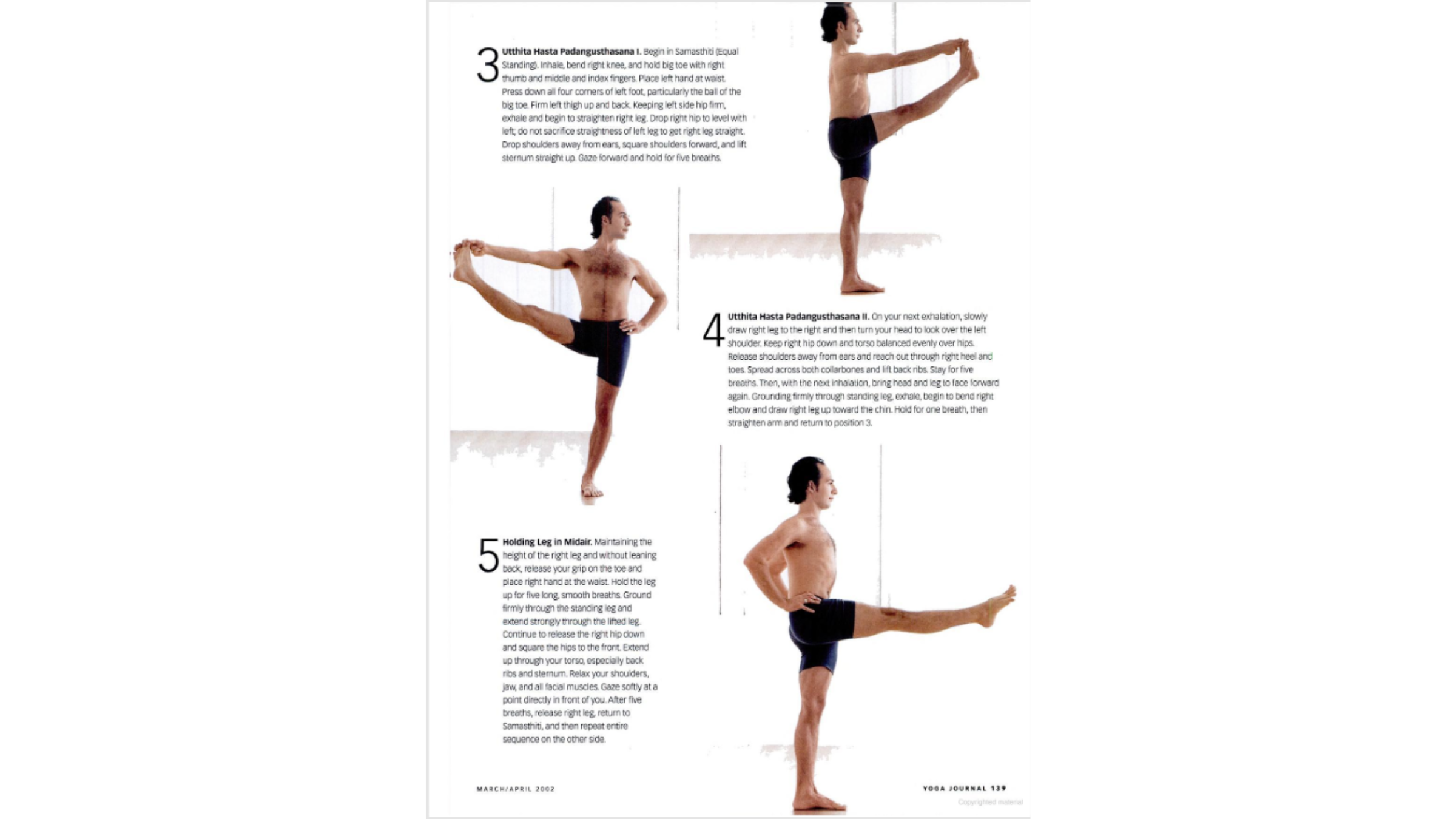 (Photo: Yoga Journal 2002)
To Prop or Not to Prop
When you use props, there is a danger that they will become a crutch. Perhaps for that reason, in Pattabhi Jois’s teaching props are not the first resort. But often an Ashtanga teacher will help a student hold the leg up, and that too is a kind of prop. I prefer to let my students work with the feedback of the wall. It can’t move, it’s stronger than I am, and I want my students to develop an independent practice, exploring for themselves how to solve difficulties in the poses.
So when is it time to leave the wall? More often than not, students want to do this before they are ready. Slowing down and practicing at the wall often provides a greater challenge—and a better learning opportunity—than moving prematurely away from it. You are ready to leave the wall when the lower back does not round, the hips square with ease, and the standing leg can remain firm and steady.
If you are ready to practice Utthita Hasta Padangusthasana in the center of the room, begin by standing in Samasthiti. Balance the weight evenly between the right and left foot. Without leaning to the left or collapsing your left hip out to the side, inhale, bend your right knee, and grasp your right big toe with your middle and index fingers and thumb. Your left hand is at your left hip. Press down all four corners of your left foot, especially under the mound of the big toe. Steady the ankle. Do not let the left thigh buckle forward; draw it toward the back of the leg. Firm the thigh strongly upward by grounding the foot down.
Holding the right big toe and keeping the standing leg straight, exhale and begin to reach the right foot forward. Extend the foot directly in line with your navel. Do not sacrifice the straightness of the left (standing) leg in order to straighten the right leg. As the left thigh moves back into the hamstring, lift out of your lower back. If the hamstrings are stiff, it’s easy to compensate and lean the torso forward in an attempt to straighten the front leg. Resist this temptation. Stand upright out of the standing leg and out of your lower back. If the right leg does not straighten fully, that’s OK. With time and patience, it will. Do not let your ego get the best of you; don’t get discouraged just because this action is difficult. Eventually, if you maintain a positive attitude and regularly practice the actions you’ve learned, both legs will straighten.
As you did at the wall, create a straight line on the standing-leg side from the center of the ankle to the center of the hip and the center of the shoulder. The right shoulder should be square with the left, so do not pull the upper arm away from the socket in order to straighten the leg. Drop the shoulders down, spread across your collarbones, and from deep inside lift the sternum (Figure 3). Practice the pose with the leg straight forward like this until you can comfortably stand upright with both legs straight while remaining relaxed on the inside.
If both legs are straight and the posture is calm and steady, exhale and move the leg to the right. Nothing should change in the standing leg. Ideally, the hips remain level on each of the three planes; don’t take the leg so far to the side that you compromise these symmetries. The torso should remain square over the hips and the front ribs soften as the back ribs lift. Keep the right arm straight and the shoulder in the socket. If you are steady, turn your head to gaze over the left shoulder and hold for five breaths (Figure 4). Then inhale and bring the leg to face forward again. If you lose your balance, don’t be frustrated. Bringing the leg back to center is often the hardest part of the sequence. With time and practice this too will become effortless.
If you were successful in bringing the leg back to point straight forward, keep the right leg at the same height as you release the hand to your hip, balancing the leg in space. This requires abdominal strength. Keep the back ribs up and resist leaning back! If you’re doing this properly, it may even feel as though you are leaning forward. Reach out through the right leg, keeping it straight, and spread the toes (Figure 5). Stay here for five breaths and then exhale to lower the leg. Pause in Samasthiti, take a breath to notice the effects of the pose, and then change sides.
Putting It All Together
In Ashtanga yoga, Utthita Hasta Padangusthasana is a series of movements connected by breath and gaze. If you’ve done your homework at the wall and in the center of the room, you are ready to string it all together.
Stand in Samasthiti. Balance the weight evenly on the feet and pause, drawing the breath gently through the back of the throat. Do not harden the breath, as this will cause your mind to tighten. Inhale and place your left hand at the hip. Bend the right knee and grasp the big toe. Stand firmly on the left leg, as though it were in Tadasana. With a slow, smooth exhalation, extend the right leg straight forward. Again pause and draw yourself upright on the standing leg. With your next exhalation, bend the elbow and begin to lift the leg up toward your nose. Do not fold down but rather reach the leg up. If the standing leg begins to bend, do not go further. Work here, where you haven’t sacrificed Tadasana.
At this point, it is traditional to bow toward the leg, but I find that most students are so focused on getting the chin to the shin that they give up proper alignment in the legs, hips, and back. To avoid this, I prefer that my students keep the torso upright and continue to work all the actions necessary for keeping the legs straight, the back extended, and the hips as symmetrical as possible in all three dimensions. If you continue to work all the proper actions in the pose, someday you may be able to remain upright, draw your shin to your chin, and gaze comfortably at your big toe.
Stay for five breaths at your current limit, the point where you can just manage to keep the standing leg straight. Then inhale, coming upright if you have folded forward, straighten the right arm, and level the shoulders. Exhale, slowly taking the leg sideways and looking to the left. Stay here for five breaths. The torso should be evenly stacked over the pelvis so that the right and left sides of the waist are equal in length. Inhale and slowly bring the leg back in front of you. From the strength of the standing leg, exhale, bend the right elbow, and again lift the right leg up to meet the chin for one breath, gazing up at your big toe. With the next inhalation, straighten the right arm and look forward. Keep the height of the right leg as you release the right hand to your hip. Remain here for five breaths, standing upright, reaching out through the right leg, and lifting the back ribs. If your leg is higher than parallel to the floor, gaze at the big toe; if your leg drops below this, keep your gaze at eye level. After five breaths, bring the leg down gracefully, stand in Samasthiti, and then repeat on the other side.
Aligning the body in balancing poses helps still the wavering of the mind, and no posture serves as a better mirror for your mental state than Utthita Hasta Padangusthasana. Yoga philosophy tells us that by cleansing the body and mind we become a vessel for true yoga: the union of opposites, the coming together of body and attention. In other words, practice leads to freedom. But, as my teacher says, most of us need to practice one series a thousand times to begin to truly understand this.











 English (US) ·
  French (CA) ·