

In our homes and in our hands, we’ve become used to using high-speed internet for everyday tasks as well as for non-stop entertainment. But now the threads of the worldwide web also criss-cross the world’s oceans.
Whatever your feelings are about staying in touch while offshore, for better or worse the technology has now arrived at an affordable price to enable high-speed internet at sea.
There is one company whose name has been constantly mentioned in the world’s media over the last couple of years, especially since the start of the war in Ukraine, and in part due to the notoriety of its founder, Elon Musk. That name is Starlink.
So, what is all the fuss about Starlink? And does it matter to typical bluewater cruisers who have had access to affordable offshore communications for a decade, thanks to the innovations of the Iridium satellite system?
We set out to answer these questions during the 2025 edition of the Atlantic Rally for Cruisers, asking the skippers across the fleet of 226 yachts about their actual experiences of communicating offshore. By finding out how the equipment functions in the real world, what the true costs are, and exposing some of the hidden costs, we aimed to find out if the reality of having Starlink lives up to the hype, and, importantly, whether it makes bluewater cruising safer. Here’s what we learned:
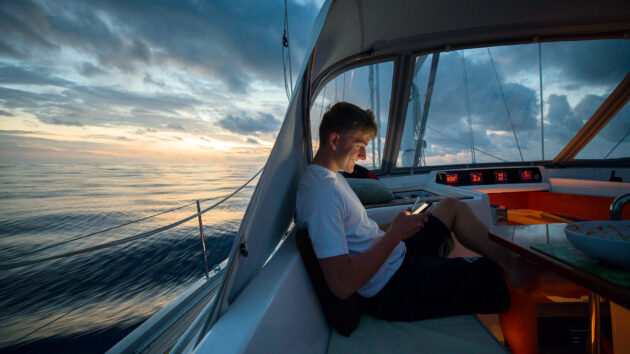
Staying in touch mid-Atlantic aboard the Oyster 575 Angel’s Share. Photo: Tim Bishop/timbismedia.com
Starlink: The techie bit
Users don’t need to understand the science to benefit from a system such as Starlink, but it helps to appreciate the scale and the likely impact of this technology in other areas of our lives. Starlink is one of several actual and proposed communications systems intended to seamlessly bridge the gap between areas of poor land-based internet or mobile services.
In simple terms, it uses a network of around 4,500 low earth orbiting satellites to create a shell around the globe, with each satellite acting as a mobile telephone mast in the sky. By placing sufficient satellites in orbit, coverage gaps are closed, either via direct links to subscriber devices or by connecting with land-based telecoms companies around the world.
The idea seems simple, but by comparing Starlink to earlier global systems, the scale becomes clear; for example, older, more established rivals Inmarsat operate around 15 geostationary satellites, while the newer Iridium system has around 78 polar orbiting satellites; Yet SpaceX, owner of Starlink, is aiming for more than 10,000 satellites!
Designing and producing this number of satellites, plus the rockets to launch them into space, and the ground stations to control them all, needs a lot of money, hence only global billionaires such as Elon Musk or Jeff Bezos’ Amazon Corporation have the deep pockets and ambition required to turn the science fiction into science fact.
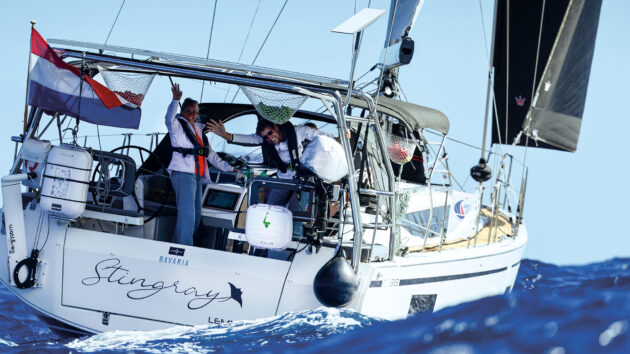
Loaded up and heading west, the 38ft Bavaria Stingray sets off on the ARC 2025, with Starlink receiver ready to keep them in touch. Photo: Paul Wyeth/WCC
Having gradually launched, trialled and developed their system since 2019, the technology has matured, and the user-base expanded so that Starlink now claims to have around 10 million users. Its connections with regional telecoms companies are rolling out to ‘connect anywhere’ services for mobile phones, and major airlines are competing to offer their passengers high-speed internet for modest costs or even free use.
Who used what?
Across the fleet of 226, a staggering 209 yachts were fitted with Starlink, so just 17 did not have the system on board. Interestingly, more than half of the boats with a Starlink also had an alternative communications system aboard, 108 versus 101 with just Starlink alone.
Looking at those boats with Starlink plus another system, significant numbers were opting to carry either an Iridium handheld satphone or Inmarsat’s equivalent iSatPhone – in total, there were 44 Iridium handheld phones and 10 iSatPhones – almost a quarter of the fleet.

Illustration concept of a fleet of Starlink satellites in orbit. Photo: xnk/Shutterstock
Among boats with more than one system, Iridium’s offering was most frequently seen. These were either the newer Certus system, which comes in a variety of equipment packages, or the previous generation of Iridium GO! and handheld devices. [Due to the confusing product name – Iridium GO! Exec for the Gen 2 (Certus 100) version – some of the Iridium equipment may be incorrectly logged as Iridium GO! Gen 1 in our survey.]
A significant difference between Starlink and rival systems is Starlink’s lack of a true phone connection, with the newer system offering only data calls via VoIP apps such as WhatsApp.
Both Iridium and Inmarsat offer handset dialling with dedicated phone numbers, and for the smaller handheld devices, the benefit of a pocket phone suitable for taking into a liferaft in an emergency. Plus, with a dedicated telephone number, the Iridium and Inmarsat devices operate just as a landline would, enabling incoming and outgoing calls to any number.
HF radio (SSB) paired with a Pactor modem is still a viable technology, and was on board 16 boats, although of this group, only one of them did not also have a Starlink.
Just over half the skippers (54%) fitted their satcom equipment within a year of their Atlantic crossing.
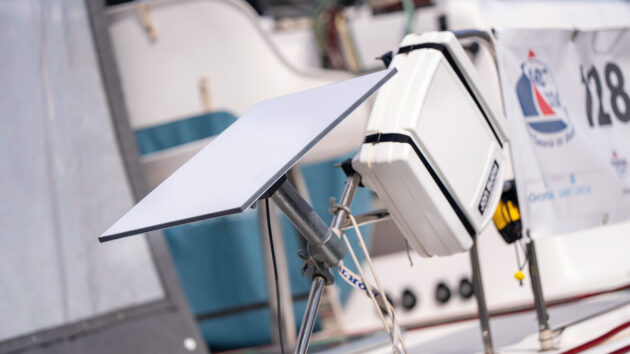
Typical Starlink satellite dish installation. Photo: James Mitchell/WCC
Starlink types
Starlink is offered in various equipment packages and has been rebranded as new generations of equipment have come into use. Not all equipment was clearly identified in our survey responses. There are four types of Starlink models (Mini, Gen1, Gen 2, Gen 3), of which only Mini is a 12V system. There are also a variety of service plans:
- Roam 50GB and Roam 100GB, intended for inland waterways and territorial waters (up to 12 nautical miles from shore). These are limited to five consecutive days and 60 days per year in these waters.
- Roam Unlimited is the same as Roam 50GB but can be upgraded with optional Ocean Mode for extended use beyond 12 nautical miles, exceeding 5/60-day limits, with higher network priority.
- Maritime, also known as Global Priority, offering 50GB, 500GB, 1TB, 2TB and Unlimited.
Performance
As Einstein may have said, speed is relative, so when we talk about high-speed, we are looking through the lens of an ocean sailor, not a home user plugged into a fibre-optic cable. Perception of internet speed is also based on the tasks a user needs to achieve, so downloading a basic weather GRIB file via an Iridium GO! may well be fast enough, but try using the same equipment for WhatsApp, and it becomes impossibly slow.
Of the 151 skippers who commented on the performance of their Starlink system, almost all of them were very satisfied, with many calling the performance ‘excellent’ or a similar superlative.
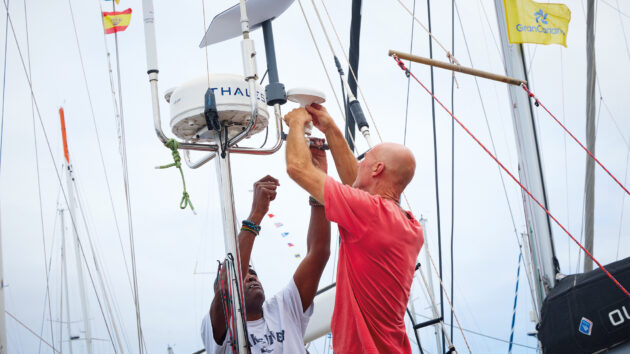
With Starlink, satellite dishes, VHF/DSC antenna, AIS aerials and radar, today’s off shore cruising yacht communication masts can get busy. Photo: James Mitchell/WCC
“Starlink Mini on Global Priority – absolutely unbelievable. Banking, video calls etc mid-Atlantic, total gamechanger!” – Christopher Monk (Southerly 42RST Breeze) “Starlink worked faultlessly, however we wanted the high integrity from Iridium in an emergency, so we also had a ‘big red phone’ (Certus), and an Iridium handheld ‘big red phone’ was a brilliant safety net for kids,” Lawrence Ellis (Moody 44 Canopus).
“No issue. Efficient for weather forecast, email, and WhatsApp. Our Starlink was easy to install,” Frédéric Vandenberghe (Grand Soleil 37 Lovitana).
There were just six users whose feedback was less than superb, but still hardly damning, referring to Starlink as ‘adequate’ or ‘good enough’. And there were just two comments about dropped connections or dark patches – areas mid-ocean without satellite coverage.
“Overall, it was good. Sometimes we experienced communication problems during calls and WhatsApp,” Nils Dauber (Outremer 51 Mathilda).
“Starlink excellent, sometimes slow to connect. Our Iridium sat phone was also excellent,” Tapio Lehtinen (Swan 55 Ganesha).
“Starlink was OK, but it took a long time, more than 30 seconds, to connect” Ettore Bandieri (Garcia Passoa Yemanja).
Interestingly, one skipper, Christopher Blackburn, commented that his Starlink failed en route to Las Palmas, but that his Iridium Certus 100 was “very reliable”. He did get his Starlink working for the transat and was subsequently pleased with its performance.
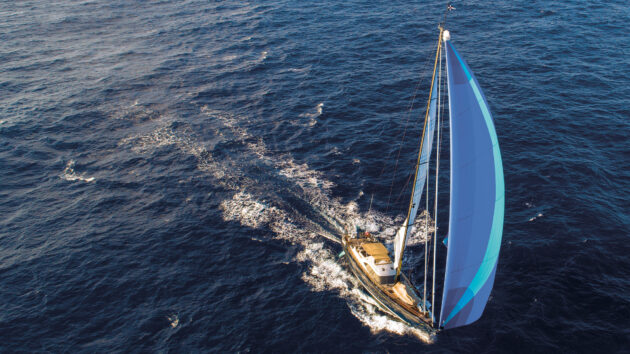
‘When we talk about high speed we’re looking through the lens of an ocean sailor, not a home user’. Photo: Rick Tomlinson / Oyster World Rally
Two other skippers reported Starlink electrical failures – one caused by a burned-out inverter, so not strictly due to the Starlink itself, and the other skipper, Richard Close-Smith (Starlight 39 Diamond Blue), commenting that “It worked fine, but melted our switch panel wiring in the process.”
Power requirements
While overwhelmingly in favour of their Starlink systems, there was a significant split between skippers who felt it was a power-hungry device and so limited its operation, and those who ran it 24/7.
“Really impressive, although it used a lot of battery,” Robert Morton (Hanse 348 More Shenanigans).
“Starlink using 2-3A was an issue when times were tight on power,” Tapio Lehtinen (Swan 55 Ganesha)
In statistical terms, 104 skippers felt that power consumption did not impact their usage – and in this group it was a typical fit of 700Ah lithium service batteries. Where 56 skippers did consider power consumption to be an issue, in this group it was a typical fit of 600Ah lithium service batteries.

High speed internet communications allowed Massimo Peschiulli to continue to run his business and attend online meetings while crossing the Atlantic aboard his Hanse 540 Ahinamà. Photo: Massimo Peschiulli
We need to be careful drawing conclusions from skippers’ comments about power usage as the equipment was not used in isolation and the use of other large consumers, such as autopilot, refrigeration and radar were not surveyed. Generally, skippers whose boats were fitted with lithium service batteries (median size 750Ah) were much more likely to keep their systems connected 24/7. From the skippers’ feedback it’s also clear the smaller equipment types – Starlink Mini and Iridium Certus 100 – are better suited for those boats with a tight power budget.
“Starlink Mini worked perfectly, low power consumption, only needs 2Ah,” Ralf Conrad (Saare 38 Havanna).
“Certus has minimal impact and Starlink Mini run through local inverter means consumption was very low,” Laurence Ellis (Moody 44 Canopus).
“Our Gen 2 Starlink draws 5Ah, so off overnight and during low power episodes,” Michael Neave (Najad 380 Falken).
As the larger systems require AC power, inverters are a potential point of failure unless boats have an AC generator. Mark Cavendish (Jeanneau Sun Odyssey 479 Orea II) explained: “Our Starlink was connected via our 12V inverter, which failed, so we used our Iridium Certus more than I expected to”.
Other skippers opted to turn off their systems regularly rather than running 24/7 to “give the inverter a rest”. Another power hack was offered by Andrew Heppel (Oyster 595 Carina) who reduced his power consumption by changing his Starlink High Performance unit to run off 24V DC.
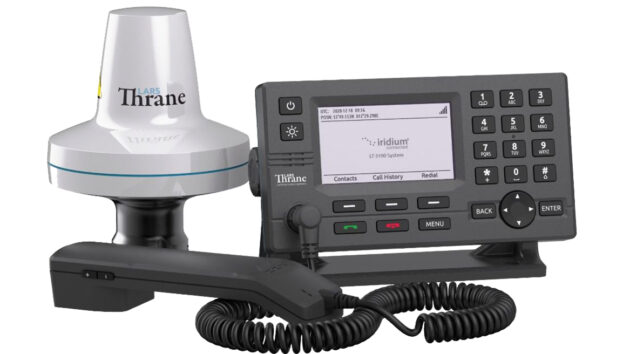
The Iridium Certus 100 is a lower power system that skippers found a reliable backup when Starlink signals were dropping out
A potential power-consuming pitfall for unwary users, and possibly linked to the reported dropped connections mid-ocean, is the more limited satellite coverage of Starlink when far offshore, compared to rival Iridium.
The power usage of the equipment is increased when the system is started and must search for a satellite connection – the longer the hunt for a connection, the more time spent in high-power mode.
“We switched off Starlink sometimes as 46W is consumed and can get to 90W when searching satellites, which happened a lot at the end of leg 2 (Cape Verde to Grenada), because we have the flat high-performance antenna which uses 100W,” Sylvain Rayé (Excess 11 Liko).
Other skippers accepted the power cost of running 24/7, in part due to the time it could take to get connected. “It took 10 minutes to get online, so we left it on for security,” Robert Allan (Bali 5.4 Blue Oceans).
Satcom usage
On land, many of us are used to running our social and work lives with chat-type messaging apps, so it’s not surprising that more than a quarter of skippers reported using WhatsApp during their ARC crossing. This is perhaps the most significant change for intra-boat communications brought about by widespread ‘always on’ internet connections.
Responding to this shift, the ARC organisers now run two WhatsApp Groups for each of its ARC and ARC+ routes.
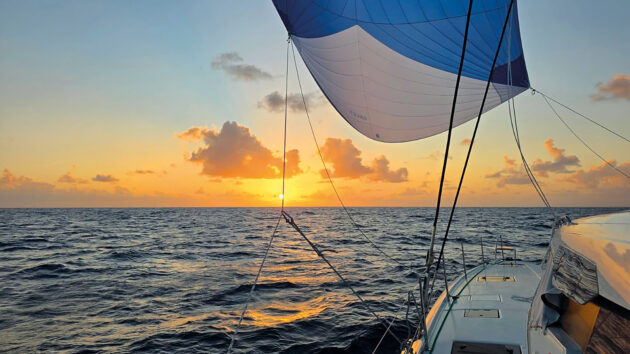
Photo: World Cruising Club
There’s a traditional Safety-net group, with boats checking-in daily, sharing positions, sail plans, local weather conditions and any safety messages with the fleet. To keep data usage low, which encourages wider participation, there is a strict ‘no photos or video’ policy on the Safety-net. There is also a separate Crew-chat group for the crossing, encouraging crews (most boats had a local wifi network to share their connections) to share stories, photos, fishing updates and memes. While more light-hearted than the Safety-net, it was still used as a means for joint problem-solving between boats. On both ARC routes it proved very popular, and both groups are still going strongly after the crossings.
“We did a huge amount of WhatsApp when en route – only really feasible through Starlink,” comments Laurence Ellis (Moody 44 Canopus). “We used it for the Kids net (ARC Families Group) and for help with fuel transfer after rig failure and checking in with nearby boats with equipment failure.”
Overall, 136 boats reported using social media at sea in addition to chat messaging, with Instagram, Facebook, TikTok, Polarstep and personal blogs all very popular. Four crews confessed to streaming TV, films, music or games during the crossing.
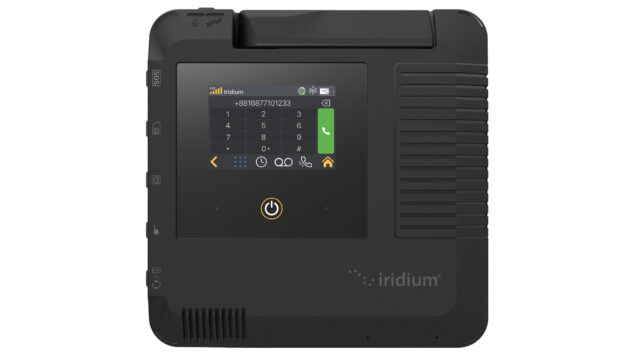
Iridium GO! and the newer Exec version was the staple satellite linked wifi hotspot option that keeps your smartphone, tablet or laptop connected – before Starlink arrived
There were 11 named weather apps used across the ARC fleet, ranging from professional suites that embed into navigation plotters such as Expedition, Adrena and Squid, to the well-known apps optimised for smartphones and tablets, such as Windy and PredictWind. Apps such as Windy and VentuSky, which give a global animated wind view, are now accessible at sea via high-speed connections.
In addition 72 skippers specifically mentioned using their satcoms for technical support with equipment or medical problems. While a direct satphone call has been a realistic option for cruising boats since the introduction of Iridium handheld phones in the late 1990s, plugging into the worldwide web at sea has opened more opportunities for problem solving. Searching for YouTube videos and asking questions of AI chatbots were reported as usage types by several skippers this year.
Running costs
Although rating their Starlink system as ‘excellent’, eight skippers also said it was expensive to operate. It’s notable that only 89 skippers kept their systems active 24/7, accepting the impact on their power and financial budgets as a consequence. Not surprisingly, smaller, cheaper systems tend to be run for lower operating costs than faster, more power-hungry systems. Leaving equipment on 24/7 has a cost in data as well as power usage.
More than half of skippers thought safety was improved, not just by instant communication, but the ability to access troubleshooting solutions at sea. Photo: Hanno Renner
Conclusions
Almost all the skippers who opted for Starlink, Iridium Certus or Inmarsat Fleet systems were happy with their equipment. Importantly, over 70% of the ARC skippers felt their safety was improved by having these systems. The performance versus cost of purchase equation has swung greatly in favour of having satcoms on board, as the numbers fitted in the 2025 ARC show.
A Starlink Mini can be bought for around £400 and a monthly plan from £50-£75. When used with an Ocean-enabled roaming plan, this typically provides download speeds of around 110-120Mbps, fast enough to stream video, social media and frequent weather data downloads.
Does the significant uptake of Starlink mean it’s now the only option to consider for bluewater cruisers? Well, perhaps not. As with so much bluewater cruising equipment, there’s still a trade-off with cost, power and functionality. Our survey showed there are still limits to Starlink – power consumption being the most relevant.
Service batteries and charging systems need to be in good condition, and beware of the knock-on effects on other big consumers, such as autopilots, which are often run 24-hours per day. While good connectivity was experienced during the ARC, there were still dropped connections, black-spots and long start-up times reported, which are failings less common in rivals Iridium and Inmarsat.
Your style of bluewater cruising and the make-up of your crew may well also be a consideration. Teenagers may well resent sailing with parents these days if it means losing contact with friends at home, in which case mobile internet is a must-have. Easy and frequent weather downloads were also widely appreciated by all the skippers in our survey.
Probably the biggest change brought about by this equipment is the ease of access to outside advice from helpful YouTube videos, AI chatbots or the ability to share a video of broken parts and problems at sea. It was noticeable that so many skippers also took a handheld satphone, which shows the value still placed on reliable phone calls, both incoming and outgoing.
 If you enjoyed this….

Yachting World is the world’s leading magazine for bluewater cruisers and offshore sailors. Every month we have inspirational adventures and practical features to help you realise your sailing dreams.
Build your knowledge with a subscription delivered to your door. See our latest offers and save at least 30% off the cover price.
Note: We may earn a commission when you buy through links on our site, at no extra cost to you. This doesn’t affect our editorial independence.












 English (US) ·
  French (CA) ·