

PROTECT YOUR DNA WITH QUANTUM TECHNOLOGY
Orgo-Life the new way to the future Advertising by AdpathwayOn Jun 1, 2026 Last updated Jun 1, 2026

BY JODY WEISEL
I’m a motorcycle test rider—that’s all I have been since 1971. I must admit that testing motorcycles for a living is a pretty cool way to put tiramisu on Lovely Louella’s plate. It may sound like the ultimate job, but it really entails spending long days in hot, dry and dusty places that are far from civilization and even farther from an ambulance.
But, the sensation of throwing a leg over an exotic, one-off, yet to be sold to the public race bike before anyone else in the world sees it is a powerful drug. My job is to criticize the bad and praise the good. I must admit that I’m much better at complaining about the bikes I test than loving them. The corporations who build the bikes I test are much like the chefs at fancy restaurants when the New York Times food critic drops in unannounced. They are nervous. I fully understand that the hopes of corporation’ sales department rest on the test rider’s shoulders—and I can feel the anxious eyes of the engineers staring at me every time I come into the pits for the slightest smile, twitch or grimace on my face.
The marketing men are very adept at reading body language and even the slightest shrug of your shoulders will send them scurrying into a huddle to ask each other, “Is that a yay or a nay?” For this situation, a good test rider remains stone faced, stoic and emotionless. You ask for whatever changes you want without whining, whimpering or being giddy. Some times that’s very hard. Don’t get me wrong. I’m not a sales Svengali. I’m only one source of information—and a minor one at that. Unlike Nero, the life or death of that particular machine does not lie on the direction of my thumb.

“I’M A VERY POLITE TEST RIDER. I NEVER THROW A BIKE DOWN ON THE GROUND AND STOMP OFF. I DON’T SWEAR, MUTTER OR COMPLAIN. AT THE WORST, I WILL SHAKE MY HEAD IN A WAY THAT COULD MEAN EITHER GOOD OR BAD.”
I’m a very polite test rider. I never throw a bike down on the ground and stomp off. I don’t swear, mutter or complain. At the worst, I will shake my head in a way that could mean either good or bad. At the best of times, I get a slight smile on my face that telegraphs my opinion of a good bike. My greatest strength is that if I don’t have an opinion, I will gladly say, “I don’t know.” There are lots of things that I don’t know and way too many opportunities to prove it. Too many test riders succumb to the pressure of the moment and spout off about “not enough rebound and the pilot is too lean” only to discover later in the day that the bike has too much rebound and is fuel injected.
Not every bike is a gem of the sea. There are more flounders than most people care to admit. If I don’t like a bike, there is no guilt on my part. “I don’t make ‘em, I just break ‘em!” is my motto. Although, there is always a sense of sadness knowing that a product will go on sale whether I point my opposable digit towards China or not. But, I like what I do and I can’t let disgruntled executives or unhappy engineers dissuade me from my appointed rounds.
So, it was with some surprise that I got a call from an old friend who worked for a Japanese motorcycle manufacturer. “Jody,“ he said, “We have a totally revolutionary rear suspension system that we want you to test. It isn’t ready for production. It’s still in prototype form, so you can’t tell anybody about it. But, since you have been our harshest critic over the years, we’d like you to set up a test session at your convenience. We can’t do this project with our regular test riders, because they are how we got in this predicament already. I’ve convinced management that before we continue with this project and waste a lot of money, we need to get some objective feedback. What do you say?” Of course I agreed, but only out of curiosity. I don’t test bikes for the factory teams or the high-powered Pro Superstars, I’m best known for testing bikes to make sure that they work for regular riders, Vets and paying customers.
On the appointed day, they rented Glen Helen Raceway, positioned guards at the gate and unloaded the bike from the factory box van. It had contraption-factor written all over it. There were links, bell cranks and widgets sprouting out of it like eyes on a potato (other than that I can’t tell you any more). I tried to ask the two Japanese engineers about the theory behind the Rube Goldberg-looking device, but neither of them spoke English. I got dressed while they adjusted the dials and punched numbers in a laptop.
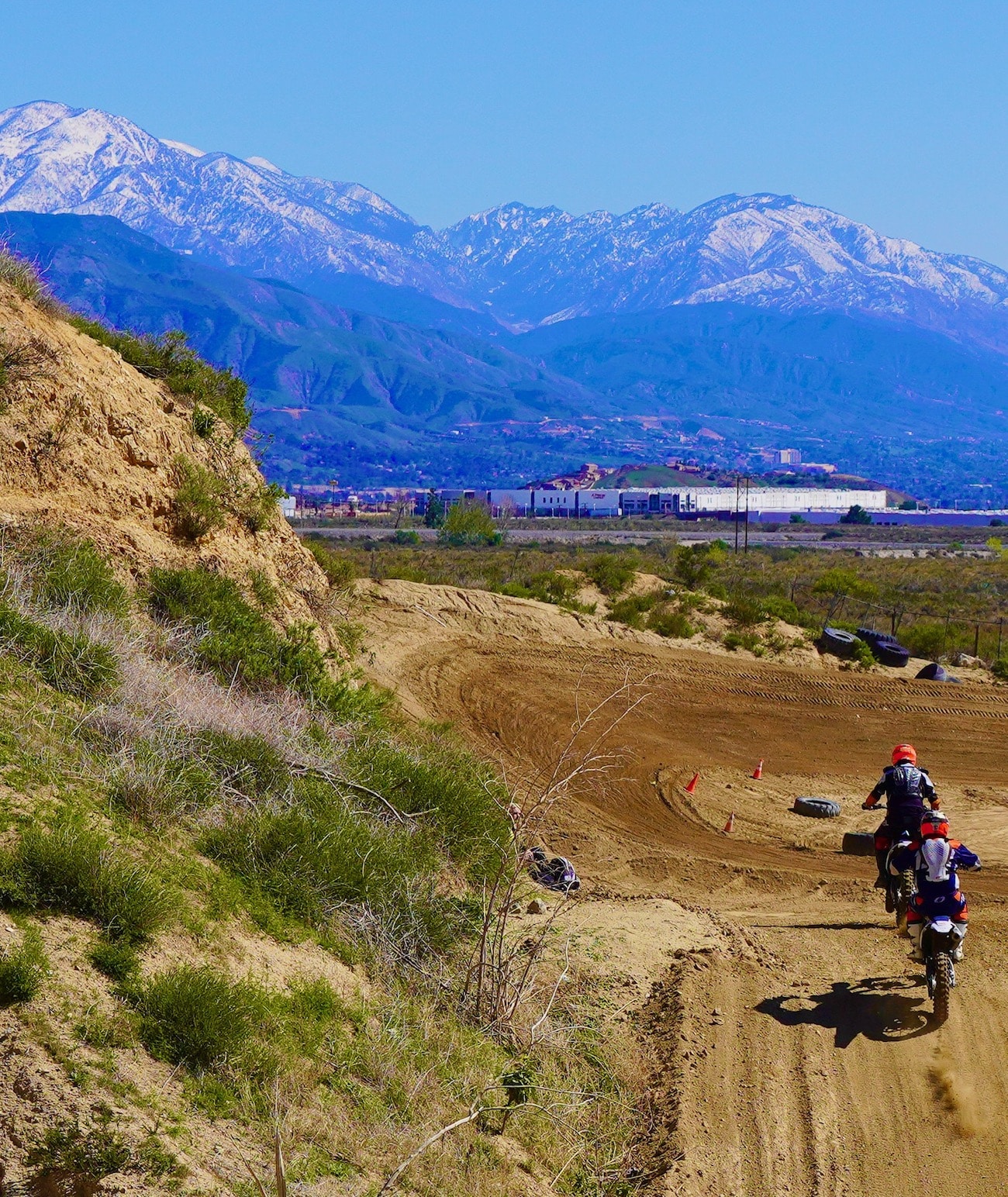
“I CASED THE BIG DOUBLE TO TEST THE SUSPENSION (ALTHOUGH I CASE THE BIG DOUBLE EVEN WHEN I’M NOT TESTING SUSPENSION).”
On the track the bike felt pretty comfortable. I cruised for two laps and then steadily began to pick up the pace. Everything felt good. Through the sand whoops the bike tracked straight. There was no twitching in the corners. I cased the big double to test the suspension (although I case the big double even when I’m not testing suspension). It absorbed everything without a whimper. My confidence in the system began to grow and I began to let it hang out. I could see the two Japanese engineers standing nervously by the side of the track, so I dug a little deeper than I normally do on a test day. My lap times were good, and no matter how hard I landed or short I came up, the experimental rear suspension worked like a charm.
When I finally pulled up to the box van after 30 minutes, I had a noticeable smile on my face. That was nothing compared to the two Japanese engineers. They were hugging each other and jumping up and down. Each one ran over and pumped my hand and bowed. They were enthusiastically shouting the phrase “Sore wa kono-jikan o’ kowashite imasen.” They were so enthusiastic that I started repeating “Sore wa kono-jikan o’ kowashite imasen” back to them. For five minutes we chanted “Sore wa kono-jikan o kowashite imasen” and high-fived each other.
It wasn’t until later that I learned that “Sore wa kono-jikan o kowashite imasen” translates into English as “it didn’t break this time.”













 English (US) ·
  French (CA) ·