

PROTECT YOUR DNA WITH QUANTUM TECHNOLOGY
Orgo-Life the new way to the future Advertising by Adpathway 
For winter snowshoeing on hiking trails and in the backcountry, you want a durable snowshoe with aggressive crampons for traction and a secure binding system that locks your boots to the snowshoes. If you want to get off the grid and snowshoe through backcountry terrain, here are our 10 recommended snowshoes. For more information, see our buying advice below.
1. MSR Lightning Ascent Snowshoes

The MSR Lightning Ascent revolutionized snowshoeing when is was first introduced and MSR has continued to refine them since. They feature a unique 360 degree toothed crampon that’s built into the frame for traction when you’re walking uphill, downhill, or side-hilling across a slope. A flip-up heel bar makes it easier to climb hills, while the mesh-net Paragon binding lays flat, and makes them easy to pack or strap to a backpack. A women’s model is available. Read the SectionHiker Review.
2. MSR Evo Ascent Snowshoes

MSR’s Evo Ascent Snowshoes are made with a hard plastic frame instead of the flexible decking used by many snowshoes. This makes them extra tough and durable, and Search and Rescue groups love them because they’re virtually indestructible. They use a strap-based, lay-flat binding that straps easily to the outside of a backpack and won’t freeze up. There are two long crampon rails along the sides of the Evo Ascent that provide excellent traction, in addition to a steel crampon under your foot and rear braking bars. It also includes a heel bar for hill climbing. Unisex. Read the SectionHiker Evo Ascent Review.
3. Tubbs Flex VRT Snowshoes

The Tubbs Flex VRT is an aggressive backcountry snowshoe designed for mountainous terrain. It has a boa binding and a heel strap that make it easy to adjust and secure to wear. Carbon steel toe crampons maximize traction, while curved, toothed side rails provide enhanced grip when side-hilling on sloped terrain. A 19° heel lift makes these snowshoes mountain-climbing machines. Read the SectionHiker Review. A women’s Flex VRT is also available.
4. Tubbs Flex ALP Snowshoes

The Tubbs Flex ALP has a simplified binding that is easy to use, comfortable, and compatible with all styles of boots. The Flex ALP has carbon steel toe crampons that maximize traction, while long, toothed side rails (similar to the MSR Evo Ascent) provide enhanced grip on hard snow and icy conditions. The plastic decking provides good flotation and has some flex to it, which helps with balance when hiking across mixed surfaces and side-hilling. A heel bar is included. The main difference between the Tubbs Flex Alp and the Tubbs Flex VRT is that the VRT has a BOA binding and the Alp doesn’t. A women’s Flex ALP is also available.
5. MSR Lightning Explore Snowshoes

MSR’s Lightning Explore snowshoes provide excellent grip with aggressive 360° traction frames and steel crampons, making them reliable on steep slopes, traverses, icy trails, and challenging terrain. Their mesh paradigm bindings offer secure, comfortable support without pressure points. Lightweight, quiet TPU-coated nylon decks improve efficiency, while flip-up Televators reduce fatigue during climbs. They come in three sizes, and a separate women’s model is available.
6. Tubbs Mountaineer Snowshoes

Tubbs Mountaineer Snowshoes have a teardrop design that provides excellent flotation, along with an aggressive front crampon and specially designed heel crampons that are angled to help with braking down steep slopes. They have a ratchet-strap-controlled step-in binding system w/ a rear heel strap to hold your boots in place. The Mountaineers are also available in a very large 36″ size, suitable for larger individuals, or if you need to carry heavy loads and need more flotation in deep powder. A heel bar is included. A women’s model is available.
7. Atlas Access Snowshoes

Atlas Access snowshoes deliver comfortable, secure performance on rolling terrain. Intuitive Wrapp bindings use a simple two-buckle closure for quick entry and exit, while the V-Frame’s turned-up tail supports smooth, effortless steps. A light ride suspension lets your feet move naturally and cushions impact. Advanced rear traction improves heel grip in deep snow, and twin grip toe crampons provide multidirectional traction. Durable aluminum frames, Nytex nylon decking, carbon-steel crampons, and heel lifts support loads up to 250 pounds. A women’s model is also available.
8. MSR Revo Explore Snowshoes
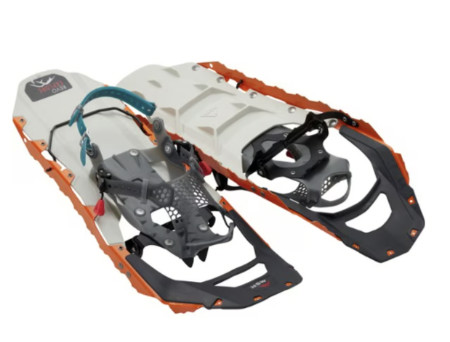
The MSR Revo Explore Snowshoe has a fold-flat mesh-net Paradigm binding system that makes them easy to lash to the side of a backpack. They feature an aggressive toe crampon, a toothed crossbar, and a serrated frame that provide excellent traction on snow and ice. Plastic decking keeps them lightweight, and a heel bar reduces calf fatigue when climbing slopes. A women’s model is available.
9. MSR Evo Trail Snowshoes

The MSR Evo Trail Snowshoe is a tough, reliable choice for winter hiking. Its UniBody deck and steel traction rails deliver confident grip on packed snow and icy trails, while its simple, glove-friendly bindings keep your foot centered for efficient strides. The streamlined design resists snow buildup, while the durable materials handle rough terrain and cold temperatures. Easy to use, stable, and low-maintenance, the Evo Trail balances performance and value, making it perfect for beginners and seasoned hikers tackling day hikes and rolling terrain. Read the SectionHiker Review. Unisex.
10. Crescent Moon Big Sky 32 Snowshoes

Crescent Moon’s Backcountry Snowshoes have a high flotation teardrop design. Loaded with traction, these snowshoes have four crampons under the toe, forefoot, and heel, plus side crampons for traversing sloped terrain. They feature a step-in binding system tightened with a single strap and a ratchet-style rear strap to lock your boot in place. Sizing runs large, fitting men’s boot sizes 10-15, including large-volume boots like snowboard or hardshell tele boots.
How to Buy Winter Snowshoes
Winter hiking snowshoes serve two key functions: they provide traction on icy trails and when climbing steep terrain, and they provide flotation over snow, so you don’t sink or posthole, which can be quite exhausting. While all the winter hiking snowshoes listed above meet both requirements, some excel in traction, like the MSR Lightning Ascents, MSR Evo Ascents, and Tubbs Flex VRTs, while others emphasize flotation, like the Tubbs Mountaineers.
As a rule of thumb, teardrop-shaped snowshoes with synthetic, riveted decks tend to emphasize flotation, while rectangular snowshoes focus more on traction. If you’ll be climbing ice-covered mountains mostly, you’ll probably want a snowshoe that emphasizes traction; snowshoes that focus on flotation are better for areas where deep, powdery snow is the norm.
 Snowshoes are bulky and can be difficult to pack
If you’re trying to choose between different snowshoes, there are four key properties that should guide your decision-making:
- Packability
- Weight
- Bindings
- Sizing
Packability
Most winter hikers carry multiple traction devices and switch between them during the day. If you’re hiking a packed trail, you might start in bare boots, relying on your boot treads for traction because less weight on your feet means you’ll fatigue more slowly. If you hit slick or icy terrain, you might switch to microspikes, then snowshoes if you encounter fresh, uncompacted snow or slush.
To have these traction aids when you need them, you need to carry them. Microspikes are pretty easy to pack, but snowshoes aren’t because they’re big and bulky. Their bulk comes from their length, width, and thickness, which depends largely on the binding style they use. Lay-flat bindings, like the simple straps on the MSR Lightning Ascent and the MSR Evo Ascent, make snowshoes easy to attach and carry in a backpack, while snowshoes with Boa binding systems tend to be the bulkiest and hardest to pack.
Weight
Weight is also a key factor when choosing a snowshoe. Most snowshoes weigh four to five pounds, and they’re probably going to be the heaviest thing in your backpack, after water. That weight adds up over the course of a day, whether it’s in your backpack or on your feet.
Bindings
We’ve already considered the packability of snowshoe bindings, but you should also consider comfort, security, ease of use while wearing gloves, whether the binding can freeze and become inoperative, and how easy it is to repair if it breaks. For example, some people worry that Boa closure systems can freeze if they get wet and stop working until they thaw. It’s a valid concern. One advantage, however, is that they are easy to use while wearing gloves and provide a secure grip that’s unlikely to come undone once set. Contrast that to the flat straps used on MSR snowshoes. They’ll never freeze up, they’re easy to replace if torn or lost, but they can be hard to attach when wearing gloves, and they tend to pop open once or twice during a hike.
Sizing
Snowshoes come in a wide variety of sizes. These are determined by the total weight you want to carry (body weight + pack weight) and the flotation you need. Men’s sizes are usually larger than women’s because men are taller and heavier, while women’s snowshoes tend to be narrower because their gait is narrower.
If you’re buying a more traction-oriented snowshoe, you can sometimes drop a size below the manufacturer’s recommendation, especially if you’re hiking in an area that doesn’t get much snow or on trails that other hikers have already broken out. Sizing is directly correlated to gear weight and this is a tactic you can use to lighten your load. If flotation is a priority, you can buy tails, add-on snowshoe extensions that make them longer and increase their surface area. This is another way to cut down on the weight of a snowshoe because you can bring your tails when you need more flotation, but carry a lighter-weight snowshoe in less challenging conditions.
SectionHiker never accepts payment for gear reviews or editorial coverage. When you buy through affiliate links on our site, we may earn a small commission at no extra cost to you. Help us continue to test and write unsponsored and independent gear reviews, hiking and backpacking FAQs, and free hiking guides.










 English (US) ·
 French (CA) ·